To Participate on Thurstonblog

email yyyyyyyyyy58@gmail.com, provide profile information and we'll email your electronic membership


Friday, November 4, 2016

"... people just don't love Clinton. She's leading in the presidential race in large part because Donald Trump is historically unpopular."

...................................................................................................................................................................
Hillary Clinton is already being set up to fail as president
By Aaron Blake, November 4, 2016

A plurality of Americans wants Hillary Clinton to be the next president of the United States, according to most polls.

But they don't want her to have free rein over the place.

A new poll from Gallup reinforces the less-than-ideal situation that Clinton faces even if she does hold off Donald Trump to become the next president — namely: low expectations and (quite possibly) a pretty smallish mandate. The poll asked which party voters would like to control Congress if Clinton is elected president, and they actually chose Republicans 52-42 percent.

Voters prefer a GOP Congress if Clinton is elected

"If Hillary Clinton is elected president, which party would you prefer to have in control of Congress?"
                    0     10     20     30     40     50
Republicans                                                   52%
Democrats                                          42%
Source: Gallup                                                                                            THE FIX

The inverse isn't true if Trump is elected. In that case, people still prefer a Republican Congress, albeit by a smaller 48-46 margin.

This kind of split preference has happened before, but not with the front-runner. Back in 2008, Americans preferred a Democratic Congress by a 57-37 percent margin if John McCain were elected. Otherwise, though, this is rare. People were about evenly split on who should control Congress if Barack Obama won in 2008 and if George W. Bush and Bill Clinton were reelected in 2004 and 1996, respectively, per Gallup numbers.

The overall result in the new Gallup poll confirms the results of a mid-October poll from NBC News and the Wall Street Journal. Asking a slightly more-detailed question, the margin was 53-40 for Republicans, as I wrote a few weeks back:
The poll asked whether registered voters would be more likely to support a congressional Republican who would be a check and balance on Clinton and Democrats, and 53 percent said they would. Just 40 percent preferred a congressional Democrat who would help Clinton pass her agenda.
Voters prefer a GOP check on Clinton to Democrats to help her

A separate poll, from NBC News and the Wall Street Journal, asked a more detailed question -- whether people preferred a GOP Congress to be a check on Clinton or a Democratic Congress to help her pass her agenda.
                             0     10     20     30     40     50
Republicans                                                             53%
Democrats                                              40%
Source: NBC/WSJ poll                                                                                  THE FIX

So what's going on here? People want Democrats to be in charge, but not completely in charge?

In a word: Yes.

Part of this, undoubtedly, is that people just don't love Clinton. She's leading in the presidential race in large part because Donald Trump is historically unpopular. If this were a referendum on her alone, she would probably lose, given more people dislike her than like her.

But it's also somewhat of a sign of the times, and the fact that the American people will be difficult to please no matter who the president is.

Americans at once dislike gridlock in Washington and don't trust politicians or either party enough to give them the tools to pass their agendas. Given how partisan our politics have become, it's exceedingly difficult for either party to do much unless it's got control of both the legislative and executive branches.

It's no coincidence that the signature legislative achievement of Barack Obama's presidency was Obamacare, which passed in 2010 — during the two years Democrats had full control of Congress and the presidency. Even then, of course, it wasn't easy, and the rancor surrounding its passage helped contribute to GOP's return to full congressional control.

The lack of a preference for a Democratic Congress is even more striking when you consider that President Obama's approval rating is north of 50 percent. People genuinely seem to like what's happening in his administration — but they don't want his successor to have a full mandate going forward.

This appears to be at least part of the reason the GOP's House majority was never really in jeopardy this year. Even in mid-October, when Trump appeared to be imploding in the presidential race, voters weren't rewarding Democrats with a major advantage on what is known as the generic ballot (the question that asks voters whether they prefer a generic Democrat for Congress or a generic Republican).

Back then, I spotlighted the NBC/WSJ poll finding as part of the reason Trump's woes didn't translate into Republicans suddenly tanking; Clinton's front-runner status appeared to make a majority of voters actually want a GOP Congress more — at least, in the abstract.

Of course, that's not a recipe for actually getting things done in Washington. And that will likely only lead to more frustration over Washington not getting anything done.

But one candidate will land in the White House. So, congratulations to the winner.
...................................................................................................................................................................

"... the recent GOP jettisoning of basic political norms on multiple fronts suggests they may adopt even more of a scorched earth approach to a Clinton presidency, should she win, than they did to Obama’s."

...................................................................................................................................................................
If he loses, Trump will continue spreading destruction and mayhem. This chart shows how.
By Greg Sargent, November 4, 2016

With only a few days until Election Day, Donald Trump’s closing argument is now that electing Hillary Clinton president will grind our entire system of government to a halt. “If she were to be elected, it would create an unprecedented Constitutional crisis,” he has been saying lately. “She is likely to be under investigation for many years, probably concluding in a very large scale criminal trial.” Trump now pairs this argument with his frequent claim that the election will be “rigged.”

But it’s important to understand that this isn’t just a closing argument. He’s laying the groundwork for an argument that he may continue to make after the election. That argument is that Hillary Clinton’s presidency is illegitimate, not just because the election was rigged, of course, but also because she is a criminal whose candidacy was always fundamentally illegitimate. In the short term, he’s asking voters to elect him to spare the country the hell we’ll inevitably go through if she wins and our system is thrown into chaos as the truth about her comes out. But if he loses, this argument may long outlast the election.

A new New York Times/CBS News poll shows that a whole lot of his supporters will likely be captivated by this whole narrative. It finds that large chunks of Trump supporters are not too confident their votes will be counted accurately and believe voter fraud happens a lot:

Screenshot 2016-11-04 at 9.13.06 AM

It also finds that more than a quarter of Trump’s supporters say they won’t accept the result, and that barely more than a third of them think it’s very important for their candidate to concede publicly if he loses:
Screenshot 2016-11-04 at 9.15.38 AM
Now, it is encouraging that 63 percent of Trump voters say they’ll accept the results. But that 34 percent who say they probably won’t or that it depends is higher than it should be. And a large majority of Trump supporters say they don’t think it’s that important for Trump to publicly acknowledge that Clinton won, if that happens.

We’ve already seen that Trump campaign CEO Stephen Bannon is looking to convert the Trump campaign into a vehicle for a political movement that will continue to function as a disruptive force inside the GOP well after the election. It’s a big unknown whether Trump will go along with that plan. But he might. And at the center of this movement will be the idea that Clinton’s presidency is illegitimate.

But this idea of Clinton’s fundamental illegitimacy — expressed with varying degrees of explicitness — could also infect relations between Clinton and Congressional Republicans, and by extension, how our government functions under a Clinton presidency. The through line here goes from Trump’s claim that the election is rigged, through his use of the FBI discovery of new emails (of unknown relevance) to support the claim that she is a criminal who should never have been able to get elected at all, through the vow by Congressional Republicans to keep investigating Clinton, through the scattered chatter among Republicans (already) about impeaching Clinton, and even through to the suggestion that Republicans may not act at all to fill the Supreme Court vacancy even well after the election.

As Brian Beutler explains, the recent GOP jettisoning of basic political norms on multiple fronts suggests they may adopt even more of a scorched earth approach to a Clinton presidency, should she win, than they did to Obama’s. This is the result of a confluence of factors — currently unresolved questions about Clinton’s email set up, due to the FBI’s discovery, and the prospect of a Supreme Court that tilts liberal, which represents a major threat to many conservative priorities. And all this could be made even worse if Trump — unlike Romney — does not concede, and a sizable chunk of Republican voters is persuaded that the outcome was illegitimate. Bannon (perhaps with Trump himself), Trump’s supporters in Congress, and other hardline conservatives in Congress might cynically weaponize that against Republicans who decline to meet this supposedly illegitimate president with the full blown war footing that she requires. And the destruction and mayhem may well continue.
...................................................................................................................................................................

Is SCOTUS practicing "quid pro quo", i.e. using "courtesy votes"?

...................................................................................................................................................................
Supreme Court Votes Bridge Usual Left-Right Divide
By Mark Sherman, November 3, 2016

An Alabama death row inmate may be alive today because a transgender Virginia high school student was denied the use of the bathroom of his choice this year.

The two seemingly unrelated cases have one thing in common: In each, a Supreme Court justice switched sides to provide a needed fifth vote to preserve the status quo.

In August, Justice Stephen Breyer broke with liberal colleagues to provide the requisite fifth vote against high school senior Gavin Grimm in what he called "a courtesy" to four conservative justices. Late Thursday, conservative Chief Justice John Roberts did a similar favor, switching sides to stay the execution of inmate Tommy Arthur, convicted in the 1982 murder-for-hire of a woman's husband.

The two votes in emergency appeals offer a rare peek behind the curtain about how the high court operates, especially at a time when it is one justice short of its nine-member strength because of the death in February of conservative Antonin Scalia. They could portend a return to a time a generation ago when the court more often halted an execution when only four justices initially wanted to do so.

Some liberal commentators puzzled over Breyer's vote on the transgender student's case in August, because he typically is part of the liberal bloc in civil rights cases. But the court's last-minute vote to halt the execution may provide an explanation, said Supreme Court lawyer Tom Goldstein.

"The chief justice seems to have, in a sense, returned the favor for Justice Breyer agreeing to put on hold a ruling in favor of a transgender student," Goldstein said.

Goldstein said he sees the votes as a signal to a politically polarized country that the court can still function collegially.

Providing a fifth vote to halt executions had once been more common, but it's been less in evidence in recent years. Eight years ago, Breyer complained in another eleventh-hour death penalty appeal that "it is particularly disappointing that no member of the majority has proved willing to provide a courtesy vote for a stay," even though four justices wanted one.

Scalia's death has deprived the court of a vocal opponent of efforts to delay executions. Breyer, on the other hand, has become a more outspoken critic of the death penalty. He was joined by Justice Ruth Bader Ginsburg in his 2015 opinion in which he concluded after more than 20 years as a justice that the death penalty probably is unconstitutional.

The issue of courtesy votes arose at Roberts' 2005 Senate confirmation hearing. Democratic Sen. Patrick Leahy of Vermont asked Roberts what he would do if four other justices favored blocking an execution.

Speaking of the court's requirement for five votes to take action, Leahy asked, "Do you feel, as chief, you should do the courtesy of the rule of five and kick in the fifth one?"

Roberts was equivocal. "I don't want to commit to pursue a particular practice. But it obviously makes great sense," he said.

Hofstra University law professor Eric Freedman said Roberts' vote "does indicate a return to a prior practice in capital cases, which is a desirable practice."

Courtesy votes grow out of the court's differing vote requirements. To accept a case for review takes four votes. Issuing a decision or court order needs at least five.

A courtesy fifth vote could allow the other four to reconsider their views, as Roberts spelled out Thursday when he said Arthur's appeal "does not merit the court's review." Roberts said that perhaps some more time would allow the other justices to "more fully consider the suitability of this case."

"It's a very significant development that shows the justices working together despite their disagreements. The court's ideological center is trying to bridge the gap between its wings," Goldstein said.

The split, now with the possibility of 4-4 tie votes, may have been heightened by the prolonged vacancy in Scalia's seat. It's not clear when a ninth justice might be confirmed, and some Senate Republicans have suggested they might never to vote to confirm a nominee of Democratic candidate Hillary Clinton's if she wins the presidency.

Judge Merrick Garland's nomination for Scalia's seat has been in limbo since March.
...................................................................................................................................................................

"... it is difficult for Republicans to claim to be 'shocked, shocked' with a straight face by any of Trump’s offensive, xenophobic, authoritarian, untruthful and narcissistic rhetoric ..."

...................................................................................................................................................................
Will The Most Enduring Obama Legacy Be The Fracturing Of The GOP? Will Trump’s Be Violence?
By Terry Connelly, November 4, 2016

“Fracking” (hydraulic fracturing) involves vertical and horizontal drilling a mile or more beneath the Earth’s surface to capture oil and gas resources trapped beneath solid rock by first pulverizing that rock with an extremely high-pressure blast of a mixture of common water, specialized abrasive sands and toxic chemicals.

Certainly the Republican Party has plumbed unconventional depths with its nomination of Donald Trump as its presidential candidate: no person without military or elected or appointed governmental service has ever been elected to that office. And Mr. Trump’s personal platform has also consisted of a highly specialized mixture of both ordinary political populist rhetoric combined with especially abrasive and highly toxic messages delivered in high-pressure settings and volumes.

In addition, most of these abrasive and highly toxic messages have been surging “underground” via right-wing talk radio and similarly focused print, online and cable media for the eight-plus years spanning President Obama’s campaigns and two terms in office. Virtually the entirety of Trump’s messages about undocumented immigrants, Muslims, U.S. military incompetence, “radical Islamic terrorists,” trade deals, the Europeans, Japanese, Chinese, as well as Obama’s supposed foreign birth, allegiance to Islam, linkages to ISIS, Iran, the “Arab Spring,” the “gay agenda,” infanticide, the “fraud” of climate change, and dictatorial and treasonable actions have circulated in such media well before Trump picked them up — particularly from the likes of Rush Limbaugh, Sean Hannity, Mark Levin, and especially Trump’s frequent radio interlocutor, Michael Savage, who has even virtually called for the president’s assassination on his program (“Obama is a rabid dog that should be dealt with accordingly!” — a statement personally heard by this writer).

During Obama’s terms, the Republican Party has, to some degree, kept an arm’s length distance from Savage, Limbaugh and especially the conspiracy theorist Alex Jones, as well as journals like National Enquirer and Breitbart, as they promoted mere gossip as facts and conspiracy theories as evidence of the “underground” version of “truth” that the above-ground “liberal media” could not be trusted to tell. (Mark Levin even purports to broadcast from an “underground bunker.”) Some of these talk-show folks and conspiracy theorists got their start during the Clinton Administration in the 1990s and simply picked up where they left off (with more contemporary “revelations”) Bill Clinton’s impeachment and survival when Obama came on the scene. They have now simply tripled-down on Hillary Clinton using the same techniques.

Just as during Clinton’s time, however, the GOP leadership and its supporters have been happy during Obama’s terms to quietly enjoy the fruits of the underground political “frackers,” particularly in the form of a Tea Party-driven majority in Congress. Often the Tea Partiers were elected from gerrymandered districts in largely rural states, where the only national radio news is delivered by those right-wing radio hosts, where National Enquirer is on sale at many supermarket check-out stands, and Fox News is the most watched cable news channel. But the Tea Partiers went too far in the view of the GOP establishment, forcing a government shutdown, putting the divided Republicans on the defensive for months and, along with the ultra-right Freedom Caucus, forcing a Party split and the resignation of GOP House Speaker John Boehner during the 2014-16 term.

That Party breakdown, however, pales in comparison to the GOP’s current existential crisis, brought on by the inflammatory statements and conduct toward women of its presidential candidate. That has already cost Trump the active support of the current Republican House Speaker Paul Ryan and the even more pronounced disdain of 25 percent of GOP state and federal office holders.

Lately, the GOP seems to be painfully learning — if not yet acknowledging — the Biblical lesson that you reap what you sow. Trump, by winning the GOP primaries “fair and square” with the largest vote in the Party’s history, even with multiple highly-qualified and well-enough funded political opponents most of the way, has made it virtually impossible for the GOP to use the defense of “plausible deniability,” given that Trump is only saying stuff that they quietly tolerated from the likes of Limbaugh (who has his own record of “locker-room” moments, as exemplified by his comments about “feminazis” and Sandra Fluke).

Unlike Louis in Casablanca, it is difficult for Republicans to claim to be “shocked, shocked” with a straight face by any of Trump’s offensive, xenophobic, authoritarian, untruthful and narcissistic rhetoric — not only because these traits were on full exhibit in Trump’s campaign from its very first day, but also because the Party has been living off the same messaging via the right-wing talk radio and media for many years. Obama, even more than Bill Clinton before him, got so into the GOP’s heads that they were all too susceptible to drink the ultra-right wing’s conspiracy theory Kool-Aid.

Race-baiting and treason charges against Obama from Limbaugh, Savage, Levin, Hannity and O’Reilly, and birtherism by pre-candidate Trump and others, were tolerated and even subtly encouraged as a way to de-legitimatize the first black president. Party leadership became so irrationally unhinged that their governing political posture seemed to be: “If Obama is for it, we’re against it, even if it’s our own idea.” (See, for example, ObamaCare’s mandates, and the tax cuts in the 2009 stimulus package).

But most Republican officeholders just want to win and, as noted, many seem willing to abandon Trump to do so. With Trump at the top of the ticket, GOP chances for retaining the small but controlling majority they now hold in the Senate and the larger, 30-seat majority in the House of Representatives are now at big-time — but not yet decisive — risk.

Trump’s obsession with a former Miss Universe, his leaked sex-soaked bus-ride tape and confrontation with, at last count, a dozen additional women who have charged him with some form or other of unwanted sexual approaches or contact have coincided with the poll numbers showing Clinton with a four- to eight-or-more-point national lead, and smaller but significant margins now in most of the so-called “swing states.” These poll results may be just as bad, if not worse, in the GOP’s own private polling, given the Party-splitting actions by seasoned officials like John McCain and John Thune as well as multiple state governors.

House Speaker Paul Ryan (booed in his home state by Trump supporters after he had banned Trump from his rally) tried to thread the needle through both sides of the emerging Party splintering by asserting he would no longer campaign for or defend Trump, but would also maintain his endorsement and vote for him. The Republican National Committee held a national conference call to confirm (remarkably, at this late stage of the presidential campaign) that it remained behind its candidate (though exactly how close or far behind, they didn’t quite say — evidence on that will come when we see how it allocates campaign resources in the closing weeks). Both these moves, in effect, acknowledged the seriousness of the very same Party split they tried to cover up. As one leadership meeting observer put it: “It’s every person for himself or herself.” That’s not a political party, it’s political anarchy.

Trump, as might have been be expected, has responded in kind by asserting the “shackles” holding back further criticism of his GOP critics are off! He knows from the polls that his debate performance energized his “base” but apparently did not expand it. Do not Trump and even his GOP critics — many of whom share Trump’s animus toward the president but in less hysterical terms — appreciate that no Democrat president, even the most popular or powerful like FDR, LBJ or JFK, has been able to trigger the fundamental destruction of the Republican Party such as we are now witnessing, but their nemesis Obama seems on the brink of doing so through virtually no action or intent of his own?

As The Dallas Morning News has put it, “Who knows what it means to be a Republican now?” The Trump phenomenon has it roots in the visceral, take-no-prisoners opposition to Obama adopted by the GOP leadership immediately upon his inauguration, with the stated, overarching goal of making him “a one-term President.”

Obama himself argues forcefully for the necessity of having two healthy contending political parties in the American democracy. But who would have guessed in 2009 that his second term could wind up being the last term of the Republican Party as we know it! And they continue to bring that fate upon themselves. Trump now portends a refusal to concede if defeated, and a few of his supporters now speak openly of riots, revolution and even rebellion and assassination if Trump should lose what they think is a rigged election (as Trump has charged).

Without the discipline inherent in a two-party political structure, there is reason to fear for the safety of Ms. Clinton even before inauguration. Trump’s threat to jail her if he wins (as authoritarian as it has ever been in America this side of Nixon) pales by comparison to the darker forces he has unleashed. The challenge to remaining Republicans to speak out against such rebellion talk — regardless of their own fear of not only Party primary challenges but now also violent reprisals by Trump diehards — and their silence to date are only furthering the GOP’s self-destruction. The Party can recover from a loss on its hands, but not blood.
...................................................................................................................................................................

Gee, #Lyin'Donald, you're WAAAAAY beyond "Lie No. 269".

........................................................................................................................................


Thursday, November 3, 2016

"In this year’s presidential election, the size, strategy, and potential effects of social automation are unprecedented—never have we seen such an all-out bot war."

...................................................................................................................................................................
How Twitter Bots Are Shaping the Election
Between the first two presidential debates, a third of pro-Trump tweets and nearly a fifth of pro-Clinton tweets came from automated accounts.
By Douglas Guilbeault and Samuel Woolley, November 1, 2016

There is power in numbers, or so the saying goes. But statistics mean different things to different people. Take Donald Trump and Hillary Clinton, for instance.

Last week, the conservative political commentator Scottie Nell Hughes summed up the relative value of digits in a conversation with Anderson Cooper. “The only place that we’re hearing that Donald Trump honestly is losing is in the media or these polls,” she said. “You’re not seeing it with the crowd rallies, you’re not seeing it on social media—where Donald Trump is two to three times more popular than Hillary Clinton on every social media platform.”

The candidate himself has echoed this argument. During the first presidential debate, he touted a 30-million strong Facebook and Twitter following as a sign of mainstream popularity not reflected elsewhere.

The Clinton campaign, meanwhile, has stuck by traditional polls as evidence of her success.

All these numbers—social media followings, polls, or statistics—are only as viable as the tools used to get to them. Political campaigns worldwide now use bots, software developed to automatically do tasks online, as a means for gaming online polls and artificially inflating social-media traffic. Recent analysis by our research team at Oxford University reveals that more than a third of pro-Trump tweets and nearly a fifth of pro-Clinton tweets between the first and second debates came from automated accounts, which produced more than 1 million tweets in total. This data corroborates recent reports suggesting that both candidates’ social media followings are highly automated.

What does this mean for democracy?

* * *

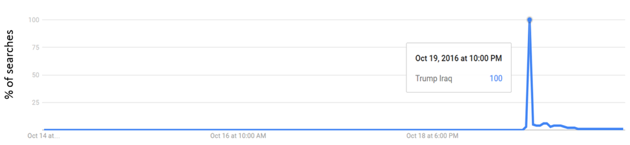
It is fashionable among futurists and technocratic utopians to wax poetic about robot butlers, self-driving cars, and the internet as a democratizing tool. And it is certainly true that social media and other digital tools can enhance the election process. Never before has an election been subject to so much real-time fact checking. During the final debate, Clinton asked viewers to Google the words “Trump” and “Iraq”—and they did. Google trends shows a huge surge in the number of searches containing these words, minutes after Clinton’s request.
(Google Trends)

At the same time, aspects of social-media infrastructure introduce major problems. Bots are easily programmable through the Twitter API (application programming interface) and can be deployed by just about anyone with preliminary coding knowledge. Marginal populations use bots to create an illusion of popularity around fringe issues or political candidates. For instance, the alt-right and white nationalists have used these automated proxies to artificially project hate speech and xenophobia on social-media platforms. Hoaxers from 4chan have been accused of using bots to game online polls in favor of Trump. And Trump often refers to online polls as evidence that he has “won” the debates.

Our team monitors political-bot activity around the world. We have data on politicians, government agencies, hacking collectives, and militaries using bots to disseminate lies, attack people, and cloud conversation. The widespread use of political bots solidifies polarization among citizens. Research has revealed social-media users’ tendency to engage with people like them, a concept known as homophily by social scientists. In the book Connected, Nicholas Christakis and James Fowler suggest that social media invites the emergence of homophily. Social media networks concretize what is seen in offline social networks, as well—birds of a feather flock together. This segregation often leads to citizens only consuming news that strengthens the ideology of them and their peers.

In this year’s presidential election, the size, strategy, and potential effects of social automation are unprecedented—never have we seen such an all-out bot war. In the final debate, Trump and Clinton readily condemned Russia for attempting to influence the election via cyber attacks, but neither candidate has mentioned the millions of bots that work to manipulate public opinion on their behalf. Our team has found bots in support of both Trump and Clinton that harness and augment echo chambers online. One pro-Trump bot, @amrightnow, has more than 33,000 followers and spams Twitter with anti-Clinton conspiracy theories. It generated 1,200 posts during the final debate. Its competitor, the recently spawned @loserDonldTrump, retweets all mentions of @realDonaldTrump that include the word loser—producing more than 2,000 tweets a day. These bots represent a tiny fraction of the millions of politicized software programs working to manipulate the democratic process behind the scenes.

Bots also silence people and groups who might otherwise have a stake in a conversation. At the same time they make some users seem more popular, they make others less likely to speak. This spiral of silence results in less discussion and diversity in politics. Moreover, bots used to attack journalists might cause them to stop reporting on important issues because they fear retribution and harassment.

* * *

The propagandistic power of bots is strengthened when few people know they exist. Homophily is particularly strong when people believe they have strength in numbers, and bots give the illusion of such strength. The more people know about bots, the more likely it is that citizens will begin reporting and removing bots, as well as using bots to boost their own voices.

Because bots have received little public attention, critics regularly frame bots in terms of a doomsday rhetoric that is lopsided toward their negative impact. But bots aren’t only used for manipulation of unsuspecting publics. Socially empowering bots are out there. For instance, @she_not_he is “a bot politely correcting Twitter users who misgender Caitlyn Jenner.” Silicon Valley has been developing bots in attempts to broadly enhance civic engagement: On Facebook, the The New York Timeselection bot promotes political participation.

In addition to social justice bots, there are also bot services that seek to enhance everyday life online. Digital artists build bots that generate humorous messages, such as @godtributes, which takes the tweets of others and reframes them as an impassioned praise of a nondescript god: “Self-education for the self-education god!” The artificial-intelligence company Luka is designing intelligent bots that “you teach and grow through conversation.” These digital automatons are marketed as a new form of online companion.

While many people are unsettled by the rise of bots, it’s important to remember that many of today’s most ubiquitous technologies were harnessed for political ends when they were first invented. In Europe, the printing press was almost immediately used to fuel the cultural war between the Protestants and the Catholics. Martin Luther, a seminal priest in the Protestant Reformation, was the first to take advantage of it, printing thousands of bibles translated into German. The proliferation of the Lutheran bible triggered a surge in German nationalism, which amplified conflict between the faiths. Generations later, after the printing press became more widespread and accessible, it provided a tool for minority and dissident voices fighting for social justice, such as the Suffrage and the Civil Rights movements.

* * *

Currently, there is almost no regulation on the use of bots in politics. The Federal Elections Commission has shown no evidence of even recognizing that bots exist. Bots that are used to trumpet hate speech, harass women journalists, and spread propaganda are also designed to conceal the identity of their creators. This layer of anonymity challenges the ability to hold people legally responsible. Moreover, it challenges notions of free speech—what happens when a bot, which might do things unforeseen by its maker, is the entity committing malicious acts?

Fortunately, methods for pinpointing the sources of bots are constantly improving. Continuing development efforts towards detecting—but also tracking and demobilizing—malevolent bots will allow governments to set legal precedents for fraudulent and hurtful automated abuses. It will also enhance the ability for social-media websites to detect and regulate bots, in what has become an ever-growing arms race against bot designers. While it’s possible for Facebook and Twitter to flag accounts suspected to be under bot control—bots tend to tweet several times a minute, and their comments are often less coherent than human users’—bot designers regularly tell us they have little trouble circumventing detection. Moreover, the debate on whether social-media websites should be allowed, or even have the desire, to censor posts has limited sites’ detection efforts.

Technology firms are currently investing in the new bot economy, which some say is the future of digital communication. Bots are being incorporated into services like Facebook Messenger, and platforms like Kik, Slack, and Periscope are claiming that bots will greatly enhance their user experience by acting as automated assistants that deal with a wide range of needs and requests—from checking the weather to booking plane tickets.

These developments foreshadow a future where bots will be intimately interwoven with everyday social interaction online. As bot awareness and usage grows, the greater pressure there will be for governments, nonprofit organizations, and research institutions to develop bots that protect and empower citizens—and don’t convince people to vote for particular presidential candidates.
...................................................................................................................................................................

"A tie is a win for the person who already has prevailed in the lower court." All because the Republicans have refused to approve Obama's nominee!

...................................................................................................................................................................
‘Nightmare’ — Supreme Court tying 4-4 on election dispute
By Mark Sherman, November 3, 2016

What happens if America wakes up on Nov. 9 to another undecided, hotly disputed presidential election? What if the outcome turns on the razor-thin margin in one or two states, one candidate seeking a recount, the other going to court?

We know what happened in 2000, when the Supreme Court in a 5-4 vote effectively settled the election in favor of George W. Bush.

As controversial as that decision was, it was made by a nine-justice court. This time around, there are only eight justices and the possibility of a tie vote. That would leave a lower federal or state court ruling in place, with no definitive judgment from the nation’s highest court.

“It would be Bush v. Gore, with a twist,” said one election law expert, law professor Richard Hasen at the University of California at Irvine.

“I call it the nightmare scenario,” said University of Kentucky law professor Joshua Douglas.

Sixteen years ago, the court divided 5 to 4 about whether to get involved at all and then voted the same way to stop Florida’s state court-ordered recount. The five more conservative justices sided with Republican nominee Bush, while the four more liberal justices would have ruled for Democrat Al Gore.

“A no-brainer!” Justice Anthony Kennedy said in Jan Crawford’s book “Supreme Conflict,” recalling the decision to take on the case. “A state court deciding a federal constitutional issue about the presidential election? Of course you take the case.”

The odds of history repeating itself in Florida or elsewhere are long. But it’s hard to discount any possibility, however remote, in a tight campaign that already has seen Democratic lawsuits charging voter suppression and Republican claims the election will be rigged.

The reason a tie Supreme Court vote is even possible stems from another aspect of this unusual election year, the Senate Republicans’ refusal to act on President Barack Obama’s nomination of Judge Merrick Garland to fill the seat of Justice Antonin Scalia, who died in February.

Any decision to seek a recount or otherwise contest the election results would depend on the margin in any one state and its potential for affecting the national outcome. In 2000, neither Bush nor Gore could muster an Electoral College majority of 270 votes without Florida.

“For candidates who lose by a fraction of a percent, even up to 1.5 percent, they will at least explore their options for seeking a recount or challenging the results in a particular state,” said Michael Morley, a law professor at Barry University in Orlando, Florida. Morley represented Republican Joe Miller in his postelection challenge to Alaska Sen. Lisa Murkowski, who won re-election as a write-in candidate after losing the GOP primary to Miller in 2010.

If an initial recount doesn’t settle things, a lawsuit could follow, with appeals possible all the way to the Supreme Court.

If a case should make it that far, it would reach a court made up of four justices appointed by Republican presidents and four by Democrats. Just four of the eight were on the court for Bush v. Gore, although Chief Justice John Roberts aided Bush’s cause as a lawyer in private practice.

At this point, it’s impossible to know who might go to court and in which state, what the issue might be and who might benefit if justices were evenly divided. A tie is a win for the person who already has prevailed in the lower court.

But for some who already are dismayed about the extended Supreme Court vacancy since Justice Scalia’s death, a tie would have broad implications beyond the election.

“I worry about a 4-4 tie because it would undermine the court’s legitimacy,” Douglas said.

A Supreme Court appeal also would raise another delicate question. Would Justice Ruth Bader Ginsburg participate after the comments she made about Trump in July to The Associated Press and other news outlets?

She told AP then that she didn’t want to think about the possibility of Trump being elected and later called him a “faker” in an interview with CNN. Soon afterward, she said her comments were ill-advised and apologized.

Federal law requires recusal from any case in which a judge’s impartiality “might reasonably be questioned.” But at the Supreme Court, a justice alone is the final judge of whether to sit out a case.

A suit challenging presidential election results almost certainly would have to be wrapped up before Dec. 19, the date electors will meet.

But control of the Senate also might rest on results in one state. If a candidate is dissatisfied with the initial tally and a recount, then sues, it could be months before the winner is known.

That’s what happened in Minnesota in 2008. Democrat Al Franken trailed Republican incumbent Norm Coleman by a couple of hundred votes in the first count and led by about the same margin after a mandatory recount.

Coleman went to court and ultimately dropped his appeal after the Minnesota Supreme Court ruled against him.

Franken didn’t take his seat in the Senate until July 2009, more than eight months after the election.
...................................................................................................................................................................

"And please vote. Show all the haters than you still believe in the ability of the people to govern themselves without killing each other."

...................................................................................................................................................................
Opinion: Stop reading about the election! It’s just driving you crazy!
If you step away from politics and the media, America doesn’t look so terrible after all
By Rex Nutting, November 3, 2016

Stop it. Stop reading about the election on Facebook. Stop checking Twitter, and YouTube, and FiveThirtyEight, and Think Progress, and Infowars. Stop watching Fox News and Samantha Bee. Stop listening to Rush. Stop posting comments on the internet that label your political opponents as criminals, murderers, fascists, elitists, or racists. Stop calling people names like “libtard,” “Trumpanzees” and “Nutwing.”

Just stop already. Just walk away. Turn it all off.

The election is driving me crazy, and probably you too. And it’s driving us further apart, further away from our shared goal of making America an even greater country. Views that were once found only on the fringes have now become mainstream. More and more, we regard our political adversaries as enemies, not as our brothers and sisters and neighbors and fellow countrymen. It’s us versus them. Good versus evil.

This election is making us stupid, mean, and paranoid. I’d like to think that it’s all coming from one side (Donald Trump and his supporters), but I see too many liberals talking the same way to give them a pass. So just stop it.

Democrat or Republican, we seem to eager to believe almost anything — no matter how outlandish — that “our” side says: Hillary is a crook. Trump is a puppet of Putin. Comey is a partisan hack. Lynch is a partisan hack. The fix is in.

Our electoral political process is supposed to allow us to express our differences civilly, and then, once the votes are counted, to come back together as one nation, more or less united, united at least in the belief that our imperfect democratic republic is a whole lot better than the alternative of dictatorship.

But politics is failing us. Instead of adjudicating peacefully between competing views, politics as practiced today only widens our differences. Elections settle nothing; democracy itself is dysfunctional. And the media are eager to inflame our passions further, recognizing that the more emotional we are, the more their revenues and profits rise.

Don’t misunderstand me: Politics has always been a contact sport. Elections have always been hard fought. But once the people had spoken, the losers stepped aside to fight another day. Elections settled things, if only for two or four years. Democrats cried foul when Al Gore lost in 2000, but they accepted the results. But now we have Trump’s threat to contest the results if he doesn’t prevail.

And some true believers on both sides, egged on by an increasingly partisan and shrill media that reinforce their worst behaviors, seem unwilling to accept the election results if they don’t go their way. And if you don’t believe me, just read the comments below.

This isn’t just a matter of good manners, it’s also a matter of good government. Already, we have Republican senators announcing they will refuse to allow even a vote on any nominee for the Supreme Court vacancy if Hillary Clinton wins.

This isn’t politics as usual.

If you paid attention only to the extreme political views (which are unfortunately becoming more mainstream), you might think that America is a failed state, utterly bankrupt and corrupt to the core, its people reduced to scavenging for scraps of food and ready to shoot anyone who dares come close. It’s a disturbingly dystopian vision of American, and it’s wrong.

We are not Syria. We are not Somalia, Haiti, or Venezuela. We are not even Greece. We are not Mississippi of 1963 either. We are America, where most people (at least in real life, as opposed to online) are hardworking, honest, charitable, kind to animals, kids and strangers. Where most people have a job, a home and a dream. Where most people are sensible, except when it comes to politics, when some brains just freeze up, and the only parts that work are the id and the lizard brain.

Turn off the TV, leave the smartphone behind, and go outside. Walk around your town, your neighborhood, your city. Do you see carnage? Cities burning? A race of cruel apes ruling over humans? Do you see a police state breaking down your door to take away your guns, your religion, your Prius and your locally sourced kale? Are you afraid of your neighbors? Are you afraid of your mayor? Your president?

In the cold light of day, these paranoid nightmares fade away. If we can pry ourselves away from the 24/7 newsfeed of bile, we can see that they are nothing more than the sick dreams of a few who are using the election and the media to spread hate, venom, and bigotry.

The right wing has been preaching this end-of-days sermon for a long time. They told us that we’d all go to hell as soon as [fill in the blank]. As soon as the water is fluoridated. As soon as the Negroes can vote. As soon as women get uppity. As soon as you hear Spanish on your block. As soon as the gays can come out of the shadows. As soon as Obama takes away our guns. As soon as we’re all sent to FEMA camps. As soon as they outlaw Christmas.

Did any of their terrible predictions come true?

(In the comments, feel free to provide your list of all the things the left has warned us about that never happened.)

Yes, we still have lots of problems here in America. Too many people are poor. Too many are unskilled. Too many can’t afford a house, or an education, or a doctor, or even a decent meal without the help of food stamps. Too many are left behind because of their race, their gender, their age, or a dozen other irrelevant attributes. Too few have all the money, all the power, and all the opportunity to get ahead.

We need to fix these things, and we can. It won’t happen in a day. It won’t happen if we are suspicious and fearful of our fellow Americans. It won’t happen if we can’t trust our political system, our government, our media, or our neighbors. That’s the biggest hurdle of all. Maybe that’s why there’s so much hatred being spread — to discourage us, and to make us cynical, hopeless and alone.

Listen up! People can disagree with you and still be human. People don’t have to think like you, or look like you, or talk like you, or love like you to be good people.

Stop being so afraid! Stop obsessing about politics! Stop the hate.

And please vote. Show all the haters than you still believe in the ability of the people to govern themselves without killing each other.
...................................................................................................................................................................

Wednesday, November 2, 2016

Comey, you would have done better by throwing yourself onto that grenade!

......................................................................................................................................


At least one truthful image of #Lyin'Donald has been published.

...................................................................................................................................................................
New York magazine cover brands Trump a ‘loser’
By Dylan Stableford, October 31, 2016


Donald Trump has been on so many magazine covers in this campaign that he says he doesn’t have enough room on the walls of his Trump Tower office to display them all. But chances are the Republican nominee wouldn’t want to put this one up, anyway.

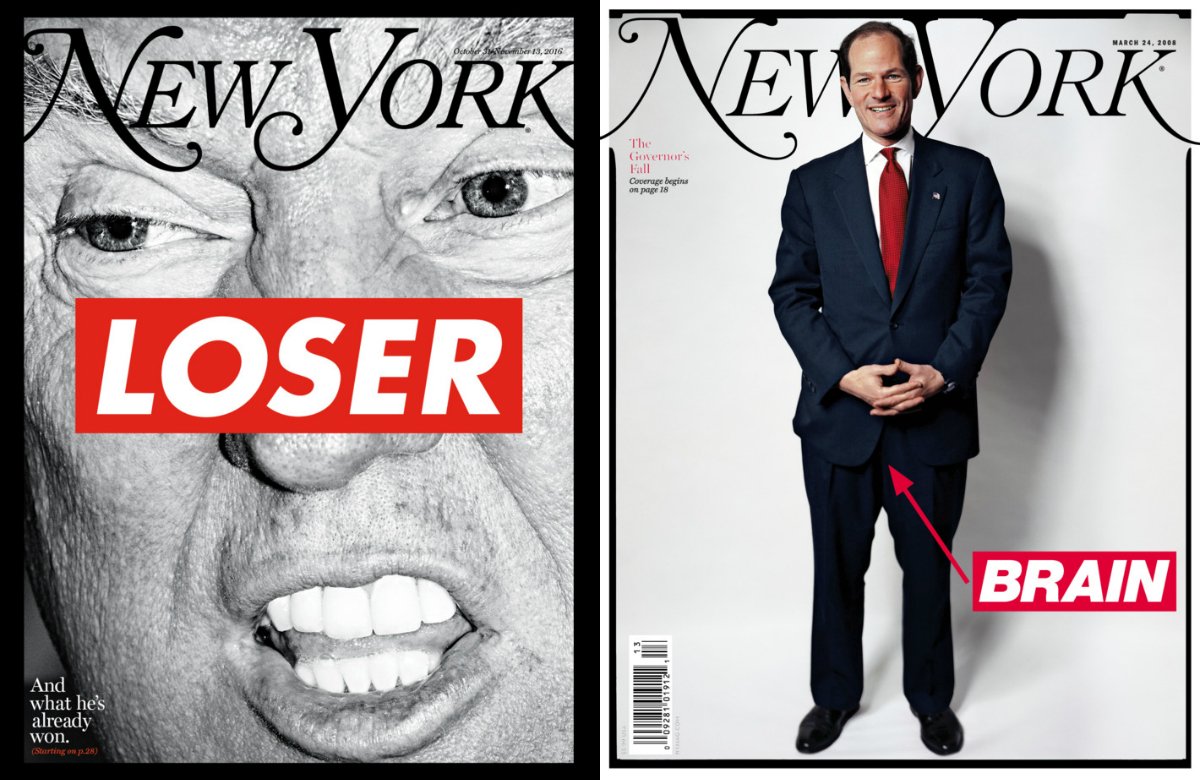
New York magazine created a striking cover of Trump for its new election issue, enlisting Barbara Kruger — the artist behind its iconic Eliot Spitzer cover — to brand the brash Manhattan real estate mogul and unlikely GOP White House hopeful a “loser.” (Trump has long been obsessed with the concept of winning, and frequently brands his foes as “losers.”)

According to New York magazine editor in chief Adam Moss, the latest cover can be interpreted in several different ways.

“As Trump speaking (single word epithets being his specialty); as a description of Trump; and as a call on the election result,” Moss explained on the magazine’s website. “On this latter point, who knows — and we confess to being a little rattled when the … news [of FBI Director James Comey’s letter] broke just as were shipping it. But in the end we felt that the power of Kruger’s image transcended any one meaning you could read into it.”


 Dylan Stableford ✔ @stableford
.@NYMag, which famously located Eliot Spitzer's brain, brands Trump a “Loser” on cover of its election issue.
7:55 AM - 31 Oct 2016
Moss added: “The issue analyzes many aspects of Trump’s extraordinary candidacy, and an important point is spelled out in the headline we appended to the bottom corner: Trump has already changed America, not much for the better. Which adds a fourth meaning: in that sense we are all losers too.”

Of course it’s not the first time Trump’s campaign has been the subject of scathing glossy critiques.

In August, Time magazine published a cover featuring an illustration of Trump’s dripping face above a single-word cover line: “Meltdown.”

“It looks as if someone took a flame thrower to the face of Trump’s wax statue at Madame Tussauds,” Callum Borchers wrote in the Washington Post.


  TIME ✔ @TIME
TIME's new cover: Inside Donald Trump's total meltdown http://ti.me/2dZ8bcS
5:43 AM - 13 Oct 2016
Earlier this month — following Trump’s poor debate performances and the release of the explosive 2005 “Access Hollywood” tape, in which he was caught boasting about kissing and groping women without their consent — Time updated its August cover to depict what it called the candidate’s “Total Meltdown.”
...................................................................................................................................................................

CUBS WIN! CUBS WIN! CUBS WIN! The demons have been exorcised!

...................................................................................................................................................................
Cubs win! Cubs win! Epic Game 7 victory ends Series curse
By Bradford Doolittle, November 2, 2016

Are the skies black with locusts? Has Lake Michigan turned red? Two days after Halloween, the curse has been cursed. The Comeback on the Cuyahoga is complete. After a century and eight years, the Chicago Cubs are world champions, and they did it by surviving a game for the ages, a contest in which they finally slew demons that refused to be exorcised.

The baseball facts matter, especially these, though they hardly do justice to the scale of the outcome or the level of drama that unfolded. In what seemed like the most heartbreaking yet of nightmarish Cubs postseason games gone wrong, Ben Zobrist’s 10th-inning double off Bryan Shaw broke a 6-6 tie, and the Cubs outlasted the Cleveland Indians 8-7 in a title-winning, drought-breaking, impossible-to-believe Game 7 of the World Series on Wednesday.

[MAJOR SNIPPAGE]
...................................................................................................................................................................

#Lyin'Donald, of course you knew #LiButti-the-Mobster-- you can't snow us!

...................................................................................................................................................................
COMMENTS:
*  Whatever happened to his anazing [sic] memory, the best memory ever.
    *  His lying tongue got in the way.
    *  He has the best Selective memory ever.
*  Yet, Trump has the greatest memory of all time. Odd...
*  I'd be surprised if Trump ever told the truth! Lying comes as easily to him as closing one's eyes.
*  Mob ties, a close relationship with Russia, oh boy. We will never, ever recover as a nation if this professional liar gets elected.
*  Can't pay his taxes, can't pay his creditors but can buy a deplorable mobster a fleet of Ferraris and Rolls Royces.
...................................................................................................................................................................
Video Shows Donald Trump With Alleged Mobster He Denied Knowing
Robert LiButti was a preferred patron at Trump’s casino, which got fined $200,000 for accommodating his racist and sexist requests.
By Jennifer Bendery, November 2, 2016

Donald Trump denies that he ever knew Robert LiButti, a reputed mob figure with a penchant for high-dollar gambling. LiButti was a regular at Trump’s Atlantic City casino until 1991, when he was banned from New Jersey gaming halls over his alleged ties to Mafia boss John Gotti.

“If he was standing here in front of me, I wouldn’t know what he looked like,” Trump told The Philadelphia Inquirer in 1991. 

Asked again about LiButti in March 2016, Trump told Yahoo News: “During the years I very successfully ran the casino business, I knew many high rollers. I assume Mr. LiButti was one of them, but I don’t recognize the name.”

But a new video uncovered Tuesday by Yahoo News shows Trump attending a 1988 “WrestleMania IV” match with LiButti in Atlantic City. The video shows the two together, along with Trump’s then-wife Ivana, in the front row for the hours-long event. It wasn’t a coincidence they were seated next to each other. LiButti’s daughter said she and her father were Trump’s guests.

Trump’s campaign spokeswoman Hope Hicks told Yahoo News the GOP presidential nominee has attended many events with thousands of people, so there’s nothing to see here.


But LiButti, who died in 2014, wasn’t just another patron at Trump Plaza Hotel and Casino. He was one of its biggest spenders in the 1980s, and his business was so appreciated that the resort’s management routinely accommodated his racist and sexist requests.

New Jersey state regulators launched a 1991 investigation into allegations by nine Trump Plaza employees that the hotel was reassigning black and female casino employees from gaming tables because LiButti wanted white men instead. LiButti regularly berated minorities and women on the Trump staff, calling them the “vilest” names, including “cunt,” “black bastard” and “Jew bitch,” according to a 1991 transcript from a New Jersey Casino Control Commission hearing.

Trump Plaza was eventually fined $200,000 for discrimination. The hotel was hit with an additional $450,000 fine after the Casino Control Commission discovered that management gave LiButti $1.6 million in the form of luxury carsthree Ferraris, three Rolls-Royces, a Mercedes-Benz and two Bentleys. LiButti later exchanged the cars for money, which violated state law.
...................................................................................................................................................................

Looks like #Lyin'Donald had a SECRET SERVER that communicated exclusively with a Russian bank! So, #TruthlessTrump, tell us why Clinton's server was worse than yours?

...................................................................................................................................................................
Experts: Trump Organization may have used private server to communicate with Russian bank
By Catherine Garcia, November 1, 2016

On the hunt for malware, a group of computer scientists say they stumbled upon a server registered to the Trump Organization in Manhattan that they believe secretly communicated almost exclusively with a bank in Moscow.

After it was reported that Russian hackers had gained access to the Democratic National Committee's servers, the computer scientists decided to look into whether other servers were also hit. "We wanted to preserve the integrity of the election," one participant, who asked to remain anonymous because of his line of work, told Slate. In July, a computer scientist with specialized knowledge of the domain name system (DNS) found what appeared to be malware coming from Russia, with "Trump" in its destination domain. After keeping track of the Trump server's DNS activity, he realized the server was communicating during office hours in New York with two servers registered to Alfa Bank in Moscow.

The computer scientists shared what they learned with Christopher Davis, a cybersecurity expert, who said the Trump server "looked weird, and it didn't pass the sniff test." After digging through logs, they found that the server was first registered in 2009 and set up to run consumer marketing campaigns, but now was only able to accept incoming communication from just a few IP addresses, with 87 percent of the DNS lookups involving the Alfa Bank servers. After looking at the logs, DNS code expert Paul Vixie concluded that "the parties were communicating in a secretive fashion," he told Slate. "The operative word is secretive. This is more akin to what criminal syndicates do if they are putting together a project."

The New York Times soon learned about this, and started working on a story; after contacting Alfa Bank, but before notifying the Trump campaign, the Trump domain name stopped working. Four days later, the Trump Organization created a new host name, and the only lookups came from Alfa Bank, Slate reports; once the Times asked the Trump campaign for comment, traffic between the servers stopped. Alfa Bank's Washington representative told Slate the bank and its principles "have never had any contact with Mr. Trump or his organizations" and there is no "special or exclusive internet connection with Mr. Trump or his entities." The Trump campaign also told Slate the Trump Organization "has no communication or relationship with this entity or any Russian entity." Read Franklin Foer's entire exploration into the mysterious servers at Slate
...................................................................................................................................................................

Tuesday, November 1, 2016

Sounds typical of #Lyin'Donald.

....................................................................................................................................


"With Trump’s racist, xenophobic, misogynistic campaign for the White House, the fringe became mainstream."

...................................................................................................................................................................
Don’t ignore the danger signs presented by Donald Trump’s militant supporters
By Jonathan Capehart, October 31, 2016

“Lighting a fuse for rebellion on the right: Loose alliances of protesters join under tea party umbrella,” front page article in the New York Times on Feb. 16, 2010.

“Trump backers see revolution if Clinton wins: Dark fears and talk of a stolen election,” front page article in the New York Times on Oct. 28, 2016.

What those two stories have in common is that they are historical bookends. The former sounded an alarm. The latter is the result of an alarm ignored. We cannot afford to make that mistake again with a threat to democracy like Donald Trump on the ballot.

The 2010 Times story was about how the legitimate concerns of folks feeling “taxed enough already” and suffering severe economic hardship in the wake of the 2008 financial collapse were being co-opted by the likes of birthers and other conspiracy theorists like Alex Jones. One passage of note highlighted the concern of Tony Stewart, a civil rights activist in Coeur d’Alene, Idaho, whose work helped bankrupt the Aryan Nations through a 2000 lawsuit.
When the Tea Party uprising gathered force last spring, Mr. Stewart saw painfully familiar cultural and rhetorical overtones. Mr. Stewart viewed the questions about Mr. Obama’s birthplace as a proxy for racism, and he was bothered by the “common message of intolerance for the opposition.”

“It’s either you’re with us or you’re the enemy,” he said.

Mr. Stewart heard similar concerns from other civil rights activists around the country. They could not help but wonder why the explosion of conservative anger coincided with a series of violent acts by right wing extremists. In the Inland Northwest there had been a puzzling return of racist rhetoric and violence.

Mr. Stewart said it would be unfair to attribute any of these incidents to the Tea Party movement. “We don’t have any evidence they are connected,” he said.

Still, he sees troubling parallels.
Branding Mr. Obama a tyrant, Mr. Stewart said, constructs a logic that could be used to rationalize violence. “When people start wearing guns to rallies, what’s the next thing that happens?” Mr. Stewart asked.
The Times report also featured a quote from a “multiracial” woman from Coeur d’Alene named Rachel Dolezal, then the curator of the Human Rights Education Institute, discussing tea party rallies in her area. “To her,” the Times reported, “what stands out are the all-white crowds, the crude depictions of Mr. Obama as an African witch doctor and the signs labeling him a terrorist. ‘It would make me nervous to be there unless I went with a big group,’ she said.”

The grass-roots energy the tea party provided the Republican Party turned into political power with the GOP takeover of the House in the 2010 midterm elections. The burn-this-mutha-down ethos the new members brought with them led to a flirtation with federal default in 2011, a government shutdown in 2013 and the 2015 retirement of Rep. John Boehner (R-Ohio), the then-beleaguered speaker of the House who tired of riding the tiger — which devoured the GOP through the nomination of Donald Trump for president in 2016. And now, Trump is the reckless human wrecking ball laying waste to the American and global establishment.

With Trump’s racist, xenophobic, misogynistic campaign for the White House, the fringe became mainstream. Stephen Bannon, his campaign chairman, gave the white supremacy of the so-called alt-right movement a home on Breitbart.com. “Your reputation is amazing,” Trump told conspiracy theorist Jones when he appeared on his radio show last December. “I will not let you down.”

By then, the king of the racist birther movement was already championing immoral and unconstitutional policies. Things like deportation of undocumented immigrants and their American-born children or a proposed ban on Muslims from entering the United States. And Trump threatens to upend the world order with loose talk about nuclear weapons and not honoring U.S. commitments to NATO.

Six years after the alarm was sounded, we are a week away from a presidential election where an extremist candidate vows to jail Hillary Clinton, revels in chants of “lock her up” at his rallies, talks incessantly about the election being “rigged” and undermines the foundation of the Constitution by casting doubt on whether he will accept the election results, leading to threats of revolution by Trump’s supporters if he loses to Clinton.

Jared Halbrook of Wisconsin told the Times that a Clinton victory would cause folks to “march on the capitols” and “to do whatever needs to be done to get her out of office, because she does not belong there.” He added ominously, “If push comes to shove [and Clinton] has to go by any means necessary, it will be done.”

Paul Swick warned against Clinton trying to take his guns. Not that she has advocated doing so. “If she comes after the guns, it’s going to be a rough, bumpy road,” Swick told the Times. “I hope to God I never have to fire a round, but I won’t hesitate to. As a Christian, I want reformation. But sometimes reformation comes through bloodshed.”

It would be unfair to say that these revolutionary sentiments reflect all or a majority of Trump’s supporters. One can be mad as hell at Washington and want to blow things up without actually taking up arms. But we must not ignore the clear warning signs. Republicans turned a blind eye to the extremists glomming onto the tea party six years ago only to watch them take over their party. The nation must not repeat that mistake now. #staywoke
...................................................................................................................................................................

#TruthlessTrump's "... approach to everything: Do whatever it takes to win, even if that means undermining the integrity of the entire system."

...................................................................................................................................................................
ROBERT REICH: TRUMP LEADS THE RACE TO THE BOTTOM
By Robert Reich, October 24, 2016

Donald Trump’s warning that he might not accept the results of the presidential election exemplifies his approach to everything: Do whatever it takes to win, even if that means undermining the integrity of the entire system.

Trump isn’t alone. The same approach underlies Senator John McCain’s recent warning that Senate Republicans will unite against any Supreme Court nominee Hillary Clinton might put up if she becomes president.

The Republican Party as a whole has embraced this philosophy for more than two decades. After Newt Gingrich took over as speaker of the House in 1995, compromise was replaced by brinksmanship and normal legislative maneuvering was supplanted by threats to close down the government—which occurred at the end of that year.

Like Trump, Gingrich did whatever it took to win, regardless of the consequences. In 1996, during the debates over welfare reform, he racially stereotyped African-Americans. In 2010, he fueled the birther movement by saying President Obama exhibited “Kenyan, anti-colonial behavior.” Two years later, in his unsuccessful bid for the Republican presidential nomination, he called President Obama the "food stamp president."

As political observers Norman Ornstein of the American Enterprise Institute and Thomas Mann of the Brookings Institution have noted, “the forces Mr. Gingrich unleashed destroyed whatever comity existed across party lines.” Gingrich’s Republican Party became “ideologically extreme; scornful of compromise; unmoved by conventional understanding of facts, evidence and science; and dismissive of the legitimacy of its political opposition.”

In truth, it’s not just Republicans and not just relationships between the two major parties that have suffered from the prevailing ethos. During this year’s Democratic primaries, former Democratic National Committee Chair Debbie Wasserman-Schultz and her staff showed disdain for the integrity of the political process by discussing ways to derail Bernie Sanders’s campaign, according to hacked emails.

The same ethos is taking over the private sector. When they pushed employees to open new accounts, Wells Fargo CEO John Stumpf and his management team chose to win regardless of the long-term consequences of their strategy. The scheme seemed to work, at least in the short term. Stumpf and his colleagues made a bundle.

Mylan Pharmaceuticals CEO Heather Bresch didn’t worry about the larger consequences of jacking up the cost of life-saving EpiPens from $100 for a two-pack to $608, because it made her and her team lots of money.  

Martin Shkreli, former CEO of Turing Pharmaceuticals, didn’t worry about the consequences of price-gouging customers. Called before Congress to explain, he invoked the Fifth Amendment, then tweeted that the lawmakers who questioned his tactics were “imbeciles.”

A decade ago, Wall Street’s leading bankers didn’t worry about the consequences of their actions for the integrity of the American financial system. They encouraged predatory mortgage lending by bundling risky mortgages with other securities and then selling them to unwary investors because it made them a boatload of money and they knew they were too big to fail.

Even when some of these trust-destroyers get nailed with fines or penalties, or public rebuke, they don’t bear the larger costs of undermining public trust. So they continue racing to the bottom.

Some bankers who presided over the Wall Street debacle, such as Jamie Dimon of JPMorgan Chase, remain at the helm—and are trying to water down regulations designed to stop them from putting the economy at risk again.

Meanwhile, according to The New York Times, Newt Gingrich is positioning himself to be the politician best able to mobilize Trump supporters going forward.

“I don’t defend him [Trump] when he wanders off,” Gingrich recently told ABC News. But “there’s a big Trump and there’s a little Trump,” he said, explaining that the “big Trump” is the one who has created issues that make “the establishment” very uncomfortable. “The big Trump,” he said, “is a historic figure.”

By stretching the boundaries of what’s acceptable, all the people I’ve mentioned—and too many others just like them—have undermined prevailing norms and weakened the tacit rules of the game.

The net result has been a vicious cycle of public distrust. Our economic and political systems appear to be rigged because, to an increasing extent, they are. Which makes the public ever more cynical—and, ironically, more willing to believe half-baked conspiracy theories such as Trump’s bizarre claim that the upcoming election is rigged.

Leadership of our nation’s major institutions is not just about winning. It’s also about making these institutions stronger and more trustworthy.

In recent years, we have witnessed a massive failure of such leadership. Donald Trump is only the latest and most extreme example.

The cumulative damage of today’s ethos of doing whatever it takes to win, even at the cost of undermining the integrity of our system, is incalculable.
...................................................................................................................................................................

"... the failure of their education is attributable to the country as a whole for failing to ensure that every student is adequately educated, in particular regarding the government."

...................................................................................................................................................................
WHY ARE WHITE, UNEDUCATED VOTERS VOTING FOR TRUMP?
By Marci A. Hamilton, November 1, 2016

There is a deep connection between education and a successful, well-run representative democracy.

Voters need significant education to be able to judge the people to whom they delegate the power to make governing decisions and to assess how their governing system is operating. Without adequate education generally and specifically about representative democracy, the system itself is at risk.

This is one reason that Justice Sandra Day O’Connor, after she retired from the Supreme Court, dedicated time and resources to establish iCivics.org, which is dedicated to providing engaging content about the federal government and especially the courts to junior high and high school students.

It is also why attorneys have worked together to establish the James Otis Lecture Series, which brings leading scholars together to debate current issues before groups of high school students.

And those are just two of the many offerings seeking to fill a perceived gap in civics and government education across the United States.

The Constitution’s framers labored to construct a constitutional system that would deter abuses of power and keep elected representatives on the road to serving the public (rather than themselves). The Constitution is filled with checks and balances and limits on the exercise of power generally.

The framers were aware of their limitations, however, and knew full well that humans would try to drive the governing system off its track in order to serve themselves. In that era, after a failed Articles of Confederation, the last thing they believed was that they could concoct a foolproof, perfect system that would inevitably serve the public good. Rather, this system would need careful attention to ensure that the public is being served.

The task they left to later generations was to identify when the system goes off the rails. When that happens, it is that generation’s obligation to bring the system back to accountability or risk letting the system devolve into one that is both unaccountable and unworkable.

While there are constitutional amendments that could increase accountability and take out some of the chicanery that goes into lawmaking, as Professor David Schoenbrod has pointed out repeatedly in his visionary work, the people have been the primary means by which the United States has righted itself.

The most potent weapon the people have is the ballot box. One of the more interesting developments in the 2016 election cycle is that there is an educational divide among voters. Hillary Clinton is significantly ahead of Donald Trump among college-educated voters, while Trump is more appealing to white, less educated voters.

She is also significantly ahead generally, and with millennials.

Trump, apparently tailoring his message to his less educated base, has made statements that indicate he need not respect the framers’ governing system, e.g., saying he would not concede if he lost the election. But if he won the election, he would happily accept the result of the system. His apparent inclination to respect the system according to the result is precisely the type of power grab the framers rightly feared and sought to deter.

He also has implied that his supporters could or should use guns against Hillary Clinton, his rival. Again, he is advocating dealings with the government that go beyond the constitutional system into the fields of anarchy and ipse dixit power. His statements would have been the stuff of the framers’ nightmares.

Why are white, uneducated voters willing to vote for Trump? Job unhappiness to be sure, but I would posit that it is also because they have not been adequately educated to understand just how dangerous a President Trump would be to the Constitution.

I would further posit that the failure of their education is attributable to the country as a whole for failing to ensure that every student is adequately educated, in particular regarding the government.

If Trump has done anything for the United States in this election, he has brought to center stage the struggles and unhappiness of undereducated citizens. There should not be an educational divide in the United States. Every child deserves a full education through high school and then realistic opportunities by means of a technical education or a college education.

The focus on improving educational levels for all of our sakes applies to all students really, not just those at risk of being severely undereducated. In fact, there are strong arguments to augment the school day and/or school year because even our top students are not the best in the world. This election cycle makes clear that we no longer can afford to leave education off the table for millions of children.

The Supreme Court in Wisconsin v. Yoder blithely reasoned that letting the Amish take their children out of high school several years early posed no threat to the system of representative democracy. The court was wrong then but even more wrong now, when there is so much more to learn and master to be a fully functioning citizen in this complicated, tech- and data-heavy era.

The religious entities that embrace the reasoning of Yoder that religion should trump minimum education requirements are not just harming their own children, as I discuss here, but also the rest of us.

The problem of educational neglect is not limited to religious entities, however. There are whole states that are simply not making quality education a high enough priority. Where Trump does lead, it is in states that occupy those lower rungs on the education ladder, like Alabama.

The time has come to be frank about the educational divide and to solve it. Not only does our economic future depend on it, but so does the future of our very democracy.
...................................................................................................................................................................

A leopard never changes its spots!

...................................................................................................................................................................
Donald Trump Owes Former Pollster $776K
By Leigh Ann Caldwell, October 31, 2016

Republican presidential candidate Donald Trump owes a former pollster three-quarters of a million dollars records from the Federal Election Commission show.

In the latest filings, which are updated daily because of the close proximity to Election Day, show that Trump is contesting a $766,756 bill from the polling firm Fabrizio, Lee & Associates. The news was first reported by the Washington Post.

Trump hired his first pollster in May. Tony Fabrizio was an ally of Trump's second de facto campaign manager Paul Manafort, but was let go during the last shake up when Manafort was fired and Trump hired Steve Bannon and pollster Kellyanne Conway to run his campaign.

Trump has a long history and dozens of lawsuits recounting his refusal to pay his employees and contractors.
...................................................................................................................................................................

Just wait, there will be something more to be added to this!

.....................................................................................................................................