..................................................................................................................................
From politics to the pulpit, faith groups see 'the hand of God' in immigration reform
By Carrie Dann, August 3, 2013
When lawmakers return to their home districts this August, they’re likely to hear strident opinions about immigration reform from local business owners, farmers, political activists, talk radio devotees and regular citizens engaged in the democratic process.
But many Christian leaders are hoping that they also hear the voice of the Almighty as well.
“It is very difficult to argue theologically that Jesus would be opposed to immigration reform,” says Rev. Samuel Rodriguez, the leader of the National Hispanic Christian Leadership Conference. “Beyond the issue of the public policy, the heart of God is for those that are suffering and for the oppressed and the marginalized.”
Rodriguez’s group – encompassing more than 40,000 evangelical congregations nationwide – is just one of many faith-based organizations hoping to influence the immigration debate this fall by invoking scripture and the compassion of God, from the pulpit and at political events.
Pro-reform Christian organizations trace their support for the overhaul from Biblical passages and parables; the most often-quoted is Matthew 25:35, which reads “ For I was hungry, and ye gave me meat; I was thirsty, and ye gave me drink; I was a stranger, and ye took me in.” Leviticus 19 is another common refrain: “The stranger that dwelleth with you shall be unto you as one born among you, and thou shalt love him as thyself; for ye were strangers in the land of Egypt.”
But there are also very practical reasons for these organizations to engage in the pro-reform effort. Immigrants are increasingly a part of the fabric of American faith communities, advocates say – even those in congressional districts that are still overwhelmingly white. And when undocumented individuals face poverty, health problems and deportations, they’re turning to churches for help.
“Most evangelicals who are concerned about immigration aren’t concerned about immigration as an abstract issue,” says Dr. Russell Moore, the new head of the Southern Baptist Convention’s Ethics and Religious Liberty Commission. “They’re concerned about people in their pews who are facing a broken system. They’re concerned about families that are threatened with being split apart.”
The faith-based push is far from new, but it’s reaching peak volume as the effort to pass immigration reform that includes a pathway to citizenship for undocumented immigrants is bogged down in the GOP-led House going into the August recess.
Some, like the National Hispanic Christian Leadership Conference, are specifically targeting Republican members of Congress who are on the fence by appealing to members of their congregation to attend town hall meetings and visit district offices. Others are more focused on building support for the reform effort through prayer and community events.
The United States Conference of Catholic Bishops is urging local dioceses to organize pilgrimages, devote masses and deliver sermons on the subject; it has also suggested Sept. 8 as a day of action for Catholics to pray for – and speak up about – immigration.
The “Bibles, Badges and Business” campaign, made up of diverse faith groups as well as law enforcement and business groups, is planning about 50 events nationwide, including roundtables, speeches and town hall visits. The Evangelical Immigration Table, a coalition made of up many of the same evangelical organizations, aims to target about 80 congressional districts with in-person visits, phone calls and op-eds, according to Jim Wallis, founder of Sojourners, a national Christian organization focused on social and racial justice.
“When a pastor with 5,000 members calls his member of Congress, he answers the phone,” Wallis said.
The alliances between different religious groups – not always on the same page on other issues like sexual morality, war and the economy – also allow the pro-reform coalition to offer a consistent message to people of faith from born-again Christians and Mormons, who have supported Republicans overwhelmingly in past presidential elections, to Catholics and mainline Protestants, who are more evenly split between the two parties.
“The faith groups can reach to both sides of the spectrum,” said Kevin Appleby, the director of migration policy and public affairs at the U.S. Conference of Catholic Bishops. “We have an ability to reach into offices where others may not be able to and make the argument that this is the right thing to do.”
Appleby acknowledges that the politics of immigration reform aren’t easy for some lawmakers, who may be hearing overwhelmingly from constituents who oppose the reform effort when they go home to heavily conservative districts.
Not all who hear the message are going to be convinced that creating a path to citizenship is the Christian thing to do. (Critics of the citizenship policy, after all, also cite the Bible, pointing to Romans 13: “Let every person be subject to the governing authorities.”)
“But,” Appleby adds, “it certainly doesn’t hurt for members to know that their church or their faith organization would support them on this, and thank them for it.”
Moore, from the Southern Baptist Convention, says that – although his organization doesn’t specifically organize political activity – the most effective way to influence lawmakers on the fence about the reform effort is simply to tell the stories of how the broken immigration system affects people in their own churches.
“As our congregations become more ethnically diverse – and they are, rapidly – our people are seeing the human element here,” he said. “Those stories are finding their way out of local congregations and toward elected officials.”
A May 2013 study by the Pew Research Center’s Religion and Public Life Project estimated that, over the last two decades, the United States has admitted about 12.7 million legal immigrants who identify as Christians. About 60 percent of new legal immigrants last year were Christian.
And among undocumented immigrants, the percentage of Christians is even more striking. More than eight in ten undocumented immigrants are Christian, the study found, translating to an estimated 9.2 million individuals living in the United States today.
“The future of the churches, all of them – Catholic, Southern Baptist, evangelical, mainline – the future of our churches are immigrants,” Wallis says. “They are our future.”
Rodriguez agrees, citing projections that show the majority of evangelicals in the United States may be Latino by the year 2030.
“The optics that guide the community in addressing immigration reform are not just morally driven – which is the most important – but are also about self-preservation,” Rodriguez says.
“The very future of American evangelicalism lies in the hands of the immigration reform debate. So it’s a matter of survival.”
..................................................................................................................................
Monday, August 5, 2013

Of course members of Congress use the terror warnings to attempt to advance their own agendas!
..................................................................................................................................
First Thoughts: The Politics of Terror
NBC News Political Unit, August 5, 2013
Terror politics return. Washington and the government is still consumed today with this yet-undefined terror plot that’s now closed at least 19 U.S. embassies in the Middle East and Africa through Saturday, August 10. There isn’t a government official who’s seen some form of this intelligence who isn’t spooked by it. The threat is from AQAP (al Qaeda in the Arabian Peninsula, aka Yemen) but officials have been careful not to identify what kind of plot they think they’ve stumbled on. Essentially, just about every member of the country’s national security apparatus has called this warning the most dire since before the president took office in 2009. On NBC’s “Meet The Press,” Senate Intelligence Ranking Member Saxby Chambliss (R-GA) called the chatter “very reminiscent of what we saw pre-9/11.” It was interesting to watch the weekend chatter and see many members of Congress and others use the terror warnings to advance their own agendas. Sen. Lindsey Graham said on CNN that the new threats were evidence of why the phone surveillance program was needed. "To members of the Congress who want to reform the NSA program, great,” said Graham. But if you want to gut it, you make us much less safe and you’re putting our nation at risk.” Former PA Sen. Rick Santorum, who admitted he was eyeing another presidential bid, saw the warning as another chance to bring up the administration’s failures in last year’s attack on the Libyan consulate. “This is to me a direct response to what we saw in Benghazi and the general program the administration has which is not being aggressive.” A few questions we don’t have the answers to -- Did the administration go public because they didn’t know specifics, so CYA (over) learning the lessons from Benghazi? Was this about using tactics from the Bush era, which was, go public and hope it breaks up the plot, scares the terrorists off for a time? Or something else? Either way, no one, left or right, appears to be criticizing the Obama administration’s extra caution.
..................................................................................................................................
First Thoughts: The Politics of Terror
NBC News Political Unit, August 5, 2013
Terror politics return. Washington and the government is still consumed today with this yet-undefined terror plot that’s now closed at least 19 U.S. embassies in the Middle East and Africa through Saturday, August 10. There isn’t a government official who’s seen some form of this intelligence who isn’t spooked by it. The threat is from AQAP (al Qaeda in the Arabian Peninsula, aka Yemen) but officials have been careful not to identify what kind of plot they think they’ve stumbled on. Essentially, just about every member of the country’s national security apparatus has called this warning the most dire since before the president took office in 2009. On NBC’s “Meet The Press,” Senate Intelligence Ranking Member Saxby Chambliss (R-GA) called the chatter “very reminiscent of what we saw pre-9/11.” It was interesting to watch the weekend chatter and see many members of Congress and others use the terror warnings to advance their own agendas. Sen. Lindsey Graham said on CNN that the new threats were evidence of why the phone surveillance program was needed. "To members of the Congress who want to reform the NSA program, great,” said Graham. But if you want to gut it, you make us much less safe and you’re putting our nation at risk.” Former PA Sen. Rick Santorum, who admitted he was eyeing another presidential bid, saw the warning as another chance to bring up the administration’s failures in last year’s attack on the Libyan consulate. “This is to me a direct response to what we saw in Benghazi and the general program the administration has which is not being aggressive.” A few questions we don’t have the answers to -- Did the administration go public because they didn’t know specifics, so CYA (over) learning the lessons from Benghazi? Was this about using tactics from the Bush era, which was, go public and hope it breaks up the plot, scares the terrorists off for a time? Or something else? Either way, no one, left or right, appears to be criticizing the Obama administration’s extra caution.
..................................................................................................................................
This falls into the category of "what goes around, comes around"
..................................................................................................................................
Tea Party planning to ditch GOP stars
By Michael J. Mishak, August 4, 2013
This wasn’t the revolution the Tea Party had in mind.
Four years ago, the movement and its potent mix of anger and populism persuaded thousands of costumed and sign-waving conservatives to protest the ballooning deficit and President Barack Obama’s health care law. It swept a crop of no-compromise lawmakers into Congress and governor’s offices and transformed political up-and-comers, including Florida Sen. Marco Rubio, into household names.
But as many Tea Party stars seek re-election next year and Rubio considers a 2016 presidential run, conservative activists are finding themselves at a crossroads. Many of their standard-bearers have embraced more moderate positions on bedrock issues such as immigration and health care, broadening their appeal in swing states but dampening grass-roots passion.
“They keep sticking their finger in the eyes of the guys who got them elected,” said Ralph King, a co-founder of the Cleveland Tea Party Patriots. “A lot of people are feeling betrayed.”
The Tea Party is a loosely knit web of activists, and some are hoping to rekindle the fire with 2014 primary challenges to wayward Republicans. But many more say they plan to sit out high-profile races in some important swing states next year, a move that GOP leaders fear could imperil the re-election prospects of former Tea Party luminaries, including the governors of Florida and Ohio.
“It changes the playing field for us,” said Tom Gaitens, former Florida director of FreedomWorks, a political action committee that has spent millions of dollars on Tea Party candidates.
..................................................................................................................................
Tea Party planning to ditch GOP stars
By Michael J. Mishak, August 4, 2013
This wasn’t the revolution the Tea Party had in mind.
Four years ago, the movement and its potent mix of anger and populism persuaded thousands of costumed and sign-waving conservatives to protest the ballooning deficit and President Barack Obama’s health care law. It swept a crop of no-compromise lawmakers into Congress and governor’s offices and transformed political up-and-comers, including Florida Sen. Marco Rubio, into household names.
But as many Tea Party stars seek re-election next year and Rubio considers a 2016 presidential run, conservative activists are finding themselves at a crossroads. Many of their standard-bearers have embraced more moderate positions on bedrock issues such as immigration and health care, broadening their appeal in swing states but dampening grass-roots passion.
“They keep sticking their finger in the eyes of the guys who got them elected,” said Ralph King, a co-founder of the Cleveland Tea Party Patriots. “A lot of people are feeling betrayed.”
The Tea Party is a loosely knit web of activists, and some are hoping to rekindle the fire with 2014 primary challenges to wayward Republicans. But many more say they plan to sit out high-profile races in some important swing states next year, a move that GOP leaders fear could imperil the re-election prospects of former Tea Party luminaries, including the governors of Florida and Ohio.
“It changes the playing field for us,” said Tom Gaitens, former Florida director of FreedomWorks, a political action committee that has spent millions of dollars on Tea Party candidates.
..................................................................................................................................
I vote for the 9th circle of Hell for Perry and Kasich
..................................................................................................................................
Kafka in Texas
By Jason Stanford, August 5, 2013
Denise Romano would make a lousy terrorist. She has a severe chronic refractory cough that causes her to pass out several times a day. She uses a walker so she has something to lean on when she gets one of her coughing fits. She can’t drive. During the “people’s filibuster,” she let protestors use the parking space at her condo two blocks from the capitol. As much as she wanted to join the protests, her body just couldn’t take it. Online activism was her only outlet.
That’s why she joined the Day of Permission, a national online protest against anti-abortion Republicans leaders. On Jul. 8, women all over the country called, emailed and tweeted Govs. John Kasich of Ohio and Rick Perry of Texas, seeking their advice. Organizer Bethany Erickson of Texas decided that “if you want to make decisions about my uterus and my reproductive life, you get to make all the decisions about my life. You don’t get to cherry pick.” Absurdity ensued.
The Day of Permission was a perfect outlet for Romano, who poured out her frustration into 60 tweets aimed at Kasich, Perry, and Texas Lt. Gov. David Dewhurst. Using the #PermissionDay hashtag, she asked whether she should wear a bikini or a one-piece swimsuit, floss before or after brushing, and dye her hair or let it go grey.
Not all of Romano’s tweets were so nice. She asked whether she should use a clean or rusty knife to castrate pro-life men, should stone or electrocute Republican adulterers, and whether Kasich, Perry and Dewhurst wanted to go to the 9th circle of Hell or just the 7th. Strong stuff, but in the context of seeking bathing suit advice, Romano’s tweets were clearly satire. You would have to see the world through idiot-colored glasses to take Romano’s tweets literally.
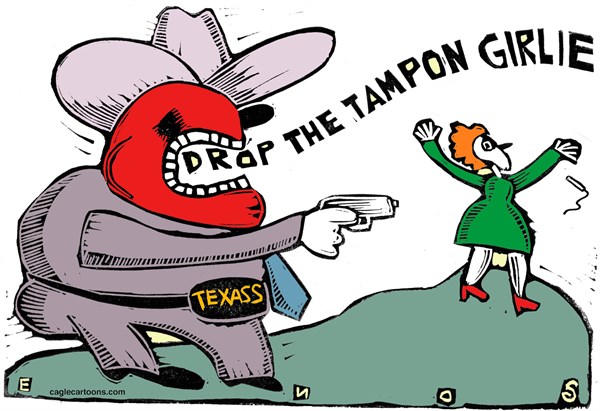
Enter the Texas Department of Public Safety, the state troopers who have jurisdiction at the Texas capitol. This is the same bunch that confiscated tampons from women who wanted to watch the Texas legislature pass the anti-abortion bill before claiming that protestors also tried to sneak in 18 jars of feces. Because DPS can’t prove this happened, many pro-choice activists think the DPS was smearing them to deflect criticism for tampon-gate. Now we have “Poop Truthers” in Texas. It’s been that kind of summer in Austin.
On July 25, 2013, DPS Officer Jason McMurray subpoenaed Twitter for Romano’s tweets on #PermissionDay as part of an “ongoing criminal investigation” of a “terroristic threat” Romano made. This was pretty stupid even for the DPS poop patrol, but it appears what Romano was facing was more Franz Kafka than Barney Fife.
Romano’s supporters figured what was good for the goose was good for the gander and investigated the online activities of Officer McMurray, a computer forensic agent from Tyler. It appears from his Facebook page that Officer McMurray is interested in something other than the equal application of the law to ensure public safety. On the Facebook page of Rep. Bryan Hughes, McMurray commented, “Please keep pushing to end all murder of the unborn regardless of the gestational period.” Under a picture of the Alamo on Hughes’ page, McMurray commented, “That liberty, especially the right of free speech and assembly, is being threatened every day.”
While McMurray was investigating Romano’s satirical activism to push a radical political agenda, the DPS was ignoring explicit threats from conservatives. MichaelB, a conservative radio host, tweeted threats to lynch Sen. Wendy Davis, Rep. Jessica Farrar, and Planned Parenthood’s Cecile Richards. Others called for retroactive abortion and placed specific bomb threats. There is no evidence the DPS investigated these threats.
Turns out, McMurray was right. The right of free speech is being threatened, but he’s the one doing it. The DPS withdrew its subpoena of Romano’s tweets after a week, but the damage was done. When a cop with a political agenda can get away with persecuting a woman with a debilitating illness, Republicans can stop talking about limited government and personal liberty. If Romano’s a potential terrorist, then so are you.
..................................................................................................................................
Kafka in Texas
By Jason Stanford, August 5, 2013
Denise Romano would make a lousy terrorist. She has a severe chronic refractory cough that causes her to pass out several times a day. She uses a walker so she has something to lean on when she gets one of her coughing fits. She can’t drive. During the “people’s filibuster,” she let protestors use the parking space at her condo two blocks from the capitol. As much as she wanted to join the protests, her body just couldn’t take it. Online activism was her only outlet.
That’s why she joined the Day of Permission, a national online protest against anti-abortion Republicans leaders. On Jul. 8, women all over the country called, emailed and tweeted Govs. John Kasich of Ohio and Rick Perry of Texas, seeking their advice. Organizer Bethany Erickson of Texas decided that “if you want to make decisions about my uterus and my reproductive life, you get to make all the decisions about my life. You don’t get to cherry pick.” Absurdity ensued.
The Day of Permission was a perfect outlet for Romano, who poured out her frustration into 60 tweets aimed at Kasich, Perry, and Texas Lt. Gov. David Dewhurst. Using the #PermissionDay hashtag, she asked whether she should wear a bikini or a one-piece swimsuit, floss before or after brushing, and dye her hair or let it go grey.
Not all of Romano’s tweets were so nice. She asked whether she should use a clean or rusty knife to castrate pro-life men, should stone or electrocute Republican adulterers, and whether Kasich, Perry and Dewhurst wanted to go to the 9th circle of Hell or just the 7th. Strong stuff, but in the context of seeking bathing suit advice, Romano’s tweets were clearly satire. You would have to see the world through idiot-colored glasses to take Romano’s tweets literally.
Enter the Texas Department of Public Safety, the state troopers who have jurisdiction at the Texas capitol. This is the same bunch that confiscated tampons from women who wanted to watch the Texas legislature pass the anti-abortion bill before claiming that protestors also tried to sneak in 18 jars of feces. Because DPS can’t prove this happened, many pro-choice activists think the DPS was smearing them to deflect criticism for tampon-gate. Now we have “Poop Truthers” in Texas. It’s been that kind of summer in Austin.
On July 25, 2013, DPS Officer Jason McMurray subpoenaed Twitter for Romano’s tweets on #PermissionDay as part of an “ongoing criminal investigation” of a “terroristic threat” Romano made. This was pretty stupid even for the DPS poop patrol, but it appears what Romano was facing was more Franz Kafka than Barney Fife.
Romano’s supporters figured what was good for the goose was good for the gander and investigated the online activities of Officer McMurray, a computer forensic agent from Tyler. It appears from his Facebook page that Officer McMurray is interested in something other than the equal application of the law to ensure public safety. On the Facebook page of Rep. Bryan Hughes, McMurray commented, “Please keep pushing to end all murder of the unborn regardless of the gestational period.” Under a picture of the Alamo on Hughes’ page, McMurray commented, “That liberty, especially the right of free speech and assembly, is being threatened every day.”
While McMurray was investigating Romano’s satirical activism to push a radical political agenda, the DPS was ignoring explicit threats from conservatives. MichaelB, a conservative radio host, tweeted threats to lynch Sen. Wendy Davis, Rep. Jessica Farrar, and Planned Parenthood’s Cecile Richards. Others called for retroactive abortion and placed specific bomb threats. There is no evidence the DPS investigated these threats.
Turns out, McMurray was right. The right of free speech is being threatened, but he’s the one doing it. The DPS withdrew its subpoena of Romano’s tweets after a week, but the damage was done. When a cop with a political agenda can get away with persecuting a woman with a debilitating illness, Republicans can stop talking about limited government and personal liberty. If Romano’s a potential terrorist, then so are you.
..................................................................................................................................
Sunday, August 4, 2013
Sauce for both the goose and the gander?
..................................................................................................................................
Ex-Newspaper Editor: I Was Fired For ‘Political Pressure’ Over Harsh Anti-Obama Editorial
By Josh Feldman, August 2nd, 2013
Drew Johnson was let go from his position as head of the Chattanooga Free Press editorial page after printing an anti-Obama editorial with the headline “Take your jobs plan and shove it, Mr. President: Your policies have harmed Chattanooga enough.” He was fired for the headline, with the official reason being that he made a last-minute headline change “outside of normal editing procedures,” but Johnson told HuffPost Live today that this was a complete lie and he was fired for “political purposes.”
He explained that it’s a general practice editorial headlines get changed at the last minute, and that after he ran his anti-Obama piece we was given a warning not to do it again. Fast-forward two days, and Johnson ended up getting fired for “a policy that was never in place until Tuesday, the day after I wrote the piece.”
He said he always had freedom to write what he wanted, and even sent out this tweet shortly after his firing was made public.

He told HuffPo he suspected the firing was the result of “political pressure” and potential embarrassment over the headline, but charged that the Free Press was perfectly happy to keep his title online. The headline, as of now, has been edited to read “President Obama’s policies have harmed Chattanooga enough.”
Watch the video below, via HuffPost Live:
..................................................................................................................................
Ex-Newspaper Editor: I Was Fired For ‘Political Pressure’ Over Harsh Anti-Obama Editorial
By Josh Feldman, August 2nd, 2013
Drew Johnson was let go from his position as head of the Chattanooga Free Press editorial page after printing an anti-Obama editorial with the headline “Take your jobs plan and shove it, Mr. President: Your policies have harmed Chattanooga enough.” He was fired for the headline, with the official reason being that he made a last-minute headline change “outside of normal editing procedures,” but Johnson told HuffPost Live today that this was a complete lie and he was fired for “political purposes.”
He explained that it’s a general practice editorial headlines get changed at the last minute, and that after he ran his anti-Obama piece we was given a warning not to do it again. Fast-forward two days, and Johnson ended up getting fired for “a policy that was never in place until Tuesday, the day after I wrote the piece.”
He said he always had freedom to write what he wanted, and even sent out this tweet shortly after his firing was made public.
He told HuffPo he suspected the firing was the result of “political pressure” and potential embarrassment over the headline, but charged that the Free Press was perfectly happy to keep his title online. The headline, as of now, has been edited to read “President Obama’s policies have harmed Chattanooga enough.”
Watch the video below, via HuffPost Live:
..................................................................................................................................
Let's hope that these two Senators can find it in themselves to continue to work together
..................................................................................................................................
Senators offer plan to save cash-strapped USPS
By Andrew Miga, Augsut 2, 2013
Saturday mail delivery would be ended in a year and the Postal Service could start shipping alcoholic beverages under a plan offered Friday by two key senators seeking to turn around the struggling agency's finances.
Senate Homeland Security and Governmental Affairs Committee Chairman Tom Carper, D-Del., and the panel's ranking Republican, Tom Coburn of Oklahoma, said they hope Congress can act quickly to help the agency.
The Postal Service lost $16 billion last year, $11 billion of it in congressionally-mandated payments to its health fund for future retirees.
The Senate plan includes changes in how pensions and retiree health care costs are calculated in an attempt to stabilize the agency's finances.
It also would impose a two-year moratorium on closing mail processing plants. The agency would be allowed to ship beer, wine and spirits to compete with private shippers such as FedEx, under the proposal.
Door-to-door service for new residential and business addresses would cease to help the Postal Service shift to less costly curbside and cluster box delivery. The measure would require the agency to try to convert residential addresses on a voluntary basis from door-to-door service to curbside and cluster box delivery.
The agency has been moving toward curbside and cluster box delivery in new residential developments since the 1970s.
The House Oversight and Government Reform Committee recently approved a bill by its chairman Rep. Darrell Issa, R-Calif., for the service to gradually shift from door delivery to cluster box and curbside delivery, which includes mailboxes at the end of driveways.
Issa's bill also would end Saturday delivery and change how pension and retiree health costs are calculated to bolster the agency's budget.
The Postal Service has been seeking legislation that would allow it to eliminate Saturday mail delivery and to reduce its congressionally mandated $5 billion annual payment for future retiree health benefits. It missed two of those $5 billion payments last year and is expected to miss another at the end of September.
About 1 in 3 mail customers has door-to-door delivery, which costs the agency about $350 per year. Curbside delivery costs on average $224 per year for each address, while cluster box delivery averages $160.
Earlier this year, the service backpedaled on its plan to end Saturday mail delivery after running into opposition in Congress. It has tried repeatedly over the past several years to persuade Congress to approve ending Saturday mail delivery.
The National Association of Letter Carriers has said ending Saturday delivery would in particular hurt small businesses along with rural residents and the elderly, who depend more heavily on the mail for prescription drugs and other goods.
..................................................................................................................................
Senators offer plan to save cash-strapped USPS
By Andrew Miga, Augsut 2, 2013
Saturday mail delivery would be ended in a year and the Postal Service could start shipping alcoholic beverages under a plan offered Friday by two key senators seeking to turn around the struggling agency's finances.
Senate Homeland Security and Governmental Affairs Committee Chairman Tom Carper, D-Del., and the panel's ranking Republican, Tom Coburn of Oklahoma, said they hope Congress can act quickly to help the agency.
The Postal Service lost $16 billion last year, $11 billion of it in congressionally-mandated payments to its health fund for future retirees.
The Senate plan includes changes in how pensions and retiree health care costs are calculated in an attempt to stabilize the agency's finances.
It also would impose a two-year moratorium on closing mail processing plants. The agency would be allowed to ship beer, wine and spirits to compete with private shippers such as FedEx, under the proposal.
Door-to-door service for new residential and business addresses would cease to help the Postal Service shift to less costly curbside and cluster box delivery. The measure would require the agency to try to convert residential addresses on a voluntary basis from door-to-door service to curbside and cluster box delivery.
The agency has been moving toward curbside and cluster box delivery in new residential developments since the 1970s.
The House Oversight and Government Reform Committee recently approved a bill by its chairman Rep. Darrell Issa, R-Calif., for the service to gradually shift from door delivery to cluster box and curbside delivery, which includes mailboxes at the end of driveways.
Issa's bill also would end Saturday delivery and change how pension and retiree health costs are calculated to bolster the agency's budget.
The Postal Service has been seeking legislation that would allow it to eliminate Saturday mail delivery and to reduce its congressionally mandated $5 billion annual payment for future retiree health benefits. It missed two of those $5 billion payments last year and is expected to miss another at the end of September.
About 1 in 3 mail customers has door-to-door delivery, which costs the agency about $350 per year. Curbside delivery costs on average $224 per year for each address, while cluster box delivery averages $160.
Earlier this year, the service backpedaled on its plan to end Saturday mail delivery after running into opposition in Congress. It has tried repeatedly over the past several years to persuade Congress to approve ending Saturday mail delivery.
The National Association of Letter Carriers has said ending Saturday delivery would in particular hurt small businesses along with rural residents and the elderly, who depend more heavily on the mail for prescription drugs and other goods.
..................................................................................................................................
At least SOME Republicans are aware that people are tired of gridlock and fighting
..................................................................................................................................
G.O.P. Governors Warn Party Members in Congress Not to Shut Government
By Jonathan Martin, August 4, 2013
Worried about the potential impact on the fragile economies in their states, Republican governors this weekend warned their counterparts in Congress not to shut down the federal government as part of an effort to block financing for President Obama’s health care law.
A range of Republican governors, including some who have refused to implement elements of the health initiative in their states, said in interviews that a standoff in Washington before the new fiscal year this fall could backfire on the party if it is seen as being responsible for bringing the government to a halt.
“I have made the case that Obamacare is not good for the economy, but I have some real concerns about potentially doing something that would have a negative impact on the economy just for the short term — I think there are other ways to pursue this,” said Gov. Scott Walker of Wisconsin, who hosted about half of the country’s governors here for the summer meeting of the National Governors Association.
Gov. Jack Dalrymple of North Dakota said a government shutdown would invariably be blamed on the legislative branch.
“I’ve never felt that shutting down government function is a wise thing to do politically because I think, whoever is involved in it, it’s the Congress, regardless of what party they’re affiliated with, that will be blamed by the public,” Mr. Dalrymple said. “And so, to me, I don’t see what it accomplishes.”
Asked if Republicans would pay a political price for a shutdown, Mr. Dalrymple said, “Yeah, well, you do.”
Gov. Phil Bryant of Mississippi, who refused the law’s provision expanding Medicaid in his state, was even more pointed, capturing the tension between the Republican chief executives charged with running their states and the Republican members of Congress who have no such burden.
“Many of the members of this party do not want to fund Obamacare, but what we have to do as governors who work with our legislators is realize the reality of being able to get something passed,” Mr. Bryant said.
He added that if a measure refusing to finance the health law is not going to get passed, “How much blood are we going to leave on the floor over this?”
The Republican divide on just how far they should go to torpedo Mr. Obama’s signature domestic achievement is increasingly becoming a stand-in for the broader party dispute between purists and pragmatists.
A group of Tea Party-aligned senators — like the potential presidential prospects Senators Rand Paul of Kentucky and Ted Cruz of Texas — are pushing their fellow Republicans in Congress to oppose a stopgap measure that would keep the federal government running after Sept. 30 if it includes financing for the Affordable Care Act.
But many Republicans, including high-profile conservatives like Senator Tom Coburn of Oklahoma, fear that Mr. Obama and the Democrats will only benefit in the 2014 elections from a doomed effort to block spending on the new law because Congressional Republicans would bear the blame for the subsequent shutdown of the government.
Because of the very nature of their jobs, Republican governors mainly fall into the pragmatist camp on this issue.
The prospect of even a temporary halt to the federal government, they say, would frighten their state’s businesses and disrupt some core services.
“It would affect all 50 of us,” Mr. Walker said. “The worst part is the uncertainty. My great fear would be anything that provides great uncertainty for the employers of our country.”
Mr. Bryant’s advice to Congressional Republicans: “Take the battle to the floor, debate it, do all that you can to get that bill passed because we believe in eliminating Obamacare completely, that’s why we didn’t expand it. But at some point perhaps we have to realize that the federal government — because of the support of our military, support of our public safety, our infrastructure — we have to have a budget.”
The possibility of a government shutdown and fears of the uncertainty it may bring was raised by a pair of governors — Neil Abercrombie of Hawaii, a Democrat, and Mary Fallin of Oklahoma, a Republican — during one of the public sessions during the weekend.
But the topic was brought up more in informal conversations among the governors rather than in the regular, more scripted forums, one governor said.
As the governors tend to do when they come together for such gatherings, many of those here for a four-day mix of policy talk, batting practice at Miller Park and Harley-Davidson rides were quick to contrast their jobs with those in Congress.
Gov. Terry E. Branstad of Iowa, a Republican who also served four terms as governor in the 1980s and 1990s, pointed to the compromise he reached with his legislature on how to broaden health care coverage for low-income residents without simply accepting the Medicaid expansion that is part of the federal health law. Such efforts on the state level, he said, are what is needed — not more bitter fights in Washington.
“It just causes too much disruption, and people don’t understand,” Mr. Branstad said about using the threat of a government shutdown as leverage. “People want problems solved. They’re tired of the gridlock. They’re tired of the fighting.”
Ms. Fallin, who was in Congress before becoming governor and is the new chairwoman of the National Governors Association, said she was deeply concerned about federal spending.
But she said she would like to see Washington find ways to go about addressing that issue without shutting down the government.
“They need to buckle down, work hard, find consensus on things and certainly find ways of reducing our deficit,” said Ms. Fallin, who rejected the Medicaid expansion in Oklahoma and declined to set up a state health insurance marketplace.
At least one Republican governor here, though, voiced support for the effort to tie spending on the health care law to the broader measure that finances the federal government: Bobby Jindal of Louisiana, the head of the Republican Governors Association and a potential 2016 presidential candidate who most likely does not want to cede any space to his right.
“We absolutely should use whatever opportunity and tactic we can to repeal and replace Obamacare,” said Mr. Jindal, deeming the prospect of a shutdown nothing more than “a false threat” and “scare tactics” from Mr. Obama’s administration.
To the Democratic governors here, the prospect of a shutdown is frightening from a governing perspective.
But politically, they already seem to have their message down should the federal government close this fall.
“People are getting very tired of politicians who appear to only want to shut things down and not build things up,” said Gov. Jack Markell of Delaware, a Democrat, who with a wry grin added of Republicans: “Far be it from me to give them advice, but it can’t be helpful to them.”
..................................................................................................................................
G.O.P. Governors Warn Party Members in Congress Not to Shut Government
By Jonathan Martin, August 4, 2013
Worried about the potential impact on the fragile economies in their states, Republican governors this weekend warned their counterparts in Congress not to shut down the federal government as part of an effort to block financing for President Obama’s health care law.
A range of Republican governors, including some who have refused to implement elements of the health initiative in their states, said in interviews that a standoff in Washington before the new fiscal year this fall could backfire on the party if it is seen as being responsible for bringing the government to a halt.
“I have made the case that Obamacare is not good for the economy, but I have some real concerns about potentially doing something that would have a negative impact on the economy just for the short term — I think there are other ways to pursue this,” said Gov. Scott Walker of Wisconsin, who hosted about half of the country’s governors here for the summer meeting of the National Governors Association.
Gov. Jack Dalrymple of North Dakota said a government shutdown would invariably be blamed on the legislative branch.
“I’ve never felt that shutting down government function is a wise thing to do politically because I think, whoever is involved in it, it’s the Congress, regardless of what party they’re affiliated with, that will be blamed by the public,” Mr. Dalrymple said. “And so, to me, I don’t see what it accomplishes.”
Asked if Republicans would pay a political price for a shutdown, Mr. Dalrymple said, “Yeah, well, you do.”
Gov. Phil Bryant of Mississippi, who refused the law’s provision expanding Medicaid in his state, was even more pointed, capturing the tension between the Republican chief executives charged with running their states and the Republican members of Congress who have no such burden.
“Many of the members of this party do not want to fund Obamacare, but what we have to do as governors who work with our legislators is realize the reality of being able to get something passed,” Mr. Bryant said.
He added that if a measure refusing to finance the health law is not going to get passed, “How much blood are we going to leave on the floor over this?”
The Republican divide on just how far they should go to torpedo Mr. Obama’s signature domestic achievement is increasingly becoming a stand-in for the broader party dispute between purists and pragmatists.
A group of Tea Party-aligned senators — like the potential presidential prospects Senators Rand Paul of Kentucky and Ted Cruz of Texas — are pushing their fellow Republicans in Congress to oppose a stopgap measure that would keep the federal government running after Sept. 30 if it includes financing for the Affordable Care Act.
But many Republicans, including high-profile conservatives like Senator Tom Coburn of Oklahoma, fear that Mr. Obama and the Democrats will only benefit in the 2014 elections from a doomed effort to block spending on the new law because Congressional Republicans would bear the blame for the subsequent shutdown of the government.
Because of the very nature of their jobs, Republican governors mainly fall into the pragmatist camp on this issue.
The prospect of even a temporary halt to the federal government, they say, would frighten their state’s businesses and disrupt some core services.
“It would affect all 50 of us,” Mr. Walker said. “The worst part is the uncertainty. My great fear would be anything that provides great uncertainty for the employers of our country.”
Mr. Bryant’s advice to Congressional Republicans: “Take the battle to the floor, debate it, do all that you can to get that bill passed because we believe in eliminating Obamacare completely, that’s why we didn’t expand it. But at some point perhaps we have to realize that the federal government — because of the support of our military, support of our public safety, our infrastructure — we have to have a budget.”
The possibility of a government shutdown and fears of the uncertainty it may bring was raised by a pair of governors — Neil Abercrombie of Hawaii, a Democrat, and Mary Fallin of Oklahoma, a Republican — during one of the public sessions during the weekend.
But the topic was brought up more in informal conversations among the governors rather than in the regular, more scripted forums, one governor said.
As the governors tend to do when they come together for such gatherings, many of those here for a four-day mix of policy talk, batting practice at Miller Park and Harley-Davidson rides were quick to contrast their jobs with those in Congress.
Gov. Terry E. Branstad of Iowa, a Republican who also served four terms as governor in the 1980s and 1990s, pointed to the compromise he reached with his legislature on how to broaden health care coverage for low-income residents without simply accepting the Medicaid expansion that is part of the federal health law. Such efforts on the state level, he said, are what is needed — not more bitter fights in Washington.
“It just causes too much disruption, and people don’t understand,” Mr. Branstad said about using the threat of a government shutdown as leverage. “People want problems solved. They’re tired of the gridlock. They’re tired of the fighting.”
Ms. Fallin, who was in Congress before becoming governor and is the new chairwoman of the National Governors Association, said she was deeply concerned about federal spending.
But she said she would like to see Washington find ways to go about addressing that issue without shutting down the government.
“They need to buckle down, work hard, find consensus on things and certainly find ways of reducing our deficit,” said Ms. Fallin, who rejected the Medicaid expansion in Oklahoma and declined to set up a state health insurance marketplace.
At least one Republican governor here, though, voiced support for the effort to tie spending on the health care law to the broader measure that finances the federal government: Bobby Jindal of Louisiana, the head of the Republican Governors Association and a potential 2016 presidential candidate who most likely does not want to cede any space to his right.
“We absolutely should use whatever opportunity and tactic we can to repeal and replace Obamacare,” said Mr. Jindal, deeming the prospect of a shutdown nothing more than “a false threat” and “scare tactics” from Mr. Obama’s administration.
To the Democratic governors here, the prospect of a shutdown is frightening from a governing perspective.
But politically, they already seem to have their message down should the federal government close this fall.
“People are getting very tired of politicians who appear to only want to shut things down and not build things up,” said Gov. Jack Markell of Delaware, a Democrat, who with a wry grin added of Republicans: “Far be it from me to give them advice, but it can’t be helpful to them.”
..................................................................................................................................
Saturday, August 3, 2013
Most of the "dark money" funneling through 501(c)(4)s supports Republican candidates
..................................................................................................................................
Political posers abuse nonprofit status
Opinion by Joseph P. Kennedy II, August 4, 2013
When I started Citizens Energy Corp. in 1979, the goal was to create an oil company that would help the poor.
Tax lawyers said we should become a nonprofit 501(c)(4). As a company providing heating oil to the needy, we would qualify as a “social welfare organization” and therefore be exempt from federal income taxes — allowing us to give away even more to the poor.
Unlike nonprofit 501(c)(3) charities, which collect tax-deductible contributions, 501(c)(4)s generate most of their revenues from dues and fees and business activities. Thousands of organizations work the same way, channeling funds into providing a concrete social benefit to the public.
But recent revelations about political groups abusing their tax-exempt status show how far nonprofits have been allowed to stray from the mission of serving the public.
While legitimate 501(c)(4)s spend over $40 billion annually on social welfare projects, others — ranging from Karl Rove’s Crossroads GPS to the Democratic-leaning Priorities USA — collect hundreds of millions of dollars in secret contributions to spend on political campaigns.
Most of the dark money funneling through 501(c)(4)s supports Republican candidates. In 2012, over 80 percent of more than $300 million in such spending was plunked down by conservative groups. Yet many of these groups checked the “no” box when asked by the IRS whether they planned to engage in any campaign activity. The Koch brothers’ Americans for Prosperity spent a whopping $39.4 million to defeat Democrats in 2010, despite claiming they would spend nothing on elections.
It is ludicrous to think that such spending is a legitimate expression of a “social welfare organization.” No one should be able to spend tax-free dollars — or be able to deduct donations as a business expense — to elect candidates.
The 1913 enabling legislation of the nonprofit section of the tax code provided the exemption to groups “operated exclusively for the promotion of social welfare.” However, for complex reasons, a 1959 regulation declared that “exclusively” meant “primarily.”
For the next 40 years, 501(c)(4)s provided a vehicle for nonprofits to spend tax-exempt dollars on advocacy efforts. In the meantime, federal regulators used the “primarily” interpretation to rule that groups could keep their 501(c)(4) status so long as no more than 49 percent of their spending went toward politics.
Then came two key Supreme Court rulings: The 2010 Citizens United case allowed unlimited corporate money to be spent on politics; and a separate decision that accepted the argument that ads targeting US Senator Russell Feingold of Wisconsin were not political because they did not tell the public how to vote.
Suddenly, political 501(c)(4)s sprang up like mushrooms. Political mercenaries took advantage of the loophole, arguing that their 501(c)(4) political ads, financed with hidden money, served the public welfare by educating the public.
The result is that they routinely engage in a clear conflict of interest by using their tax-exempt status — a benefit conferred by the American people — to operate as super PACs, spending millions of corporate dollars to influence who runs the government.
A number of solutions have been proposed to end the abuse, ranging from executive orders and legal challenges to regulatory proposals and legislation. None has yet succeeded in cleaning up the mess. From Tea Party groups to Organizing for America — which morphed out of President Obama’s campaign — political 501(c)(4)s continue to grow.
Meanwhile, the IRS continues to reel under revelations that it improperly ordered investigations of groups with the words “Tea Party,” “Israel,” “progressive,” and “occupy” in their titles.
Legislation is the best guarantor that the IRS close the 501(c)(4) loophole. By returning to the “exclusive” standard that prevailed before 1959, any spending outside of that serving the social welfare would be banned. Such legislation should also codify once and for all clear standards for determining when advocacy communication crosses the line from public education to partisan purpose. However, the political divide on Capitol Hill makes the odds of passing any such bill highly unlikely.
The IRS and the Treasury recently agreed to consider regulatory reform. The IRS should at least:
* Require that political contributions of $250 or more to 501(c)(4)s be publicly reported, pulling away the mantle of secrecy that cloaks all donors.
* Deny companies the ability to write off as business expenses any donations made to political 501(c)(4)s.
* Codify regulatory standards for what constitutes political speech.
Section 501(c)(4) of the tax code provides a legitimate financial advantage to organizations devoted to social welfare. But its benefits should not be extended to political posers and pretenders hiding secret donations beneath a nonprofit disguise.
..................................................................................................................................
Political posers abuse nonprofit status
Opinion by Joseph P. Kennedy II, August 4, 2013
When I started Citizens Energy Corp. in 1979, the goal was to create an oil company that would help the poor.
Tax lawyers said we should become a nonprofit 501(c)(4). As a company providing heating oil to the needy, we would qualify as a “social welfare organization” and therefore be exempt from federal income taxes — allowing us to give away even more to the poor.
Unlike nonprofit 501(c)(3) charities, which collect tax-deductible contributions, 501(c)(4)s generate most of their revenues from dues and fees and business activities. Thousands of organizations work the same way, channeling funds into providing a concrete social benefit to the public.
But recent revelations about political groups abusing their tax-exempt status show how far nonprofits have been allowed to stray from the mission of serving the public.
While legitimate 501(c)(4)s spend over $40 billion annually on social welfare projects, others — ranging from Karl Rove’s Crossroads GPS to the Democratic-leaning Priorities USA — collect hundreds of millions of dollars in secret contributions to spend on political campaigns.
Most of the dark money funneling through 501(c)(4)s supports Republican candidates. In 2012, over 80 percent of more than $300 million in such spending was plunked down by conservative groups. Yet many of these groups checked the “no” box when asked by the IRS whether they planned to engage in any campaign activity. The Koch brothers’ Americans for Prosperity spent a whopping $39.4 million to defeat Democrats in 2010, despite claiming they would spend nothing on elections.
It is ludicrous to think that such spending is a legitimate expression of a “social welfare organization.” No one should be able to spend tax-free dollars — or be able to deduct donations as a business expense — to elect candidates.
The 1913 enabling legislation of the nonprofit section of the tax code provided the exemption to groups “operated exclusively for the promotion of social welfare.” However, for complex reasons, a 1959 regulation declared that “exclusively” meant “primarily.”
For the next 40 years, 501(c)(4)s provided a vehicle for nonprofits to spend tax-exempt dollars on advocacy efforts. In the meantime, federal regulators used the “primarily” interpretation to rule that groups could keep their 501(c)(4) status so long as no more than 49 percent of their spending went toward politics.
Then came two key Supreme Court rulings: The 2010 Citizens United case allowed unlimited corporate money to be spent on politics; and a separate decision that accepted the argument that ads targeting US Senator Russell Feingold of Wisconsin were not political because they did not tell the public how to vote.
Suddenly, political 501(c)(4)s sprang up like mushrooms. Political mercenaries took advantage of the loophole, arguing that their 501(c)(4) political ads, financed with hidden money, served the public welfare by educating the public.
The result is that they routinely engage in a clear conflict of interest by using their tax-exempt status — a benefit conferred by the American people — to operate as super PACs, spending millions of corporate dollars to influence who runs the government.
A number of solutions have been proposed to end the abuse, ranging from executive orders and legal challenges to regulatory proposals and legislation. None has yet succeeded in cleaning up the mess. From Tea Party groups to Organizing for America — which morphed out of President Obama’s campaign — political 501(c)(4)s continue to grow.
Meanwhile, the IRS continues to reel under revelations that it improperly ordered investigations of groups with the words “Tea Party,” “Israel,” “progressive,” and “occupy” in their titles.
Legislation is the best guarantor that the IRS close the 501(c)(4) loophole. By returning to the “exclusive” standard that prevailed before 1959, any spending outside of that serving the social welfare would be banned. Such legislation should also codify once and for all clear standards for determining when advocacy communication crosses the line from public education to partisan purpose. However, the political divide on Capitol Hill makes the odds of passing any such bill highly unlikely.
The IRS and the Treasury recently agreed to consider regulatory reform. The IRS should at least:
* Require that political contributions of $250 or more to 501(c)(4)s be publicly reported, pulling away the mantle of secrecy that cloaks all donors.
* Deny companies the ability to write off as business expenses any donations made to political 501(c)(4)s.
* Codify regulatory standards for what constitutes political speech.
Section 501(c)(4) of the tax code provides a legitimate financial advantage to organizations devoted to social welfare. But its benefits should not be extended to political posers and pretenders hiding secret donations beneath a nonprofit disguise.
..................................................................................................................................
Things that used to be "conservative" ideas have become "liberal" ones, and conservatives themselves have moved further and further right
..................................................................................................................................
Everything You Need to Know About Politics Today, in 2 Paragraphs
By Matthew O'Brien, August 3 2013
Let's play a game. See if you can tell the difference between a shrill professor and a couple of former Republican EPA chiefs when it comes to climate change. Here's the first:
See, things that used to be "conservative" ideas, like cap and trade or Obamacare or monetary stimulus, have become "liberal" ones, all while conservatives themselves have moved further and further right. That's what happens when you view negotiation of any kind as an ideological betrayal -- you abandon your ideology. You stop being the party of markets, and become the party of whatever-the-Democrats-are-against (and your donors are for). It's why, as Ezra Klein points out, the idea of the political "center" is such a canard.
And it's how Paul Krugman ends up sounding like a Republican. Or Republicans ended up sounding like Paul Krugman.
..................................................................................................................................
Everything You Need to Know About Politics Today, in 2 Paragraphs
By Matthew O'Brien, August 3 2013
Let's play a game. See if you can tell the difference between a shrill professor and a couple of former Republican EPA chiefs when it comes to climate change. Here's the first:
A market-based approach, like a carbon tax, would be the best path to reducing greenhouse-gas emissions, but that is unachievable in the current political gridlock in Washington..... [W]e held fast to common-sense conservative principles -- protecting the health of the American people, working with the best technology available and trusting in the innovation of American business and in the market to find the best solutions for the least cost.And here's the second:
Opponents of a strong policy to curb greenhouse gases tend to be fervent believers in the magic of market economies. Yet somehow their faith goes away when it comes to environmental issues. If you seriously believe in markets, you should believe that given the right incentives -- namely, putting a price on emissions, through either a tax or a tradable permit scheme -- the economy will find lots of ways to emit less. You should definitely not believe, as anti-environmentalists claim, that the result would be economic disaster.Okay, I didn't make that very hard. The first comes from the joint New York Times op-ed by ex-EPA heads William Ruckelhaus, Lee Thomas, William Reilly and Christine Todd Whitman, and the second from Paul Krugman. Taken together, they're a remarkable artifact into the political history of the past few decades.
See, things that used to be "conservative" ideas, like cap and trade or Obamacare or monetary stimulus, have become "liberal" ones, all while conservatives themselves have moved further and further right. That's what happens when you view negotiation of any kind as an ideological betrayal -- you abandon your ideology. You stop being the party of markets, and become the party of whatever-the-Democrats-are-against (and your donors are for). It's why, as Ezra Klein points out, the idea of the political "center" is such a canard.
And it's how Paul Krugman ends up sounding like a Republican. Or Republicans ended up sounding like Paul Krugman.
..................................................................................................................................
GOP attempts to cripple the NSF's support for political science research projects
..................................................................................................................................
National Science Foundation dodges Congressional politics by canceling new political science research
By Dante D'Orazio, August 3, 2013
Some scientists' fears may be coming true. The National Science Foundation (NSF), which is one of the primary sources of funding for science research in the US, has canceled its annual August call for political science grant proposals in what many suspect is a direct result of Congressional legislation limiting the types of research the agency can support. Henry Farrell, a George Washington University political scientist told Nature that the move "is somewhere between devastating and crippling."
On its website, the NSF says "uncertainty" over its budget for fiscal 2014 is behind the decision to not accept any new political science grant proposals this August. Scientists and experts alike think politics is the main culprit, however. A late-addition to the 2013 spending bill stipulated that the NSF could only support political science research projects "that the director of the National Science Foundation certifies as promoting national security or the economic interests of the United States." The provision adds that the director of the agency must publish an explanation of how each approved proposal adheres to those goals, and it prevents the agency from financing research that in any way duplicates other federally-funded studies.
The limitations sound reasonable at first, but by putting politics into the system, some argue, Congress is effectively undercutting the peer review processes that see worthwhile projects get funded. And by prohibiting the NSF from supporting multiple scientists working on the same problem, the agency can't take multiple approaches to finding the best solutions to scientific endeavors. Some of the provision's language comes from Senator Tom Coburn (R, OK), an outspoken critic of political science, and the federal funds at stake are relatively minor — the NSF has a roughly $10 million annual budget for research in the field.
In June the NSF made its first attempt to work with Congress' limitations on political science funding, saying that it would "continue to engage panels to review grant proposals" while asking those panels to "provide input on whether proposals meet one or both of the additional criteria required" by the spending bill. It appears the NSF was unable to grapple with converting Congress' provisions into a policy for evaluating and approving grants, however. Nature suggests that the NSF is saving its funds for next year with hopes that the controls over political science research won't make their way into the 2014 spending bill. A most recent draft of that bill doesn't include the language that requires research to further US economic or national security interests.
..................................................................................................................................
National Science Foundation dodges Congressional politics by canceling new political science research
By Dante D'Orazio, August 3, 2013
Some scientists' fears may be coming true. The National Science Foundation (NSF), which is one of the primary sources of funding for science research in the US, has canceled its annual August call for political science grant proposals in what many suspect is a direct result of Congressional legislation limiting the types of research the agency can support. Henry Farrell, a George Washington University political scientist told Nature that the move "is somewhere between devastating and crippling."
On its website, the NSF says "uncertainty" over its budget for fiscal 2014 is behind the decision to not accept any new political science grant proposals this August. Scientists and experts alike think politics is the main culprit, however. A late-addition to the 2013 spending bill stipulated that the NSF could only support political science research projects "that the director of the National Science Foundation certifies as promoting national security or the economic interests of the United States." The provision adds that the director of the agency must publish an explanation of how each approved proposal adheres to those goals, and it prevents the agency from financing research that in any way duplicates other federally-funded studies.
The limitations sound reasonable at first, but by putting politics into the system, some argue, Congress is effectively undercutting the peer review processes that see worthwhile projects get funded. And by prohibiting the NSF from supporting multiple scientists working on the same problem, the agency can't take multiple approaches to finding the best solutions to scientific endeavors. Some of the provision's language comes from Senator Tom Coburn (R, OK), an outspoken critic of political science, and the federal funds at stake are relatively minor — the NSF has a roughly $10 million annual budget for research in the field.
In June the NSF made its first attempt to work with Congress' limitations on political science funding, saying that it would "continue to engage panels to review grant proposals" while asking those panels to "provide input on whether proposals meet one or both of the additional criteria required" by the spending bill. It appears the NSF was unable to grapple with converting Congress' provisions into a policy for evaluating and approving grants, however. Nature suggests that the NSF is saving its funds for next year with hopes that the controls over political science research won't make their way into the 2014 spending bill. A most recent draft of that bill doesn't include the language that requires research to further US economic or national security interests.
..................................................................................................................................
Friday, August 2, 2013
The first test for Hillary Clinton and her allies as they weigh another run for the White House
..................................................................................................................................
Weiner Scandal Puts Clinton Political Machine to the Test
Hillary Clinton's enemies are hoping the debacle in New York City will cast doubt on the potential 2016 presidential candidate — but her allies say she's handled it perfectly
By Zeke J. Miller, August 2, 2013
Anthony Weiner’s floundering mayoral candidacy has tested the limits of political forgiveness, the patience of New Yorkers and the imaginations of tabloid headline writers everywhere. But it may also have served as the first test for former Secretary of State Hillary Clinton and her allies as they weigh another run for the White House.
The Weiner drama has not only ensnared one of Clinton’s closest aides, Weiner’s wife Huma Abedin, but also reminded a scandal-weary public of the Clintons’ checkered past. After all, Clinton, whose 2008 campaign was plagued by infighting, finger pointing and worse, is no stranger to political — and sex — scandals. But the potential 2016 presidential candidate, supporters say, has adeptly managed the crisis from afar, distancing herself from Weiner through intermediaries and remaining quietly loyal to his embattled spouse.
“They’ve handled this perfectly so far — supporting Huma and using surrogates to blast Weiner,” says Adam Goldberg, a former special associate counsel to President Bill Clinton who handled the Monica Lewinsky investigation, and founder of crisis-management firm Trident Advisors.
Republicans are betting that Weiner’s antics will heighten voters’ sense of “Clinton fatigue” — that by 2016 they won’t want to relive eight years of high drama and investigations. But they have also seized on the Weiner affair as an opportunity not just to create a cloud around Hillary Clinton, but also her husband. Both Clintons remain tremendously popular, with the former President playing a potent role on the 2012 campaign trail, even overshadowing President Obama at last year’s Democratic National Convention.
Weiner only helped the GOP’s efforts when he implicitly compared his situation to Bill Clinton’s White House sex scandal. “Weiner’s comparison to Bill might’ve been fair, but it was bad form and bad politics,” says Goldberg. “Fair because what Bill did was so much worse, bad form because of the Clintons’ support for him, and bad politics because he further alienated every Hillary supporter and hurt his wife’s career.”
Clinton-world repaid Weiner with anonymous sniping from the pages of the New York Times to the New York Post, further accelerating his slide in the polls. The Post cited one New York Democrat as saying, “The Clintons are upset with the comparisons that the Weiners seem to be encouraging — that Huma is ‘standing by her man’ the way Hillary did with Bill, which is not what she in fact did.” This provoked Weiner to insult his former patrons, further insulating them from his problems. “I am not terribly interested in what people who are not voters in the city of New York have to say,” he said in reference to the Clintons, the New York Daily News reported, a remark greeted with relief by those in Hillary Clinton’s orbit for creating public distance between the two camps.
That distance is now a gulf. The New York Times reported Thursday in great detail that Hillary Clinton’s ferociously loyal spokesman Philippe Reines swore at Weiner when he was informed of his post-resignation explicit communications. Reines then advised Abedin to distance herself from her husband’s campaign, the Times reported.
But Hillary Clinton’s critics have also sought to use Weiner’s scandal as evidence of a broader trend in Clintonian politics. “The Huma-Hillary-Danger saga is déjà vu of some of the worst Clinton-land attributes,” says Tim Miller, executive director of the Republican America Rising PAC. “There’s anonymous leaking and infighting, an addiction to drama, and hunger for power over substance. Hillary’s nowhere on the big-issue debates of the moment but all over the tabloids. Democrats claim they’ve learned their lesson from the scandal-plagued ’90s and drama-soaked 2008 campaign, but the last week has been a replay of both. That doesn’t bode well for 2016.”
Even some Democrats admit that people in the Clintons’ orbit bring a lot of drama to the table. One former Obama campaign aide pointed to the bizarre leak about a Washington, D.C., dinner this week between Reines and Abedin to CNN. The source for the report was apparently deep enough in the inner circle to push back on assertions that the Clintons are “livid” about being compared to Weiner. The Obama aide said that if Hillary Clinton ran, the episode should serve as an example of just the type of process-driven drama to avoid.
Supporters insist Hillary Clinton made the right decision in standing by her trusted staffer. “Being loyal to Huma is important, I think, to show they can stick things like this out and be loyal to good people,” said one top Democratic communicator. “No drama from them here might show they’ve learned from the chaos, throw-people-under-the-bus approach of 2008.”
“As long as Hillary avoids photo ops with Huma in the next couple of months, this won’t affect Hillary’s run at all, and Hillary’s response simply reaffirms the lesson she learned long ago: fight back hard and fast,” Goldberg says. “That said, it’s impossible to see Huma having a high-profile campaign post if she and Weiner are still together — you don’t want people thinking Weiner photos when hearing your message.”
..................................................................................................................................
Weiner Scandal Puts Clinton Political Machine to the Test
Hillary Clinton's enemies are hoping the debacle in New York City will cast doubt on the potential 2016 presidential candidate — but her allies say she's handled it perfectly
By Zeke J. Miller, August 2, 2013
Anthony Weiner’s floundering mayoral candidacy has tested the limits of political forgiveness, the patience of New Yorkers and the imaginations of tabloid headline writers everywhere. But it may also have served as the first test for former Secretary of State Hillary Clinton and her allies as they weigh another run for the White House.
The Weiner drama has not only ensnared one of Clinton’s closest aides, Weiner’s wife Huma Abedin, but also reminded a scandal-weary public of the Clintons’ checkered past. After all, Clinton, whose 2008 campaign was plagued by infighting, finger pointing and worse, is no stranger to political — and sex — scandals. But the potential 2016 presidential candidate, supporters say, has adeptly managed the crisis from afar, distancing herself from Weiner through intermediaries and remaining quietly loyal to his embattled spouse.
“They’ve handled this perfectly so far — supporting Huma and using surrogates to blast Weiner,” says Adam Goldberg, a former special associate counsel to President Bill Clinton who handled the Monica Lewinsky investigation, and founder of crisis-management firm Trident Advisors.
Republicans are betting that Weiner’s antics will heighten voters’ sense of “Clinton fatigue” — that by 2016 they won’t want to relive eight years of high drama and investigations. But they have also seized on the Weiner affair as an opportunity not just to create a cloud around Hillary Clinton, but also her husband. Both Clintons remain tremendously popular, with the former President playing a potent role on the 2012 campaign trail, even overshadowing President Obama at last year’s Democratic National Convention.
Weiner only helped the GOP’s efforts when he implicitly compared his situation to Bill Clinton’s White House sex scandal. “Weiner’s comparison to Bill might’ve been fair, but it was bad form and bad politics,” says Goldberg. “Fair because what Bill did was so much worse, bad form because of the Clintons’ support for him, and bad politics because he further alienated every Hillary supporter and hurt his wife’s career.”
Clinton-world repaid Weiner with anonymous sniping from the pages of the New York Times to the New York Post, further accelerating his slide in the polls. The Post cited one New York Democrat as saying, “The Clintons are upset with the comparisons that the Weiners seem to be encouraging — that Huma is ‘standing by her man’ the way Hillary did with Bill, which is not what she in fact did.” This provoked Weiner to insult his former patrons, further insulating them from his problems. “I am not terribly interested in what people who are not voters in the city of New York have to say,” he said in reference to the Clintons, the New York Daily News reported, a remark greeted with relief by those in Hillary Clinton’s orbit for creating public distance between the two camps.
That distance is now a gulf. The New York Times reported Thursday in great detail that Hillary Clinton’s ferociously loyal spokesman Philippe Reines swore at Weiner when he was informed of his post-resignation explicit communications. Reines then advised Abedin to distance herself from her husband’s campaign, the Times reported.
But Hillary Clinton’s critics have also sought to use Weiner’s scandal as evidence of a broader trend in Clintonian politics. “The Huma-Hillary-Danger saga is déjà vu of some of the worst Clinton-land attributes,” says Tim Miller, executive director of the Republican America Rising PAC. “There’s anonymous leaking and infighting, an addiction to drama, and hunger for power over substance. Hillary’s nowhere on the big-issue debates of the moment but all over the tabloids. Democrats claim they’ve learned their lesson from the scandal-plagued ’90s and drama-soaked 2008 campaign, but the last week has been a replay of both. That doesn’t bode well for 2016.”
Even some Democrats admit that people in the Clintons’ orbit bring a lot of drama to the table. One former Obama campaign aide pointed to the bizarre leak about a Washington, D.C., dinner this week between Reines and Abedin to CNN. The source for the report was apparently deep enough in the inner circle to push back on assertions that the Clintons are “livid” about being compared to Weiner. The Obama aide said that if Hillary Clinton ran, the episode should serve as an example of just the type of process-driven drama to avoid.
Supporters insist Hillary Clinton made the right decision in standing by her trusted staffer. “Being loyal to Huma is important, I think, to show they can stick things like this out and be loyal to good people,” said one top Democratic communicator. “No drama from them here might show they’ve learned from the chaos, throw-people-under-the-bus approach of 2008.”
“As long as Hillary avoids photo ops with Huma in the next couple of months, this won’t affect Hillary’s run at all, and Hillary’s response simply reaffirms the lesson she learned long ago: fight back hard and fast,” Goldberg says. “That said, it’s impossible to see Huma having a high-profile campaign post if she and Weiner are still together — you don’t want people thinking Weiner photos when hearing your message.”
..................................................................................................................................
"Leave it to Republicans to have the courage to kick Americans because they’re down."
..................................................................................................................................
Let me add this: if you are poor and you vote for Republicans, then you deserve to be poor!
..................................................................................................................................
For Shame for Poor-Shaming
By Tina Dupuy, August 2, 2013
You’ve heard the term “slut-shaming.” It’s a tactic used by those fighting to repeal the 20th century. As women make strides for equality, a chorus of antiquities pronounces women who want to work outside the home as promiscuous. Only wanton women would want abortion rights. Loose ladies demand day care.
Slut-shaming is even prevalent when women get sexually assaulted. In 2011, in the wake of a string of rapes in Toronto, Constable Michael Sanguinetti, a police officer, said, “women should avoid dressing like sluts.” That touched off worldwide “SlutWalks” where women marched against slut-shaming.
But what never gets called out—despite using the exact same playbook—is poor-shaming.
Here’s how it works: You’re poor because you’re not good.
This is the land of opportunity. If you’re not wealthy it’s because you’re lazy. All you need are some bootstraps to pull up and you’re on your way! It’s framed as a moral issue. Lack of wealth indicates lack of morality.
“Four out of five U.S. adults struggle with joblessness, near-poverty or reliance on welfare for at least parts of their lives,” writes the AP according to their survey published this week.
Right now, 48 million Americans are in poverty. That’s one third more than the entire population of Canada (34 million). Our wealth inequality statistics are staggering. We have the worst infant mortality rate in the industrialized world. Twenty percent of our nation’s children live in poverty.
That’s not “opportunity.”
How have we resolved these sobering numbers? By kicking the downtrodden.
Which is why we no longer enjoy our once storied upward mobility. In America you get to be middle class the same way you get to be king—by virtue of birth.
Sure, we believe in upward mobility more than Europeans do. We also believe humans domesticated dinosaurs for transportation more than Europeans do. Doesn’t make it true.
The idea is that poverty itself isn’t punitive enough. It isn’t soul crushing enough. We need to make it more dehumanizing, more humiliating, more degrading. Poor-shaming is the notion that people are destitute because we haven’t sufficiently stigmatized their misfortune—enough.
Leave it to Republicans to have the courage to kick Americans because they’re down.
This attitude was summed up nicely by born-rich GOP presidential candidate, Mitt Romney, when he was secretly filmed talking to donors: “There are 47 percent of the people … who are dependent upon government, who believe that they are victims. … These are people who pay no income tax. … and so my job is not to worry about those people. I’ll never convince them that they should take personal responsibility and care for their lives.”
Poor people are asking for it. They don’t care about themselves. If they did they wouldn’t be poor.
This is why Republicans cut the SNAP (food stamps) program from the farm bill. They want to cut the program and cut needy people off of the nutritional program. They want Americans to instead “eat cake.” So they poor-shame.
Florida Congressman Steve Southerland says government benefits actually hurt people. “One thing we cannot put a number on is the number of casualties because people were never connected to their purpose in life,” said Southerland to NPR’s Linda Wertheimer.
The aim of poor-shaming is to get the marginalized to fight over scraps instead of demanding more from their country.
Tax cuts are government handouts to the wealthy. For some reason that’s an entitlement Republicans are OK with. Poor people are greedy when they want a living wage. Wealthy people are greedy to ensure success. When rich people are on the dole—entitlements are necessary for job creation.
How about Americans who have jobs but are paid so little by their profit-hoarding, mega-conglomerate employers that they’re eligible for food stamps? People who work at fast food restaurants have been mobilizing for better pay. Poor-shamers’ answer? They’re trying to bankrupt McDonalds just like Detroit.
Poor? Get a job. Work full-time but can’t make ends meet? Be grateful you have a job. Can’t get a better job? You’re being picky. Ah, the bounty of American insults for the less fortunate.
Let’s recap: Poor-shamers are anti-union, anti-living wage and anti-social safety net.
That’s just anti-American people.
..................................................................................................................................
Let me add this: if you are poor and you vote for Republicans, then you deserve to be poor!
..................................................................................................................................
For Shame for Poor-Shaming
By Tina Dupuy, August 2, 2013
You’ve heard the term “slut-shaming.” It’s a tactic used by those fighting to repeal the 20th century. As women make strides for equality, a chorus of antiquities pronounces women who want to work outside the home as promiscuous. Only wanton women would want abortion rights. Loose ladies demand day care.
Slut-shaming is even prevalent when women get sexually assaulted. In 2011, in the wake of a string of rapes in Toronto, Constable Michael Sanguinetti, a police officer, said, “women should avoid dressing like sluts.” That touched off worldwide “SlutWalks” where women marched against slut-shaming.
But what never gets called out—despite using the exact same playbook—is poor-shaming.
Here’s how it works: You’re poor because you’re not good.
This is the land of opportunity. If you’re not wealthy it’s because you’re lazy. All you need are some bootstraps to pull up and you’re on your way! It’s framed as a moral issue. Lack of wealth indicates lack of morality.
“Four out of five U.S. adults struggle with joblessness, near-poverty or reliance on welfare for at least parts of their lives,” writes the AP according to their survey published this week.
Right now, 48 million Americans are in poverty. That’s one third more than the entire population of Canada (34 million). Our wealth inequality statistics are staggering. We have the worst infant mortality rate in the industrialized world. Twenty percent of our nation’s children live in poverty.
That’s not “opportunity.”
How have we resolved these sobering numbers? By kicking the downtrodden.
Which is why we no longer enjoy our once storied upward mobility. In America you get to be middle class the same way you get to be king—by virtue of birth.
Sure, we believe in upward mobility more than Europeans do. We also believe humans domesticated dinosaurs for transportation more than Europeans do. Doesn’t make it true.
The idea is that poverty itself isn’t punitive enough. It isn’t soul crushing enough. We need to make it more dehumanizing, more humiliating, more degrading. Poor-shaming is the notion that people are destitute because we haven’t sufficiently stigmatized their misfortune—enough.
Leave it to Republicans to have the courage to kick Americans because they’re down.
This attitude was summed up nicely by born-rich GOP presidential candidate, Mitt Romney, when he was secretly filmed talking to donors: “There are 47 percent of the people … who are dependent upon government, who believe that they are victims. … These are people who pay no income tax. … and so my job is not to worry about those people. I’ll never convince them that they should take personal responsibility and care for their lives.”
Poor people are asking for it. They don’t care about themselves. If they did they wouldn’t be poor.
This is why Republicans cut the SNAP (food stamps) program from the farm bill. They want to cut the program and cut needy people off of the nutritional program. They want Americans to instead “eat cake.” So they poor-shame.
Florida Congressman Steve Southerland says government benefits actually hurt people. “One thing we cannot put a number on is the number of casualties because people were never connected to their purpose in life,” said Southerland to NPR’s Linda Wertheimer.
The aim of poor-shaming is to get the marginalized to fight over scraps instead of demanding more from their country.
Tax cuts are government handouts to the wealthy. For some reason that’s an entitlement Republicans are OK with. Poor people are greedy when they want a living wage. Wealthy people are greedy to ensure success. When rich people are on the dole—entitlements are necessary for job creation.
How about Americans who have jobs but are paid so little by their profit-hoarding, mega-conglomerate employers that they’re eligible for food stamps? People who work at fast food restaurants have been mobilizing for better pay. Poor-shamers’ answer? They’re trying to bankrupt McDonalds just like Detroit.
Poor? Get a job. Work full-time but can’t make ends meet? Be grateful you have a job. Can’t get a better job? You’re being picky. Ah, the bounty of American insults for the less fortunate.
Let’s recap: Poor-shamers are anti-union, anti-living wage and anti-social safety net.
That’s just anti-American people.
..................................................................................................................................
McCain-- the compromiser-in-chief
..................................................................................................................................
Analysis: McCain's deals and 'wacko-bird' barbs are priceless for Obama
By Thomas Ferraro, August 1, 2013
Republican U.S. Senator John McCain accidentally walked in on President Barack Obama this week when he was addressing a Democrats-only meeting of senators.
"Come on in, John," Obama shouted.
A red-faced McCain turned around and headed out to chuckles and then applause from the Democrats. "My mistake," McCain said.
To the far-right in the Republican Party, there is no mistake about it. In a party that generally brooks no compromise with Obama, McCain is the compromiser-in-chief. He's negotiating with the White House.
And he's in-their-face about it, having recently described as "wacko birds" two of the right's most uncompromising heroes, Senators Ted Cruz and Rand Paul.
A recent article in the conservative National Review described McCain as "Obama's secret weapon" and a "lethal threat" to a Republican victory in the budget battles this fall.
If Obama somehow wins an upcoming fiscal showdown with Republicans, the president may have McCain to thank.
The 2008 Republican presidential nominee, the man Obama beat, is now engaged in talks with a half-dozen fellow Senate Republicans and the White House aimed at trying to craft a bargain on critical fiscal issues to avoid a nasty standoff in the fall that could lead to a government shutdown or a government default, or both.
Obama already owes McCain for brokering the deal last month that allowed the president to overcome Republican objections and fill seven top administration jobs.
And McCain joined four Democrats and three Republicans in drafting the Senate's landmark bill to overhaul U.S. immigration laws, a top Obama priority.
So popular has the Arizona Republican become among Democrats that Senate Majority Leader Harry Reid - who in 2008 said, "I can't stand John McCain" - now describes him as a "great senator," right up there with the late Ted Kennedy, the Democratic "lion of the Senate" who became a bridge between parties after his own presidential ambitions were crushed.
"He's become our go-to guy," a senior Democratic aide said of the 76-year-old white-haired senator.
That's an exaggeration. McCain remains a critic of Obama's handling of the deadly attack on a U.S. diplomatic mission in Benghazi, Libya, last September and of what he considers the "disgrace" of Obama's non-intervention in Syria.
But on domestic issues, McCain has emerged as one of the top deal makers in Washington, a Republican Obama can do business with.
MOVING TOWARD THE MIDDLE
McCain said in an interview that he has been able to work more with Obama in part because the president has moved toward the middle in his second term and become more willing to negotiate.
McCain has also moved toward the middle after having veered toward the right in 2010 when he survived a Republican primary challenge and won election back home in Arizona to a fifth, six-year Senate term.
Two unrelated events have helped as well: McCain's new friendship with Charles Schumer, the third-ranking Senate Democrat who worked with McCain on the immigration bill, and Obama's choice of a McCain friend, Denis McDonough, as White House chief of staff.
The three have clicked.
At a time when the top congressional Republicans, Senate Minority Leader Mitch McConnell and House of Representatives Speaker John Boehner, rarely communicate with the White House, McCain does.
He said he and McDonough talked three times a day during the negotiations over Obama's stalled nominations.
"With all due respect to his predecessors, Denis knows how the Senate works," McCain said of McDonough, whom he knows from McDonough's days as a senior aide to former Democratic Senator Tom Daschle.
"I will continue to pound him (Obama) on Syria. I will continue to pound him on Benghazi," McCain said. "I will continue to pound him on a number of things, particularly on national security.
"But at the same time, I can find common ground with the president on certain issues," McCain said.
"The president won't owe me anything, but he may have a sense of satisfaction from being able to achieve some of the things that we ostensibly came here to do," McCain said.
At the same time he is helping Obama, McCain may be helping himself.
He likes attention as much as any other politician in Washington - and more than many - and there's no better way to get it than to talk about wacko birds.
In a city that rarely makes a deal, his recent feats of deal making have put him at the center of the action in Washington, enhancing his value as one of television's favorite political guests.
"I think John has more job satisfaction now than any time in his career," said Republican Senator Lindsey Graham, one of McCain's closest friends.
"He wanted to be president, but it didn't work out," Graham said. "It takes a while to get over it. Right now, John realizes that the country is in trouble and believes he can help."
"He's back in his groove," Graham said.
..................................................................................................................................
Analysis: McCain's deals and 'wacko-bird' barbs are priceless for Obama
By Thomas Ferraro, August 1, 2013
Republican U.S. Senator John McCain accidentally walked in on President Barack Obama this week when he was addressing a Democrats-only meeting of senators.
"Come on in, John," Obama shouted.
A red-faced McCain turned around and headed out to chuckles and then applause from the Democrats. "My mistake," McCain said.
To the far-right in the Republican Party, there is no mistake about it. In a party that generally brooks no compromise with Obama, McCain is the compromiser-in-chief. He's negotiating with the White House.
And he's in-their-face about it, having recently described as "wacko birds" two of the right's most uncompromising heroes, Senators Ted Cruz and Rand Paul.
A recent article in the conservative National Review described McCain as "Obama's secret weapon" and a "lethal threat" to a Republican victory in the budget battles this fall.
If Obama somehow wins an upcoming fiscal showdown with Republicans, the president may have McCain to thank.
The 2008 Republican presidential nominee, the man Obama beat, is now engaged in talks with a half-dozen fellow Senate Republicans and the White House aimed at trying to craft a bargain on critical fiscal issues to avoid a nasty standoff in the fall that could lead to a government shutdown or a government default, or both.
Obama already owes McCain for brokering the deal last month that allowed the president to overcome Republican objections and fill seven top administration jobs.
And McCain joined four Democrats and three Republicans in drafting the Senate's landmark bill to overhaul U.S. immigration laws, a top Obama priority.
So popular has the Arizona Republican become among Democrats that Senate Majority Leader Harry Reid - who in 2008 said, "I can't stand John McCain" - now describes him as a "great senator," right up there with the late Ted Kennedy, the Democratic "lion of the Senate" who became a bridge between parties after his own presidential ambitions were crushed.
"He's become our go-to guy," a senior Democratic aide said of the 76-year-old white-haired senator.
That's an exaggeration. McCain remains a critic of Obama's handling of the deadly attack on a U.S. diplomatic mission in Benghazi, Libya, last September and of what he considers the "disgrace" of Obama's non-intervention in Syria.
But on domestic issues, McCain has emerged as one of the top deal makers in Washington, a Republican Obama can do business with.
MOVING TOWARD THE MIDDLE
McCain said in an interview that he has been able to work more with Obama in part because the president has moved toward the middle in his second term and become more willing to negotiate.
McCain has also moved toward the middle after having veered toward the right in 2010 when he survived a Republican primary challenge and won election back home in Arizona to a fifth, six-year Senate term.
Two unrelated events have helped as well: McCain's new friendship with Charles Schumer, the third-ranking Senate Democrat who worked with McCain on the immigration bill, and Obama's choice of a McCain friend, Denis McDonough, as White House chief of staff.
The three have clicked.
At a time when the top congressional Republicans, Senate Minority Leader Mitch McConnell and House of Representatives Speaker John Boehner, rarely communicate with the White House, McCain does.
He said he and McDonough talked three times a day during the negotiations over Obama's stalled nominations.
"With all due respect to his predecessors, Denis knows how the Senate works," McCain said of McDonough, whom he knows from McDonough's days as a senior aide to former Democratic Senator Tom Daschle.
"I will continue to pound him (Obama) on Syria. I will continue to pound him on Benghazi," McCain said. "I will continue to pound him on a number of things, particularly on national security.
"But at the same time, I can find common ground with the president on certain issues," McCain said.
"The president won't owe me anything, but he may have a sense of satisfaction from being able to achieve some of the things that we ostensibly came here to do," McCain said.
At the same time he is helping Obama, McCain may be helping himself.
He likes attention as much as any other politician in Washington - and more than many - and there's no better way to get it than to talk about wacko birds.
In a city that rarely makes a deal, his recent feats of deal making have put him at the center of the action in Washington, enhancing his value as one of television's favorite political guests.
"I think John has more job satisfaction now than any time in his career," said Republican Senator Lindsey Graham, one of McCain's closest friends.
"He wanted to be president, but it didn't work out," Graham said. "It takes a while to get over it. Right now, John realizes that the country is in trouble and believes he can help."
"He's back in his groove," Graham said.
..................................................................................................................................
Thursday, August 1, 2013
GOP infighting-- can the party re-coalesce and if so, how?
..................................................................................................................................
For A Split GOP, 2016 Can't Come Fast Enough
By Philip Bump, August 1, 2013
The irony of the Republican Party's success in blocking the Democratic Senate and Democratic president is that the party itself is being blocked in the same way: a committed, uncompromising minority stands in its way. But it's not always the same minority. The Republican Party is in an increasingly obvious struggle over its identity — one with its roots in the voters that comprise it.
The most public split was the very public tiff between New Jersey Governor Chris Christie and Kentucky Senator Rand Paul. If you missed it, last week Christie bashed those in his party who critique the NSA's surveillance, suggesting that concerns over the program were "esoteric" ones that wouldn't hold up in the face of those who'd lost loved ones on 9/11. Paul responded by calling Christie the "king of bacon" for his push for relief following Hurricane Sandy. Then Paul asked Christie to get a beer with him, and Christie declined, and so on. Perhaps a bit further down in its article than was warranted, Politico summarized the real problem:
And it means that it's not really their fault. In a poll conducted by Pew Research released on Wednesday, that split is immediately apparent. Pew asked Republican voters about how the party is faring and how it might need to change. Three sets of responses are worth pulling out.
In order, the charts show that:
Even on that, though, Capitol Hill Republicans are fighting. A weird procedural hiccup yesterday forced leadership in the House — the Republican-led chamber were the party's rifts are most commonly apparent — to shift its approach to key votes on a budget measure. It was largely insider stuff, but for observers like Talking Points Memo's Brian Beutler, it was revelatory. In short, the party couldn't figure out how to cobble together votes that would maintain Rep. Paul Ryan of Wisconsin's budget proposals.
..................................................................................................................................
For A Split GOP, 2016 Can't Come Fast Enough
By Philip Bump, August 1, 2013
The irony of the Republican Party's success in blocking the Democratic Senate and Democratic president is that the party itself is being blocked in the same way: a committed, uncompromising minority stands in its way. But it's not always the same minority. The Republican Party is in an increasingly obvious struggle over its identity — one with its roots in the voters that comprise it.
The most public split was the very public tiff between New Jersey Governor Chris Christie and Kentucky Senator Rand Paul. If you missed it, last week Christie bashed those in his party who critique the NSA's surveillance, suggesting that concerns over the program were "esoteric" ones that wouldn't hold up in the face of those who'd lost loved ones on 9/11. Paul responded by calling Christie the "king of bacon" for his push for relief following Hurricane Sandy. Then Paul asked Christie to get a beer with him, and Christie declined, and so on. Perhaps a bit further down in its article than was warranted, Politico summarized the real problem:
In some respects, the Christie-Paul blowup is a case study in the Republican Party’s internal divisions: The two men hail from such different wings of the GOP, and both are so nationally ambitious, that there is little short-term risk in escalating their rivalry.The "different wings" part of that is key. Christie's (relative) social moderation and support for the (limited) power of government represents the old wing of the Republican party. Paul's (relative) social conservatism and nouveau libertarianism is the new breed, an evolution of his Tea Party roots for the national stage. This is the sort of thing that often gets worked out in a presidential primary. In 2012, however, the party focused on getting rid of Barack Obama in lieu of identifying its own direction. Mitt Romney, from the Christie strain of Republicanism, tried on the Paul strain during the primaries. The mess that resulted needs no further explanation. But it meant that the party didn't try to bridge that gap, pushing off the debate until 2016. Which is why Christie and Paul have already taken it up.
And it means that it's not really their fault. In a poll conducted by Pew Research released on Wednesday, that split is immediately apparent. Pew asked Republican voters about how the party is faring and how it might need to change. Three sets of responses are worth pulling out.
- More than two-thirds of Republican voters think the party needs major change,
- Sixty percent of voters think that change needs to be a new set of positions, and
- Fifty-four percent think those positions should be more conservative while 40 percent think they should be more moderate.
Even on that, though, Capitol Hill Republicans are fighting. A weird procedural hiccup yesterday forced leadership in the House — the Republican-led chamber were the party's rifts are most commonly apparent — to shift its approach to key votes on a budget measure. It was largely insider stuff, but for observers like Talking Points Memo's Brian Beutler, it was revelatory. In short, the party couldn't figure out how to cobble together votes that would maintain Rep. Paul Ryan of Wisconsin's budget proposals.
[I]t raises much bigger, existential questions for the Republicans as a national party. If they can’t execute key elements of their governing agenda, even just to establish their negotiating positions opposite the Democrats, what can they do, and what argument can they possibly make for controlling more (or all) of Washington?In March, we made a map of GOP infighting. This week, we made a new version — a far more complex new version. Until the Republican party re-coalesces, those charts probably aren't going to be getting much simpler. In other words, for the GOP, the 2016 primaries can't come fast enough.
..................................................................................................................................
Cruz, Lee, and Paul have been warned to drop their effort to refuse to vote to fund the government
..................................................................................................................................
Senate 'wacko birds' at home among the Ron Paul faithful
By Chris Moody, August 1, 2013
There’s an old cliché that if you’re looking for a friend in Washington, get a dog. That may help explain why three renegade Republicans senators, Rand Paul of Kentucky, Ted Cruz of Texas and Mike Lee of Utah, briefly fled across the Potomac Wednesday night to mingle with a crowd more appreciative of their brand of politics.
Earlier this week, several hundred college-aged libertarians gathered for the fifth annual Young Americans for Liberty (YAL) conference inside a ballroom room of the Westin Hotel, located a safe seven miles from the capitol building. YAL is the youth outreach group that was birthed from the womb of former Texas Rep. Ron Paul’s first run for the Republican presidential nomination in 2008, and it works with Paul’s other organization, the Campaign for Liberty, to continue advocating for his causes.
The young Paulites at the Westin howled when Paul, Cruz and Lee strolled onto the stage. United screams of “Run Rand Run!”—a chant that shares the cadence of another Paulian rallying cry, “End the Fed!”—rippled through the room. The trio stood on the stage for a full minute until the noise simmered. Rand Paul, who had changed out of the buttoned up suit he wore on Capitol Hill to jeans and a blazer, sat in a chair next to Cruz and Lee looking comfortable among his flock.
“We’re not accustomed to that kind of welcome in Washington,” Lee beamed over the whoops and hollers. "There are people just a few miles from here who give us quite the opposite reception.” (He wasn’t exaggerating. A lot of Republicans find these three really annoying.)
"It seems there may be a few wacko birds in the house,” Cruz said from his perch in the middle of the stage, a reference term coined by Arizona Republican Sen. John McCain that was not made with affection at the time.
For some of the Paulites, Cruz was somewhat of a new face. His thinking on issues dear to them—ending the Federal Reserve, taming the welfare state and embracing a non-interventionist foreign policy, to name a few—are still largely untested, although both Ron and Rand Paul endorsed him during his Senate race. The conference provided Cruz with an opportunity to prove himself as a true believer.
A few weeks ago, Cruz underwent a similar test in front of more than 600 Christian church leaders in Iowa where he passed with flying colors. Now was his chance to do the same with college-aged libertarians.
Acting as a moderator for the discussion, YAL Executive Director Jeff Frazee wasted no time in quizzing Cruz on his ideological credentials.
“Would you support a war that was not constitutionally declared by the Congress?” Frazee asked, directing the question specifically to Cruz.
“No,” Cruz replied, pausing to let the audience applaud. “The Declaration of War is one of the most important checks and balances the Constitution gives on the power of the president.
By the end of the forum, it appeared that Cruz had found himself in the Paulites good graces. The era of positive feelings, however, will only last as long as he’s not running against Rand Paul for president in a future election cycle. Check out what the Campaign for Liberty is already doing to Florida Sen. Marco Rubio , who earlier that day voted against a bill Paul introduced in the Senate. Oof! But for now, Cruz seems to be making a fine impression.
All three believe they represent the future of the party and hold that elusive key that can help bring young people back to the GOP -- a demographic that largely left the party after the Reagan era.
Part of that effort, as it has played out over the past few months, has required a bit of troublemaking, at least from the viewpoint of some of the seasoned Republicans with more mileage walking the halls of Congress.
While it is traditional in the Senate for new members, for instance, to be seen and not heard in their first few years in office, newbie lawmakers like Cruz, Paul and Lee have been anything but. All have been highly outspoken during their brief careers, and that includes issues that have separated them from some of their Republican colleagues in the chamber.
In March, Paul spent nearly 13 hours on the Senate floor to protest the president’s drone policy using old-fashioned filibuster tactics, and both Lee and Cruz joined him. (While many in the GOP leadership cheered him on, the filibuster received mixed reviews from some Republicans .) Just this week, McCain—the same McCain who made the “wacko birds” remark that Cruz loves to mention so often—told The New Republic magazine that that it would be a “ tough choice” for him if Paul ran against Democrat Hillary Clinton if they both run for president.
Most recently, Cruz, Lee and Paul—as well as Rubio—have been leading an effort to refuse to vote to fund the government unless the federal health care law known as Obamacare is defunded. The push is causing a bit of consternation among some of the other lawmakers who don’t want to risk being blamed for trying to shut down the government. (Because let’s face it, Republicans will be blamed if they pick that fight.) Many Republicans have warned them to drop it, and lambasted their campaign as “dumb” and “ silly.”
Paul’s prediction: Those folks won’t be around long. And the wacko birds will multiply.
“I think that when you look at the contrast between the old guard, it’s part of the shrinking of the Republican Party,” Paul told the audience. “They’re presiding over a dying party.”
..................................................................................................................................
Senate 'wacko birds' at home among the Ron Paul faithful
By Chris Moody, August 1, 2013
There’s an old cliché that if you’re looking for a friend in Washington, get a dog. That may help explain why three renegade Republicans senators, Rand Paul of Kentucky, Ted Cruz of Texas and Mike Lee of Utah, briefly fled across the Potomac Wednesday night to mingle with a crowd more appreciative of their brand of politics.
Earlier this week, several hundred college-aged libertarians gathered for the fifth annual Young Americans for Liberty (YAL) conference inside a ballroom room of the Westin Hotel, located a safe seven miles from the capitol building. YAL is the youth outreach group that was birthed from the womb of former Texas Rep. Ron Paul’s first run for the Republican presidential nomination in 2008, and it works with Paul’s other organization, the Campaign for Liberty, to continue advocating for his causes.
The young Paulites at the Westin howled when Paul, Cruz and Lee strolled onto the stage. United screams of “Run Rand Run!”—a chant that shares the cadence of another Paulian rallying cry, “End the Fed!”—rippled through the room. The trio stood on the stage for a full minute until the noise simmered. Rand Paul, who had changed out of the buttoned up suit he wore on Capitol Hill to jeans and a blazer, sat in a chair next to Cruz and Lee looking comfortable among his flock.
“We’re not accustomed to that kind of welcome in Washington,” Lee beamed over the whoops and hollers. "There are people just a few miles from here who give us quite the opposite reception.” (He wasn’t exaggerating. A lot of Republicans find these three really annoying.)
"It seems there may be a few wacko birds in the house,” Cruz said from his perch in the middle of the stage, a reference term coined by Arizona Republican Sen. John McCain that was not made with affection at the time.
For some of the Paulites, Cruz was somewhat of a new face. His thinking on issues dear to them—ending the Federal Reserve, taming the welfare state and embracing a non-interventionist foreign policy, to name a few—are still largely untested, although both Ron and Rand Paul endorsed him during his Senate race. The conference provided Cruz with an opportunity to prove himself as a true believer.
A few weeks ago, Cruz underwent a similar test in front of more than 600 Christian church leaders in Iowa where he passed with flying colors. Now was his chance to do the same with college-aged libertarians.
Acting as a moderator for the discussion, YAL Executive Director Jeff Frazee wasted no time in quizzing Cruz on his ideological credentials.
“Would you support a war that was not constitutionally declared by the Congress?” Frazee asked, directing the question specifically to Cruz.
“No,” Cruz replied, pausing to let the audience applaud. “The Declaration of War is one of the most important checks and balances the Constitution gives on the power of the president.
By the end of the forum, it appeared that Cruz had found himself in the Paulites good graces. The era of positive feelings, however, will only last as long as he’s not running against Rand Paul for president in a future election cycle. Check out what the Campaign for Liberty is already doing to Florida Sen. Marco Rubio , who earlier that day voted against a bill Paul introduced in the Senate. Oof! But for now, Cruz seems to be making a fine impression.
All three believe they represent the future of the party and hold that elusive key that can help bring young people back to the GOP -- a demographic that largely left the party after the Reagan era.
Part of that effort, as it has played out over the past few months, has required a bit of troublemaking, at least from the viewpoint of some of the seasoned Republicans with more mileage walking the halls of Congress.
While it is traditional in the Senate for new members, for instance, to be seen and not heard in their first few years in office, newbie lawmakers like Cruz, Paul and Lee have been anything but. All have been highly outspoken during their brief careers, and that includes issues that have separated them from some of their Republican colleagues in the chamber.
In March, Paul spent nearly 13 hours on the Senate floor to protest the president’s drone policy using old-fashioned filibuster tactics, and both Lee and Cruz joined him. (While many in the GOP leadership cheered him on, the filibuster received mixed reviews from some Republicans .) Just this week, McCain—the same McCain who made the “wacko birds” remark that Cruz loves to mention so often—told The New Republic magazine that that it would be a “ tough choice” for him if Paul ran against Democrat Hillary Clinton if they both run for president.
Most recently, Cruz, Lee and Paul—as well as Rubio—have been leading an effort to refuse to vote to fund the government unless the federal health care law known as Obamacare is defunded. The push is causing a bit of consternation among some of the other lawmakers who don’t want to risk being blamed for trying to shut down the government. (Because let’s face it, Republicans will be blamed if they pick that fight.) Many Republicans have warned them to drop it, and lambasted their campaign as “dumb” and “ silly.”
Paul’s prediction: Those folks won’t be around long. And the wacko birds will multiply.
“I think that when you look at the contrast between the old guard, it’s part of the shrinking of the Republican Party,” Paul told the audience. “They’re presiding over a dying party.”
..................................................................................................................................
Will we ever learn the truth about the NSA and XKeyscore?
..................................................................................................................................
A remarkable day in the story of Internet privacy
By Scott Bomboy, August 1, 2013
Four significant events on Wednesday have pushed the public debate about government surveillance and Internet privacy to new levels—and have led to new questions about the National Security Agency and its activities.
The day started with two bombshells – new revelations from The Guardian’s Glenn Greenwald about NSA spying and the official release of three formerly top secret documents by the U.S. government. Those events were followed by a testy Senate hearing on Capitol Hill about the NSA, and then the appearance of a four-star U.S. General debating hecklers at a huge computer hackers’ convention in Las Vegas.
As the dust settled later in the day, it’s clear that the Obama administration wants to engage in a dialogue about the legitimacy of its surveillance activities under the Fourth Amendment and the USA Patriot Act. It was also clear that The Guardian’s report, based on information supplied by fugitive analyst Edward Snowden, revealed a program that on the surface may contradict the safeguards that the government says it put in place to guarantee First Amendment and Fourth Amendment protections.
As General Keith Alexander’s presentation and dialogue at the Black Hat convention also showed, there are doubts in the computer field about the NSA, and mixed feelings about the need for trading personal privacy online in exchange for greater national security.
First, the Director of National Intelligence, James Clapper, released three redacted documents that explained in more detail how the Justice Department justifies the collection of phone and email records from American citizens and others, to Congress and a judge at the top-secret Foreign Intelligence Surveillance Act court.
The documents were released to coincide with a Senate Judiciary Committee hearing on the NSA. They explained that the government has multiple levels of checks and balances to make sure that only basic phone and email “metadata” are placed into massive NSA databases, and only a handful of people see it—after there is a “reasonable suspicion” to view it.
This metadata is limited to incoming and outgoing phone numbers, the location of phone calls, their duration, email addresses and routing numbers for emails. The government documents said that the content of phone calls and emails wasn’t recorded, monitored, or stored, when an analyst voiced reasonable suspicion and accessed it with a direct court order. (The Justice Department said that Supreme Court precedents allowed this outside of the Fourth Amendment’s protections against unreasonable search and seizure.)
But before the hearing, Greenwald published his exclusive story, based on presentation slides and training materials provided by Snowden, might contradict the government’s claims about only collecting metadata.
Greenwald discussed a much-more intrusive spying system called XKeyscore that allegedly allows government analysts to read the content of emails, as well as private social media communications and Internet browsing histories. He said the training document claimed about 300 terrorists had been caught by 2008 using XKeyscore.
What’s unclear is how much XKeyscore was used to target foreign communications and how the NSA could collect the huge amount of daily Internet traffic and store it to exclude domestic content.
In a statement to The Guardian, the NSA confirmed the existence of XKeyscore and said it was used lawfully.
“XKeyscore is used as a part of NSA’s lawful foreign signals intelligence collection system,” it said. “Every search by an NSA analyst is fully auditable, to ensure that they are proper and within the law. These types of programs allow us to collect the information that enables us to perform our missions successfully – to defend the nation and to protect US and allied troops abroad.”
The Senate Judiciary Hearing then became heated, as some Senators were upset that the DNI released the formerly top secret surveillance documents with little notice.
Senator Al Franken specifically called out the DNI for its last-minute decision.
“I don’t want transparency only when it’s convenient to the government,” Franken said. The Office of the Director of National Intelligence … has known for weeks that this hearing was coming and ODNI released this only in the minutes before this hearing began. That doesn’t engender trust.”
The top Republican on the committee, Senator Chuck Grassley of Iowa, opening questioned the legal basis for the programs and again ripped DNI head Clapper, who has acknowledged he making inaccurate statements to Congress about the surveillance program in March.
General Alexander, the head of the NSA, wasn’t at Wednesday’s hearing. Instead, Alexander spoke to an overflow audience in Las Vegas at a big international convention for self-professed hackers and computer security professionals.
Alexander confronted questions about the surveillance programs head-on during his presentation, explaining at length the safeguards taken to protect data and how the information war was personal to him, since 20 NSA cryptographers had been killed over the past 10 years in Iraq and Afghanistan
“They are willing to put their lives on the line for their fellow soldiers and fellow Americans. These same people who take that same oath to uphold the Constitution are the same ones who run these programs,” Alexander said.
Alexander also directly answered a heckler in the audience at one point, who told him to “read the Constitution.”
“I have,” Alexander said. “You should too!”
Alexander will appear before Congress on Thursday in what could be another big day for Internet privacy followers. His appearance will follow news from Russia that that nation has granted Snowden political asylum for the next year.
Link: Watch full video.
..................................................................................................................................
A remarkable day in the story of Internet privacy
By Scott Bomboy, August 1, 2013
Four significant events on Wednesday have pushed the public debate about government surveillance and Internet privacy to new levels—and have led to new questions about the National Security Agency and its activities.
The day started with two bombshells – new revelations from The Guardian’s Glenn Greenwald about NSA spying and the official release of three formerly top secret documents by the U.S. government. Those events were followed by a testy Senate hearing on Capitol Hill about the NSA, and then the appearance of a four-star U.S. General debating hecklers at a huge computer hackers’ convention in Las Vegas.
As the dust settled later in the day, it’s clear that the Obama administration wants to engage in a dialogue about the legitimacy of its surveillance activities under the Fourth Amendment and the USA Patriot Act. It was also clear that The Guardian’s report, based on information supplied by fugitive analyst Edward Snowden, revealed a program that on the surface may contradict the safeguards that the government says it put in place to guarantee First Amendment and Fourth Amendment protections.
As General Keith Alexander’s presentation and dialogue at the Black Hat convention also showed, there are doubts in the computer field about the NSA, and mixed feelings about the need for trading personal privacy online in exchange for greater national security.
First, the Director of National Intelligence, James Clapper, released three redacted documents that explained in more detail how the Justice Department justifies the collection of phone and email records from American citizens and others, to Congress and a judge at the top-secret Foreign Intelligence Surveillance Act court.
The documents were released to coincide with a Senate Judiciary Committee hearing on the NSA. They explained that the government has multiple levels of checks and balances to make sure that only basic phone and email “metadata” are placed into massive NSA databases, and only a handful of people see it—after there is a “reasonable suspicion” to view it.
This metadata is limited to incoming and outgoing phone numbers, the location of phone calls, their duration, email addresses and routing numbers for emails. The government documents said that the content of phone calls and emails wasn’t recorded, monitored, or stored, when an analyst voiced reasonable suspicion and accessed it with a direct court order. (The Justice Department said that Supreme Court precedents allowed this outside of the Fourth Amendment’s protections against unreasonable search and seizure.)
But before the hearing, Greenwald published his exclusive story, based on presentation slides and training materials provided by Snowden, might contradict the government’s claims about only collecting metadata.
Greenwald discussed a much-more intrusive spying system called XKeyscore that allegedly allows government analysts to read the content of emails, as well as private social media communications and Internet browsing histories. He said the training document claimed about 300 terrorists had been caught by 2008 using XKeyscore.
What’s unclear is how much XKeyscore was used to target foreign communications and how the NSA could collect the huge amount of daily Internet traffic and store it to exclude domestic content.
In a statement to The Guardian, the NSA confirmed the existence of XKeyscore and said it was used lawfully.
“XKeyscore is used as a part of NSA’s lawful foreign signals intelligence collection system,” it said. “Every search by an NSA analyst is fully auditable, to ensure that they are proper and within the law. These types of programs allow us to collect the information that enables us to perform our missions successfully – to defend the nation and to protect US and allied troops abroad.”
The Senate Judiciary Hearing then became heated, as some Senators were upset that the DNI released the formerly top secret surveillance documents with little notice.
Senator Al Franken specifically called out the DNI for its last-minute decision.
“I don’t want transparency only when it’s convenient to the government,” Franken said. The Office of the Director of National Intelligence … has known for weeks that this hearing was coming and ODNI released this only in the minutes before this hearing began. That doesn’t engender trust.”
The top Republican on the committee, Senator Chuck Grassley of Iowa, opening questioned the legal basis for the programs and again ripped DNI head Clapper, who has acknowledged he making inaccurate statements to Congress about the surveillance program in March.
General Alexander, the head of the NSA, wasn’t at Wednesday’s hearing. Instead, Alexander spoke to an overflow audience in Las Vegas at a big international convention for self-professed hackers and computer security professionals.
Alexander confronted questions about the surveillance programs head-on during his presentation, explaining at length the safeguards taken to protect data and how the information war was personal to him, since 20 NSA cryptographers had been killed over the past 10 years in Iraq and Afghanistan
“They are willing to put their lives on the line for their fellow soldiers and fellow Americans. These same people who take that same oath to uphold the Constitution are the same ones who run these programs,” Alexander said.
Alexander also directly answered a heckler in the audience at one point, who told him to “read the Constitution.”
“I have,” Alexander said. “You should too!”
Alexander will appear before Congress on Thursday in what could be another big day for Internet privacy followers. His appearance will follow news from Russia that that nation has granted Snowden political asylum for the next year.
Link: Watch full video.
..................................................................................................................................
Oh, yeah, "just" metadata
..........................................................................................

Subscribe to:
Posts (Atom)