..................................................................................................................................
I don't see how Ted Cruz and $174,000 figure into this article as written, but it's worth reading anyway.
..................................................................................................................................
Ted Cruz Needs to Stop Getting $174,000 to Read Dr. Seuss in the Senate
By Robert Weinstein, September 25, 2013
Factions within the GOP want to defund the Affordable Care Act, better known as Obamacare, and in the process they're dividing and weakening the GOP, especially the leadership.
How can GOP elected officials make such an obvious miscalculation that has a massive downside and almost zero upside?
Does anyone think that a piece of legislation that doesn't fund the ACA will make it through the Senate?
Even if the Senate did somehow pass it, and it landed on Obama's desk, it would receive the fastest veto on record. You know it, I know it, and certainly the GOP calling for the removal of funding knows it.
So why is it happening, and why is taxpayer money wasted on the issue? I have a theory, and it includes guns, chess and beer.
This legislation is already on its way. In fact, parts of the law have already been implanted for a while now. Tanning salons pay higher taxes, and many young adults remain on their parents' insurance long after they otherwise would have left.
For the government, so far so good. It legislated benefits without spending much of its own money. The next step of ACA is where the boots hit the ground: subsidies, penalties, and enough regulations to make any bureaucrat happy for a lifetime.
Sure, the whole thing doesn't pass the smell test, but why would Republicans want to step between the public and the Democrat-owned ACA? Why give Democrats an out and the ability to say, "It would have worked great if only for the Republicans not giving it a chance."
It's just utterly stupid to slow down what everyone that understands economics already knows: It's doomed to fail (at least in current form).
In this particular case, the Republicans remind me when I was about 7 or 8 years old and visited my grandparents. It was during the holidays, and like many grandfathers in Wisconsin, mine was enjoying a beer.
I watched him and decided that I truly wanted to have a beer, too. My grandfather was my hero, so it's not a surprise I wanted to be like him, and after I gathered enough courage, I asked whether I could have one too.
My grandmother quickly replied, "Absolutely not." My grandfather, on the other hand, had a different perspective, one that the GOP should consider.
My grandfather decided to overrule my grandmother (something that rarely happened and made me nervous to watch), poured half a glass of beer and encouraged me to enjoy it. I took one taste and decided I hated it, but I took one more just to try to save face.
My grandfather understood that if he said yes it would end my curiosity. For the same reasons, The GOP should fund the ACA and let the public get a true taste of it.
The ACA will implode on its own when employees and employers realize they are receiving much smaller paychecks because they are paying much more in insurance premiums than they otherwise would.
Back to why.
The Republicans who are threatening to defund the continuing resolution understand theater much more than they understand the game of chess.
In chess, the object of the game is to win by not allowing capturing of your king. In almost every game, you will sacrifice pawns, bishops and even your queen to win the game. Each piece is like a battle in a larger war.
Instead of keeping their eye on the prize, many in the GOP are shooting at anything that moves because it makes for exciting TV. Along comes a bill and they want to shoot it with ACA defunding. The continuing budget resolution comes along, and they want to shoot that with ACA defunding, and so on, ad nauseum.
All along, they fail to realize they have only so many bullets and risk not having any when the time comes when they will genuinely need them.
If the GOP membership is smart, it will lose the theatrics and focus on what genuinely matters. Otherwise, the Democrats may figure out a way to place the ACA failure on the GOP, and that would be a failure the GOP doesn't want to own.
..................................................................................................................................
Wednesday, September 25, 2013

Conventional wisdom has been wrong about 21st century conservatives repeatedly, so don't bet against the GOP right wing shutting down government
..................................................................................................................................
Will the Republican Party Jump Off the Political Cliff?
By Joe Gandelman, September 25, 2013
Is the Republican Party about to jump off the cliff? No, not the fiscal cliff, the political cliff — as in government shutdown or debt default.
Although there are increasing rumblings from members of the Republican Party political and media establishment that they don’t intend to go along with Texas Sen. Ted Cruz’s drive to force a government shutdown to defund Obamacare, it’d be an iffy bet in Vegas that it’s a “given” the House won’t force a shutdown or debt default. Forget the conventional wisdom: it has been wrong about 21st century conservatives repeatedly.
This comes at a time when in terms of actual power and clout, the country’s political center is on life support. Why? Partly due to the growth of social media as a rallying and pressure point; left and right political news and talk shows that transmit ideological talking points, thrive on left-right controversy and diss the middle; and the breathtaking cowardice of politicians whose main priority is to stay in office. (Sorry, a bipartisan deal to avert a shutdown for two months wouldn’t be courageous.) But there is a glimmer of hope: two polls suggest America’s center is alive — with voters.
A Gallup Poll found the public favors compromise over sticking to principles and getting nothing done 53% to 23%. The poll showed a desire to compromise across the political boards with higher margins among Democrats, Independents, moderates and liberals than among Republicans and conservatives. Meanwhile, a poll by United Technologies/National Journal/Congressional Connection found a solid majority of Americans want legislation delaying or defunding Obamacare separate from any government funding or debt-limit votes.
The depth of the GOP establishment’s disagreement with younger conservatives who believe compromise and building consensus is for political wimps, talk show hosts and conservative new media types such as right wing bloggers, can be seen in the Wall Street Journal editorial board’s acknowledgement of political defeat on the Obamacare defunding issue. In an editorial, the board wrote “however this charge into the fixed bayonets turns out, we hope the folks who planned it will take responsibility for what happens now…The only real way to repeal the law is to win election. But we’ve lost this debate, and Generals Cruz and [Utah Sen. Mike] Lee are in charge.”
The problem for the GOP is that Cruz only talks to and appeals to the far-right conservative choir. And there is an irony in the Republican Party’s — and conservatism’s — situation.
On the concept of less government spending, it has been two steps forward, one step back for conservatives since then-President Ronald Reagan began downsizing government. But their advance seems inexorable. The sequester was always supposed to be some hideous bad-case scenario that the two parties would n-e-v-e-r allow to remain and be a scare-your-pants-off incentive for compromise. It turns out, however, that GOPers concluded they could live with most of the cuts — and now the Democrats are stuck with a worst-case scenario as likely permanent.
In a post on Talking Points Memo, Sahil Kapur also notes this as well, then adds: “And on top of that, the right wing proved that its iron grip on the GOP leaders, particularly in the House, remains as strong as ever, by coercing them into a dead-end Obamacare fight that even they wanted to avoid because they knew it would be irrational and self-defeating for the party. But they’re poised to score a big policy victory anyway.”
But that’s the way it has been in today’s GOP: the party is increasingly driven by its right wing, the Tea Party, and the talk show political culture consisting of talk show hosts trying to whip up audiences to gin up ratings to deliver to advertisers. Primary challenge threats are “enforcers.” And, P.S.: Republican rebranding is dead.
If there is a government shutdown, Cruz will go down in conservative political history as a hero and can’t be counted out as a 2016 Presidential primaries favorite.
And if he succeeds in getting Republicans to force a government shutdown or a default on the debt, come 2016 he’ll be considered a political Jim Jones.
..................................................................................................................................
Will the Republican Party Jump Off the Political Cliff?
By Joe Gandelman, September 25, 2013
Is the Republican Party about to jump off the cliff? No, not the fiscal cliff, the political cliff — as in government shutdown or debt default.
Although there are increasing rumblings from members of the Republican Party political and media establishment that they don’t intend to go along with Texas Sen. Ted Cruz’s drive to force a government shutdown to defund Obamacare, it’d be an iffy bet in Vegas that it’s a “given” the House won’t force a shutdown or debt default. Forget the conventional wisdom: it has been wrong about 21st century conservatives repeatedly.
This comes at a time when in terms of actual power and clout, the country’s political center is on life support. Why? Partly due to the growth of social media as a rallying and pressure point; left and right political news and talk shows that transmit ideological talking points, thrive on left-right controversy and diss the middle; and the breathtaking cowardice of politicians whose main priority is to stay in office. (Sorry, a bipartisan deal to avert a shutdown for two months wouldn’t be courageous.) But there is a glimmer of hope: two polls suggest America’s center is alive — with voters.
A Gallup Poll found the public favors compromise over sticking to principles and getting nothing done 53% to 23%. The poll showed a desire to compromise across the political boards with higher margins among Democrats, Independents, moderates and liberals than among Republicans and conservatives. Meanwhile, a poll by United Technologies/National Journal/Congressional Connection found a solid majority of Americans want legislation delaying or defunding Obamacare separate from any government funding or debt-limit votes.
The depth of the GOP establishment’s disagreement with younger conservatives who believe compromise and building consensus is for political wimps, talk show hosts and conservative new media types such as right wing bloggers, can be seen in the Wall Street Journal editorial board’s acknowledgement of political defeat on the Obamacare defunding issue. In an editorial, the board wrote “however this charge into the fixed bayonets turns out, we hope the folks who planned it will take responsibility for what happens now…The only real way to repeal the law is to win election. But we’ve lost this debate, and Generals Cruz and [Utah Sen. Mike] Lee are in charge.”
The problem for the GOP is that Cruz only talks to and appeals to the far-right conservative choir. And there is an irony in the Republican Party’s — and conservatism’s — situation.
On the concept of less government spending, it has been two steps forward, one step back for conservatives since then-President Ronald Reagan began downsizing government. But their advance seems inexorable. The sequester was always supposed to be some hideous bad-case scenario that the two parties would n-e-v-e-r allow to remain and be a scare-your-pants-off incentive for compromise. It turns out, however, that GOPers concluded they could live with most of the cuts — and now the Democrats are stuck with a worst-case scenario as likely permanent.
In a post on Talking Points Memo, Sahil Kapur also notes this as well, then adds: “And on top of that, the right wing proved that its iron grip on the GOP leaders, particularly in the House, remains as strong as ever, by coercing them into a dead-end Obamacare fight that even they wanted to avoid because they knew it would be irrational and self-defeating for the party. But they’re poised to score a big policy victory anyway.”
But that’s the way it has been in today’s GOP: the party is increasingly driven by its right wing, the Tea Party, and the talk show political culture consisting of talk show hosts trying to whip up audiences to gin up ratings to deliver to advertisers. Primary challenge threats are “enforcers.” And, P.S.: Republican rebranding is dead.
If there is a government shutdown, Cruz will go down in conservative political history as a hero and can’t be counted out as a 2016 Presidential primaries favorite.
And if he succeeds in getting Republicans to force a government shutdown or a default on the debt, come 2016 he’ll be considered a political Jim Jones.
..................................................................................................................................
Tuesday, September 24, 2013
Do you do business with State Farm? You might want to reconsider who you do business with.....
..................................................................................................................................
Money In Politics: The Companies Behind David Koch’s Americans For Prosperity
By Pema Levy, September 24, 2013
A number of corporations provided seed money for the foundation behind Americans for Prosperity, a conservative group known to be closely associated with the billionaire Koch brothers that helped turn the insurgent tea party activism in 2009 into a movement.
Due to current disclosure laws, Americans for Prosperity does disclose its donors, one of many dark money groups that pour millions into political activity without revealing its source. But a 2003 IRS Form 990 donor disclosure list, which was meant to remain private but was obtained by National Journal and published Tuesday, details who provided the initial funds for the group. Unsurprisingly, David Koch was the top contributor, providing $850,000. But a number of major American companies also gave hundreds of thousands to the upstart conservative group.
At the top of the corporate list is insurance giant State Farm, which gave $275,000, followed by much smaller donations from 1-800-Contacts, which gave $80,000, and Johnson & Johnson and Shaw Industries, which each gave $50,000. Ironically, as National Journal notes, Shaw, a Georgia-based carpet manufacturer, is owned by a subsidiary of Berkshire Hathaway, the company run by Democratic billionaire Warren Buffett.
The 2003 form, labeled “Not Open For Public Inspection,” was apparently uploaded in error on a publicly accessible state attorney general's website. Perhaps coincidentally, a number of state attorneys generals, including New York’s Eric Schneiderman, have been working to force 501(c)(4) nonprofits – like Americans for Prosperity – to reveal their donors.
A spokeswoman for State Farm told the Journal that since its initial donation, it has only given an additional $3,500 to Americans for Prosperity. "We support a variety of groups across the political spectrum in the interest of encouraging thorough discussion of issues of concern," the spokeswoman said. But State Farm did give a similarly large sum to the group that preceded Americans for Prosperity, according to a 2001 document also released by National Journal.
Americans for Prosperity Foundation Schedule B (2003) by Alex Seitz-Wald
The Koch-backed group that preceded Americans for Prosperity, a separate document reveals, also benefited from corporate donors in addition to David Koch. AFP grew out of the Citizens for a Sound Economy in 2004 after the earlier group split. The second document, from 2001, names General Electric as the largest corporate donor after Koch Industries to the Citizens for a Sound Economy Educational Fund, with $750,000, followed by Exxon Mobil with $275,250, State Farm, again, with $255,000 and Philips Lighting giving $100,000.
..................................................................................................................................
Money In Politics: The Companies Behind David Koch’s Americans For Prosperity
By Pema Levy, September 24, 2013
A number of corporations provided seed money for the foundation behind Americans for Prosperity, a conservative group known to be closely associated with the billionaire Koch brothers that helped turn the insurgent tea party activism in 2009 into a movement.
Due to current disclosure laws, Americans for Prosperity does disclose its donors, one of many dark money groups that pour millions into political activity without revealing its source. But a 2003 IRS Form 990 donor disclosure list, which was meant to remain private but was obtained by National Journal and published Tuesday, details who provided the initial funds for the group. Unsurprisingly, David Koch was the top contributor, providing $850,000. But a number of major American companies also gave hundreds of thousands to the upstart conservative group.
At the top of the corporate list is insurance giant State Farm, which gave $275,000, followed by much smaller donations from 1-800-Contacts, which gave $80,000, and Johnson & Johnson and Shaw Industries, which each gave $50,000. Ironically, as National Journal notes, Shaw, a Georgia-based carpet manufacturer, is owned by a subsidiary of Berkshire Hathaway, the company run by Democratic billionaire Warren Buffett.
The 2003 form, labeled “Not Open For Public Inspection,” was apparently uploaded in error on a publicly accessible state attorney general's website. Perhaps coincidentally, a number of state attorneys generals, including New York’s Eric Schneiderman, have been working to force 501(c)(4) nonprofits – like Americans for Prosperity – to reveal their donors.
A spokeswoman for State Farm told the Journal that since its initial donation, it has only given an additional $3,500 to Americans for Prosperity. "We support a variety of groups across the political spectrum in the interest of encouraging thorough discussion of issues of concern," the spokeswoman said. But State Farm did give a similarly large sum to the group that preceded Americans for Prosperity, according to a 2001 document also released by National Journal.
Americans for Prosperity Foundation Schedule B (2003) by Alex Seitz-Wald
The Koch-backed group that preceded Americans for Prosperity, a separate document reveals, also benefited from corporate donors in addition to David Koch. AFP grew out of the Citizens for a Sound Economy in 2004 after the earlier group split. The second document, from 2001, names General Electric as the largest corporate donor after Koch Industries to the Citizens for a Sound Economy Educational Fund, with $750,000, followed by Exxon Mobil with $275,250, State Farm, again, with $255,000 and Philips Lighting giving $100,000.
..................................................................................................................................
"Voters should demand that the Republicans they sent to Washington act responsibly, stand up to the extremists and avoid creating an economic crisis" -- AMEN
..................................................................................................................................
Editorial: Congress plays politics at expense of economy
A Tampa Bay Times Editorial, September 24, 2013
The last thing Florida and the nation needs is another manufactured financial crisis. Yet congressional Republicans are creating one by threatening to shut down the federal government next week unless a temporary spending bill cuts all funding for the Affordable Care Act. It is a reckless strategy that is doomed to fail, and Florida voters should hold Sen. Marco Rubio and House Republicans accountable for risking the economic recovery to play partisan politics.
Reps. Gus Bilirakis of Palm Harbor, Richard Nugent of Spring Hill, Dennis Ross of Lakeland and C.W. Bill Young of Indian Shores followed the Republican Party line last week in voting for the House plan that the Senate is expected to reject. This is not in the best interests of Tampa Bay, where the economy is just now coming back and thousands of their constituents need health coverage. Young, the defense appropriations subcommittee chairman who has spent decades negotiating compromises and pushing spending bills through Congress, should know better than anyone the potential consequences of this foolish tea party-fueled mission.
Rubio is particularly shameless in his attacks on the Affordable Care Act and his willingness to trigger a budget crisis over health care reform, President Barack Obama's signature achievement. Here is a first-term senator building a fundraising network that could be used to run for president, yet he is standing with extremists such as Republican Sen. Ted Cruz of Texas who are aiming to shut the government down. Is the real Marco Rubio the responsible one who helped pass a bipartisan immigration bill, or the immature one willing to shut down the government and jeopardize Florida's economy?
Republicans in Tallahassee and Washington should acknowledge they have lost the fight over health care reform and try to improve it rather than sabotage it. They lost in Congress, and they lost in the courts. They lost the presidential election, and they failed to win control of the U.S. Senate. Obama and the Senate will not back down on health care reform, and they shouldn't. If the federal government shuts down next week because congressional Republicans won't embrace a temporary spending plan unless it neuters the Affordable Care Act, it will be the Republicans who will be blamed.
Floridians will feel the consequences if Congress fails to agree on a temporary spending plan by Tuesday, and the financial markets will not react well. Among the likely consequences: Hundreds of thousands of federal workers would be sent home on unpaid furloughs; paychecks for military personnel at MacDill Air Force Base in Tampa and elsewhere would be delayed; and national parks and monuments would close. Social Security and Medicare checks would go out, but new applications would not be processed. The Federal Housing Administration would stop guaranteeing home loans; passport applications would stop being reviewed; and government contractors would stop being paid. This is self-inflicted pain that can be avoided if reasonable Republicans stand up for their constituents.
The budget fight is only the first act. Congress also must raise the federal debt limit in several weeks or the nation will not be able to pay bills it already has incurred. Raising that limit used to be routine, but congressional Republicans pledge to use the deadline as another opportunity to fight the health care law. Forcing a debt default would reverberate through the global economy.
This is not inside baseball in Washington that Floridians can ignore. Voters should demand that the Republicans they sent to Washington act responsibly, stand up to the extremists and avoid creating an economic crisis.
..................................................................................................................................
Editorial: Congress plays politics at expense of economy
A Tampa Bay Times Editorial, September 24, 2013
The last thing Florida and the nation needs is another manufactured financial crisis. Yet congressional Republicans are creating one by threatening to shut down the federal government next week unless a temporary spending bill cuts all funding for the Affordable Care Act. It is a reckless strategy that is doomed to fail, and Florida voters should hold Sen. Marco Rubio and House Republicans accountable for risking the economic recovery to play partisan politics.
Reps. Gus Bilirakis of Palm Harbor, Richard Nugent of Spring Hill, Dennis Ross of Lakeland and C.W. Bill Young of Indian Shores followed the Republican Party line last week in voting for the House plan that the Senate is expected to reject. This is not in the best interests of Tampa Bay, where the economy is just now coming back and thousands of their constituents need health coverage. Young, the defense appropriations subcommittee chairman who has spent decades negotiating compromises and pushing spending bills through Congress, should know better than anyone the potential consequences of this foolish tea party-fueled mission.
Rubio is particularly shameless in his attacks on the Affordable Care Act and his willingness to trigger a budget crisis over health care reform, President Barack Obama's signature achievement. Here is a first-term senator building a fundraising network that could be used to run for president, yet he is standing with extremists such as Republican Sen. Ted Cruz of Texas who are aiming to shut the government down. Is the real Marco Rubio the responsible one who helped pass a bipartisan immigration bill, or the immature one willing to shut down the government and jeopardize Florida's economy?
Republicans in Tallahassee and Washington should acknowledge they have lost the fight over health care reform and try to improve it rather than sabotage it. They lost in Congress, and they lost in the courts. They lost the presidential election, and they failed to win control of the U.S. Senate. Obama and the Senate will not back down on health care reform, and they shouldn't. If the federal government shuts down next week because congressional Republicans won't embrace a temporary spending plan unless it neuters the Affordable Care Act, it will be the Republicans who will be blamed.
Floridians will feel the consequences if Congress fails to agree on a temporary spending plan by Tuesday, and the financial markets will not react well. Among the likely consequences: Hundreds of thousands of federal workers would be sent home on unpaid furloughs; paychecks for military personnel at MacDill Air Force Base in Tampa and elsewhere would be delayed; and national parks and monuments would close. Social Security and Medicare checks would go out, but new applications would not be processed. The Federal Housing Administration would stop guaranteeing home loans; passport applications would stop being reviewed; and government contractors would stop being paid. This is self-inflicted pain that can be avoided if reasonable Republicans stand up for their constituents.
The budget fight is only the first act. Congress also must raise the federal debt limit in several weeks or the nation will not be able to pay bills it already has incurred. Raising that limit used to be routine, but congressional Republicans pledge to use the deadline as another opportunity to fight the health care law. Forcing a debt default would reverberate through the global economy.
This is not inside baseball in Washington that Floridians can ignore. Voters should demand that the Republicans they sent to Washington act responsibly, stand up to the extremists and avoid creating an economic crisis.
..................................................................................................................................
Obama's skills as a strategist have often been stupidly discounted by the politerati
..................................................................................................................................
Slate Pitch: Obama Is the Shrewdest Political Tactician Since LBJ
The conventional view in Washington these days is that President Barack Obama is not having such a great second term and might already be suffering a bit of lame duckery. After all, he failed to overcome NRA and GOP opposition to modest gun safety legislation after the horrific Newtown massacre, and his immigration reform push has crashed into that brick wall known as the Republican-controlled House of Representatives. But here's a Slate pitch: Obama is the most wily tactician in the nation's capital since Lyndon Johnson.
Consider what Obama has recently done to two of his most bothersome foes: Vladimir Putin and John Boehner. Faced with the thorny question of how to respond to the Bashar al-Assad's presumed use of chemical weapons in Syria, Obama sent conflicting messages at first. He dispatched Secretary of State John Kerry to deliver a hawkish message that seemed to suggest a retaliatory but limited strike against the regime was imminent, but then Obama surprisingly announced he would seek authorization from Congress for such an attack, fully realizing that such a move would take weeks to pull off—that is, if he could rally sufficient votes.
Having sparked a contentious debate on Capitol Hill—with opposition to a strike on the rise—Obama appeared to have led himself into a political quagmire. He got perilously close to what could have been an embarrassing defeat. But before Congress could vote, this mess yielded a beneficial outcome: it drew Putin into co-ownership of the chemical weapons problem. As Obama failed to gain support on the Hill for an attack on the Assad regime, Putin leapt into the fray to broker a deal that would supposedly end with Syria's chemical weapons under international control.
Whether by design or dumb luck, Obama succeeded in placing Putin on the hook for Assad's chemical weapons. The Russian leader was now acknowledging that Assad's stockpile was indeed a problem and, more important, assuming the role of guarantor. Certainly, the subsequent negotiations would be difficult, with Assad likely to slow-walk and obfuscate. But having sucked Putin into the process, Obama had increased the odds of achieving his chief goal: preventing the further use of chemical weapons by the regime. With Russia-brokered talks underway, could Assad deploy chemical weapons again? Doing so would risk embarrassing (and maybe angering) Putin, Assad's top benefactor.
Hawks on Capitol Hill and elsewhere were not happy that Obama traded a military attack for talks that are likely to be frustrating. But Obama's original aim was not negotiating a chemical weapons accord with Assad but a more narrow goal: stopping another chemical weapons attack. With Putin, perhaps Obama's most pesky antagonist on the world stage, now invested in an international effort to remove Assad's chemical weapons from the Syrian tyrant's control, Obama may well have succeeded. (One side benefit might be a détente with Iran.)
Back home, Obama has placed House Speaker Boehner in a different sort of hot seat. By declining to negotiate with Boehner about defunding Obamacare in order to prevent a government shutdown, the president has fueled the ongoing civil war within GOP ranks. True, this pitched battle would wage with or without Obama, as tea partiers try to hold the government hostage in order to destroy Obama's health care program and less extreme Republicans contend that this act of political terrorism will backfire against their party. But sometimes in politics, it takes discipline to stand back and not get in the way when an opponent is self-immolating.
Obama may start talking with congressional Republicans later this week, but he's given the Rs plenty of time and room for their internecine squabbling. In past years, Obama eschewed standing by while GOPers engaged in reckless behavior that could result in a shutdown or a financial crisis. At those times, he argued, reasonably, that he had a responsibility to ensure government operations would continue and the debt ceiling would be lifted to avert what could be serious blows to the economic recovery. And he devoted significant energy toward cutting deals with the Republicans, even endeavoring to use those occasions as opportunities to reach a so-called grand bargain on spending and taxes. But at the same time, he resolved to limit the openings for future GOP hostage-taking.
After the debt ceiling showdown of 2011, Obama repeatedly stated he would no longer negotiate future boosts in the debt ceiling. With another debt ceiling tussle coming in weeks, Obama has continued to stick to this red line. And with the government due to run out of money for its operations at the end of the month, he has not rushed to draw Boehner (or Senate GOP leader Mitch McConnell) into budget talks. He's craftily letting the Republicans brawl amongst themselves—bickering over who's a real conservative or not—as polls repeatedly suggest that the GOPers can expect to receive most of the public's scorn should the government come to a congressionally inflicted standstill.
Syria and Washington's budget woes are problems that are far from being solved. And Obama still has not demonstrated how he can overcome the serious challenges he confronts in achieving other parts of his agenda: immigration, gun safety, raising the minimum wage, expanding Head Start, and boosting employment. Moreover, implementing and selling Obamacare—with the new health insurance exchanges coming on line October 1—remains a priority and tough task for the White House, which has not figured out how to win over the public on this front. Obama's skills as a strategist have often been discounted by the politerati—in part because Obama and his team have done a poor job of promoting his successes, which sometimes are nuanced and complicated. But in recent weeks, the president has displayed his ability to outmaneuver opponents. In the days ahead, he will have plenty of opportunity to do so again.
..................................................................................................................................
Slate Pitch: Obama Is the Shrewdest Political Tactician Since LBJ
The conventional wisdom is that the president botched Syria and hasn't been up to the game of Washington power-playing. Really?
By David Corn, September 24, 2013The conventional view in Washington these days is that President Barack Obama is not having such a great second term and might already be suffering a bit of lame duckery. After all, he failed to overcome NRA and GOP opposition to modest gun safety legislation after the horrific Newtown massacre, and his immigration reform push has crashed into that brick wall known as the Republican-controlled House of Representatives. But here's a Slate pitch: Obama is the most wily tactician in the nation's capital since Lyndon Johnson.
Consider what Obama has recently done to two of his most bothersome foes: Vladimir Putin and John Boehner. Faced with the thorny question of how to respond to the Bashar al-Assad's presumed use of chemical weapons in Syria, Obama sent conflicting messages at first. He dispatched Secretary of State John Kerry to deliver a hawkish message that seemed to suggest a retaliatory but limited strike against the regime was imminent, but then Obama surprisingly announced he would seek authorization from Congress for such an attack, fully realizing that such a move would take weeks to pull off—that is, if he could rally sufficient votes.
Having sparked a contentious debate on Capitol Hill—with opposition to a strike on the rise—Obama appeared to have led himself into a political quagmire. He got perilously close to what could have been an embarrassing defeat. But before Congress could vote, this mess yielded a beneficial outcome: it drew Putin into co-ownership of the chemical weapons problem. As Obama failed to gain support on the Hill for an attack on the Assad regime, Putin leapt into the fray to broker a deal that would supposedly end with Syria's chemical weapons under international control.
Whether by design or dumb luck, Obama succeeded in placing Putin on the hook for Assad's chemical weapons. The Russian leader was now acknowledging that Assad's stockpile was indeed a problem and, more important, assuming the role of guarantor. Certainly, the subsequent negotiations would be difficult, with Assad likely to slow-walk and obfuscate. But having sucked Putin into the process, Obama had increased the odds of achieving his chief goal: preventing the further use of chemical weapons by the regime. With Russia-brokered talks underway, could Assad deploy chemical weapons again? Doing so would risk embarrassing (and maybe angering) Putin, Assad's top benefactor.
Hawks on Capitol Hill and elsewhere were not happy that Obama traded a military attack for talks that are likely to be frustrating. But Obama's original aim was not negotiating a chemical weapons accord with Assad but a more narrow goal: stopping another chemical weapons attack. With Putin, perhaps Obama's most pesky antagonist on the world stage, now invested in an international effort to remove Assad's chemical weapons from the Syrian tyrant's control, Obama may well have succeeded. (One side benefit might be a détente with Iran.)
Back home, Obama has placed House Speaker Boehner in a different sort of hot seat. By declining to negotiate with Boehner about defunding Obamacare in order to prevent a government shutdown, the president has fueled the ongoing civil war within GOP ranks. True, this pitched battle would wage with or without Obama, as tea partiers try to hold the government hostage in order to destroy Obama's health care program and less extreme Republicans contend that this act of political terrorism will backfire against their party. But sometimes in politics, it takes discipline to stand back and not get in the way when an opponent is self-immolating.
Obama may start talking with congressional Republicans later this week, but he's given the Rs plenty of time and room for their internecine squabbling. In past years, Obama eschewed standing by while GOPers engaged in reckless behavior that could result in a shutdown or a financial crisis. At those times, he argued, reasonably, that he had a responsibility to ensure government operations would continue and the debt ceiling would be lifted to avert what could be serious blows to the economic recovery. And he devoted significant energy toward cutting deals with the Republicans, even endeavoring to use those occasions as opportunities to reach a so-called grand bargain on spending and taxes. But at the same time, he resolved to limit the openings for future GOP hostage-taking.
After the debt ceiling showdown of 2011, Obama repeatedly stated he would no longer negotiate future boosts in the debt ceiling. With another debt ceiling tussle coming in weeks, Obama has continued to stick to this red line. And with the government due to run out of money for its operations at the end of the month, he has not rushed to draw Boehner (or Senate GOP leader Mitch McConnell) into budget talks. He's craftily letting the Republicans brawl amongst themselves—bickering over who's a real conservative or not—as polls repeatedly suggest that the GOPers can expect to receive most of the public's scorn should the government come to a congressionally inflicted standstill.
Syria and Washington's budget woes are problems that are far from being solved. And Obama still has not demonstrated how he can overcome the serious challenges he confronts in achieving other parts of his agenda: immigration, gun safety, raising the minimum wage, expanding Head Start, and boosting employment. Moreover, implementing and selling Obamacare—with the new health insurance exchanges coming on line October 1—remains a priority and tough task for the White House, which has not figured out how to win over the public on this front. Obama's skills as a strategist have often been discounted by the politerati—in part because Obama and his team have done a poor job of promoting his successes, which sometimes are nuanced and complicated. But in recent weeks, the president has displayed his ability to outmaneuver opponents. In the days ahead, he will have plenty of opportunity to do so again.
..................................................................................................................................
The silver lining in the GOP's obstruction of Obamacare: "Republican brinksmanship takes defunding Obamacare from a slight political loser to an overwhelming political disaster"
..................................................................................................................................
What Republicans don’t understand about the politics of Obamacare
By Ezra Klein, September 24, 2013
The GOP's strategy right now is entirely aimed at getting Democrats to begin dismantling Obamacare.
Sen. Ted Cruz (R-Texas) hopes that by shutting down the government he can convince Democrats to defund it. Speaker John Boehner hopes that by threatening to breach the debt ceiling he can convince Democrats to delay it. If that fails, top Republicans quietly think they may be able to get Democrats to compromise on delaying the individual mandate.
Republicans do have a theory as to why Democrats will ultimately agree to some of this. Obamacare is unpopular. A lot of Democrats are up for reelection in 2014. In the end, they'll see a delay of the whole thing, or at least of the individual mandate, as a gift. The Obama administration may complain, but when vulnerable Senate Democrats begin voting with the Republicans, they'll quickly cave.
Senate Democrats find this logic baffling. "We're dumb," says an aide to a moderate Senate Democrat. "But we're not that dumb."
Congressional Democrats are realists on Obamacare. It's not popular now. They don't expect it to be popular by the 2014 election. But they know they own it.
"Our members are not going to become clean on Obamacare if they take one different vote now and they won’t become culpable on Obamacare if they take one different now.," says a senior aide to the Senate Democratic leadership. "I don’t see us having a Saul on the road to Damascus change of mind on health-care reform."
But it's the specifics of the GOP's pitch that really amuse Democrats. The argument they're making might make sense for repeal, but a one-year delay in Obamacare would just mean that implementation begins in October 2014 -- which is to say, one month before the 2014 election. That's supposed to help Democrats in the election?
Democrats point out that Obamacare's implementation schedule wasn't an accident. It was purposefully designed to begin in an off-year. That way there would be a year to work out the worst kinks, and by the time of the actual election, Democrats could point to millions of people getting insurance, running ad after ad highlighting constituents who now have coverage. If implementation didn't begin until October 2014, all voters would know about Obamacare would be the early glitches, as insurance coverage wouldn't begin until January 1, 2015.
In other words, the GOP is trying to sell Democrats on a political nightmare they specifically wrote the law to avoid -- and they're doing so on the grounds that it would actually be a political boon!
The individual mandate "compromise" is also looked on with some derision. Republicans assume that it will be attractive to Democrats because the policy is unpopular. But they haven't thought through the way the law works. "If you were to delay just the individual mandate, the premiums would jump much higher," says Rep. Chris Van Hollen. "That would sabotage the entire purpose of the exchange."
Democrats would be left trying to protect a law where premiums are skyrocketing and insurers are pulling out. They would've traded an unpopular policy that won't actually impose any penalties until 2015 for a complete disaster in 2014.
"They think Obamacare is in play," says the Democratic leadership aide. "We don’t. We just take it for granted we’re not going to fundamentally change Obamacare."
Moreover, Democrats see a real silver lining in the GOP's obstruction. The American people don't like Obamacare. But they dislike the Republican Party's kill-it-at-all-costs strategy even more.

According to a CNBC poll, the public opposes defunding Obamacare 44-38 percent. They oppose shutting down the government to defund Obamacare 59-19 percent. Republican brinksmanship takes defunding Obamacare from a slight political loser to an overwhelming political disaster.
Democrats know they own Obamacare. They can't get away from that. But they figure their chances in 2014 are substantially improved if Republicans own a shutdown -- or, worse, a default.
Democrats used to hope that Obamacare would help them in the 2014 election by being popular, but now they think it might help them by driving the GOP so crazy that the American people simply don't trust them to govern.
..................................................................................................................................
What Republicans don’t understand about the politics of Obamacare
By Ezra Klein, September 24, 2013
The GOP's strategy right now is entirely aimed at getting Democrats to begin dismantling Obamacare.
Sen. Ted Cruz (R-Texas) hopes that by shutting down the government he can convince Democrats to defund it. Speaker John Boehner hopes that by threatening to breach the debt ceiling he can convince Democrats to delay it. If that fails, top Republicans quietly think they may be able to get Democrats to compromise on delaying the individual mandate.
Republicans do have a theory as to why Democrats will ultimately agree to some of this. Obamacare is unpopular. A lot of Democrats are up for reelection in 2014. In the end, they'll see a delay of the whole thing, or at least of the individual mandate, as a gift. The Obama administration may complain, but when vulnerable Senate Democrats begin voting with the Republicans, they'll quickly cave.
Senate Democrats find this logic baffling. "We're dumb," says an aide to a moderate Senate Democrat. "But we're not that dumb."
Congressional Democrats are realists on Obamacare. It's not popular now. They don't expect it to be popular by the 2014 election. But they know they own it.
"Our members are not going to become clean on Obamacare if they take one different vote now and they won’t become culpable on Obamacare if they take one different now.," says a senior aide to the Senate Democratic leadership. "I don’t see us having a Saul on the road to Damascus change of mind on health-care reform."
But it's the specifics of the GOP's pitch that really amuse Democrats. The argument they're making might make sense for repeal, but a one-year delay in Obamacare would just mean that implementation begins in October 2014 -- which is to say, one month before the 2014 election. That's supposed to help Democrats in the election?
Democrats point out that Obamacare's implementation schedule wasn't an accident. It was purposefully designed to begin in an off-year. That way there would be a year to work out the worst kinks, and by the time of the actual election, Democrats could point to millions of people getting insurance, running ad after ad highlighting constituents who now have coverage. If implementation didn't begin until October 2014, all voters would know about Obamacare would be the early glitches, as insurance coverage wouldn't begin until January 1, 2015.
In other words, the GOP is trying to sell Democrats on a political nightmare they specifically wrote the law to avoid -- and they're doing so on the grounds that it would actually be a political boon!
The individual mandate "compromise" is also looked on with some derision. Republicans assume that it will be attractive to Democrats because the policy is unpopular. But they haven't thought through the way the law works. "If you were to delay just the individual mandate, the premiums would jump much higher," says Rep. Chris Van Hollen. "That would sabotage the entire purpose of the exchange."
Democrats would be left trying to protect a law where premiums are skyrocketing and insurers are pulling out. They would've traded an unpopular policy that won't actually impose any penalties until 2015 for a complete disaster in 2014.
"They think Obamacare is in play," says the Democratic leadership aide. "We don’t. We just take it for granted we’re not going to fundamentally change Obamacare."
Moreover, Democrats see a real silver lining in the GOP's obstruction. The American people don't like Obamacare. But they dislike the Republican Party's kill-it-at-all-costs strategy even more.
According to a CNBC poll, the public opposes defunding Obamacare 44-38 percent. They oppose shutting down the government to defund Obamacare 59-19 percent. Republican brinksmanship takes defunding Obamacare from a slight political loser to an overwhelming political disaster.
Democrats know they own Obamacare. They can't get away from that. But they figure their chances in 2014 are substantially improved if Republicans own a shutdown -- or, worse, a default.
Democrats used to hope that Obamacare would help them in the 2014 election by being popular, but now they think it might help them by driving the GOP so crazy that the American people simply don't trust them to govern.
..................................................................................................................................
Not just bad politics, but distressingly bad politics
..................................................................................................................................
Hillary Clinton defends Obamacare against Republicans' 'bad politics'
By Michael Martinez, September 24, 2013
Hillary Clinton on Tuesday defended Obamacare against "a noisy minority" in Congress and described some Republicans' legislative tactics to defund the landmark program as "deeply distressing" and "bad politics."
"This president is not going to agree to defund health care," Clinton said at a health panel just before President Barack Obama was to make an appearance.
"If they want to vote to shut the government down, that's on their head and their responsibility and if they go even further, which is deeply distressing, and for the first time lead our country into default on our obligations that is not just partisan politics," Clinton said at the Clinton Global Initiative established by her husband, who was also in attendance.
A default would go to "the heart of our credibility around the world -- not just our economic leadership but our political and strategic leadership," Clinton said. "So I hope our friends on the other side of the aisle -- and it's a minority, but it's a noisy minority -- understands this is not right to do, and this is bad politics to do."
Later in the panel, Obama and former President Bill Clinton -- both Democrats -- defended the health care reform.
Obama said some Republicans' effort to resist the reform -- making it No. 1 on their agenda -- "is wrong."
Opponents of the health care law are trying to "scare" Americans about the program, Obama said.
"So what you have had is an unprecedented effort, that you have seen ramp up over the last month or so, in which those who have opposed the idea of universal health care in the first place, and have fought this thing tooth and nail through Congress and through the courts and so forth, are -- have been trying to scare and discourage people from getting a good deal," Obama said. "And so some of you may have seen some of the commercials out there that are a little wacky."
Bill Clinton praised the health initiative, saying it will make Americans "healthier" in the next decade.
..................................................................................................................................
Hillary Clinton defends Obamacare against Republicans' 'bad politics'
By Michael Martinez, September 24, 2013
Hillary Clinton on Tuesday defended Obamacare against "a noisy minority" in Congress and described some Republicans' legislative tactics to defund the landmark program as "deeply distressing" and "bad politics."
"This president is not going to agree to defund health care," Clinton said at a health panel just before President Barack Obama was to make an appearance.
"If they want to vote to shut the government down, that's on their head and their responsibility and if they go even further, which is deeply distressing, and for the first time lead our country into default on our obligations that is not just partisan politics," Clinton said at the Clinton Global Initiative established by her husband, who was also in attendance.
A default would go to "the heart of our credibility around the world -- not just our economic leadership but our political and strategic leadership," Clinton said. "So I hope our friends on the other side of the aisle -- and it's a minority, but it's a noisy minority -- understands this is not right to do, and this is bad politics to do."
Later in the panel, Obama and former President Bill Clinton -- both Democrats -- defended the health care reform.
Obama said some Republicans' effort to resist the reform -- making it No. 1 on their agenda -- "is wrong."
Opponents of the health care law are trying to "scare" Americans about the program, Obama said.
"So what you have had is an unprecedented effort, that you have seen ramp up over the last month or so, in which those who have opposed the idea of universal health care in the first place, and have fought this thing tooth and nail through Congress and through the courts and so forth, are -- have been trying to scare and discourage people from getting a good deal," Obama said. "And so some of you may have seen some of the commercials out there that are a little wacky."
Bill Clinton praised the health initiative, saying it will make Americans "healthier" in the next decade.
..................................................................................................................................
Monday, September 23, 2013
Sarah, you're a poor one to make this judgment... not to mention that Clinton is better prepared than you ever could have been
..................................................................................................................................
Sarah Palin: Hillary Clinton ill-suited for president
By Ashley Killough, September 23, 2013
Former Alaska Gov. Sarah Palin said she would be "disappointed" in the American electorate if Hillary Clinton becomes a serious candidate for president in 2016.
The 2008 GOP vice presidential nominee argued Clinton would not be right for the role as commander in chief after four Americans, including the U.S. ambassador to Libya, died last year in a terrorist attack against a U.S. consulate in Benghazi.
"If (Benghazi) doesn't have an impact on the 2016 presidential election, if she is a candidate, then America, I am very disappointed in our electorate," Palin said Sunday on Fox News, where she's a contributor.
She said "anyone who would just throw away 200 years of military ethos and leave our men behind to be murdered" should "never be considered as a commander in chief."
The lack of security at the consulate and the September 11, 2012 attack are poised to be a major point of contention by Republicans if Clinton decides to run for president. Clinton ultimately took responsibility for diplomats' safety, and was grilled before two congressional committees in January.
At one point she lost her temper while responding to questions from Sen. Ron Johnson, R-Wisconsin. He was asking her about the erroneous, initial talking points that claimed the attack stemmed from a spontaneous protest against an anti-Islam video, though the administration later defined it as a terrorist attack and said a protest never happened.
"What difference at this point does it make?" Clinton responded. "It is our job to figure out what happened and do everything we can to prevent it from ever happening again, senator."
The attack on Benghazi is still a matter of congressional investigation by House Republicans.
"That's why I'm so grateful for Congress to be pursuing what happened in Benghazi," Palin said. "Because at this point, it still makes a difference what happens in Benghazi."
"Anyone who doesn't understand that and dismisses it as being indifferent, they should not be our commander in chief," she continued.
For her part, Clinton said in a recent interview with New York Magazine that she is in no hurry to decide about a potential 2016 bid for the White House, saying it is a decision "not to be made lightly."
Asked how she plans to combat any conflicts she may face related to her political legacy, she said the best course is to "find common ground."
"I have a lot of reason to believe, as we saw in the 2012 election, most Americans don't agree with the extremists on any side of an issue," Clinton said in the interview. "But there needs to continue to be an effort to find common ground, or even take it to higher ground on behalf of the future."
Palin's comments mark a stark contrast to high praise Clinton received Sunday from House Democratic Leader Nancy Pelosi, who said if Clinton decides to run, "she will win."
"And when she becomes president, she'll be one of the best-equipped, best-prepared people to enter the White House in a very long time," Pelosi said on CNN's "State of the Union."
Noting Clinton's experience as secretary of state, as a U.S. senator from New York and as a first lady, Pelosi said Clinton would be "more prepared than President Obama; certainly more prepared than President Bush; certainly more prepared than President Clinton I might admit."
..................................................................................................................................
Sarah Palin: Hillary Clinton ill-suited for president
By Ashley Killough, September 23, 2013
Former Alaska Gov. Sarah Palin said she would be "disappointed" in the American electorate if Hillary Clinton becomes a serious candidate for president in 2016.
The 2008 GOP vice presidential nominee argued Clinton would not be right for the role as commander in chief after four Americans, including the U.S. ambassador to Libya, died last year in a terrorist attack against a U.S. consulate in Benghazi.
"If (Benghazi) doesn't have an impact on the 2016 presidential election, if she is a candidate, then America, I am very disappointed in our electorate," Palin said Sunday on Fox News, where she's a contributor.
She said "anyone who would just throw away 200 years of military ethos and leave our men behind to be murdered" should "never be considered as a commander in chief."
The lack of security at the consulate and the September 11, 2012 attack are poised to be a major point of contention by Republicans if Clinton decides to run for president. Clinton ultimately took responsibility for diplomats' safety, and was grilled before two congressional committees in January.
At one point she lost her temper while responding to questions from Sen. Ron Johnson, R-Wisconsin. He was asking her about the erroneous, initial talking points that claimed the attack stemmed from a spontaneous protest against an anti-Islam video, though the administration later defined it as a terrorist attack and said a protest never happened.
"What difference at this point does it make?" Clinton responded. "It is our job to figure out what happened and do everything we can to prevent it from ever happening again, senator."
The attack on Benghazi is still a matter of congressional investigation by House Republicans.
"That's why I'm so grateful for Congress to be pursuing what happened in Benghazi," Palin said. "Because at this point, it still makes a difference what happens in Benghazi."
"Anyone who doesn't understand that and dismisses it as being indifferent, they should not be our commander in chief," she continued.
For her part, Clinton said in a recent interview with New York Magazine that she is in no hurry to decide about a potential 2016 bid for the White House, saying it is a decision "not to be made lightly."
Asked how she plans to combat any conflicts she may face related to her political legacy, she said the best course is to "find common ground."
"I have a lot of reason to believe, as we saw in the 2012 election, most Americans don't agree with the extremists on any side of an issue," Clinton said in the interview. "But there needs to continue to be an effort to find common ground, or even take it to higher ground on behalf of the future."
Palin's comments mark a stark contrast to high praise Clinton received Sunday from House Democratic Leader Nancy Pelosi, who said if Clinton decides to run, "she will win."
"And when she becomes president, she'll be one of the best-equipped, best-prepared people to enter the White House in a very long time," Pelosi said on CNN's "State of the Union."
Noting Clinton's experience as secretary of state, as a U.S. senator from New York and as a first lady, Pelosi said Clinton would be "more prepared than President Obama; certainly more prepared than President Bush; certainly more prepared than President Clinton I might admit."
..................................................................................................................................
We must reject the barbaric Republican bullying of the needy in our name.
..................................................................................................................................
Bernie Sanders Slams Gutless Republican Bullies For Beating Up On Helpless People
By Jason Easley, September 23, 2013
On MSNBC, Sen. Bernie Sanders unloaded on the House Republicans who voted to take food away from millions of Americans. Sanders said that Republicans are arrogant gutless bullies who are beating up on helpless people.
Video:
On Martin Bashir’s MSNBC program, Sen. Sanders called out Republicans for beating up on the needy.
Sen. Sanders said,
It takes real courage to stand up to a billionaire and tell them no. It takes absolutely no courage to starve children, while championing another tax cut for the wealthy. Republicans are gutless. Much like John Boehner, when the extremists start to rumble, they all cave and fall in line. The arrogance behind the idea that they are fit to judge who is worthy of food and who isn’t is astounding.
The Republicans who voted for this bill aren’t leaders. They are the most dangerous kind of followers. House Republicans are filled with arrogance, entitlement, hate, and contempt. They lack the courage to do what is right, so they perpetually return to what is easy. (42 votes and counting to defund Obamacare).
It is time that the Republican bullies were called out. It’s also time for the rest of America to reject the barbaric Republican bullying of the needy in our name.
..................................................................................................................................
Bernie Sanders Slams Gutless Republican Bullies For Beating Up On Helpless People
By Jason Easley, September 23, 2013
On MSNBC, Sen. Bernie Sanders unloaded on the House Republicans who voted to take food away from millions of Americans. Sanders said that Republicans are arrogant gutless bullies who are beating up on helpless people.
Video:
On Martin Bashir’s MSNBC program, Sen. Sanders called out Republicans for beating up on the needy.
Sen. Sanders said,
Here’s where they come from. They are funded in a significant way by billionaires like the Koch brothers, who want more tax breaks for the rich and for corporate America. Now, these guys don’t have the guts to stand up to big money, so what they try to do is take out people’s anger against low and moderate income people. We’ve been hearing that line since Ronald Reagan, so called welfare queens. But the bottom line is right now, poverty today at forty six and a half million is higher than it has ever been. Middle class is disappearing. People are working longer hours for lower wages.
Many people in America who walk into food shelters have jobs. Maybe, they have two jobs. But they’re getting paid eight or nine bucks an hour, can’t feed their families. At the end of the day what you are talking about is incredible cruelty and arrogance for a party representing the wealthy and the powerful to punish poor and working people. That is immoral, and by the way if we get this sequestration budget passed for another year, it will mean the loss of 900,000 jobs in America. These are bullies who are beating up on helpless people in many cases, and representing the rich and powerful. They don’t impress me.Sen. Sanders went there, and yes, he was questioning the manhood of the Republican Party. It doesn’t take much of a man or woman to vote to take food away from people who really need it the most. The really sick part of this is that House Republicans are proud of themselves for taking away food aid to 170,000 veterans, school lunches from 210,000 needy children, and making it more difficult for millions of Americans to eat.
It takes real courage to stand up to a billionaire and tell them no. It takes absolutely no courage to starve children, while championing another tax cut for the wealthy. Republicans are gutless. Much like John Boehner, when the extremists start to rumble, they all cave and fall in line. The arrogance behind the idea that they are fit to judge who is worthy of food and who isn’t is astounding.
The Republicans who voted for this bill aren’t leaders. They are the most dangerous kind of followers. House Republicans are filled with arrogance, entitlement, hate, and contempt. They lack the courage to do what is right, so they perpetually return to what is easy. (42 votes and counting to defund Obamacare).
It is time that the Republican bullies were called out. It’s also time for the rest of America to reject the barbaric Republican bullying of the needy in our name.
..................................................................................................................................
Sunday, September 22, 2013
Stop donating. Stop listening. Report accurately. Seems simple to me
..................................................................................................................................
Fundraising off of political suicide
By Jennifer Rubin, September 20, 2013
You have to laugh at the brazen greed of outside groups egging the Republicans toward a suicidal leap.
Heritage Action, following today’s House vote, sent out –surprise, surprise–a fundraising e-mail imploring conservatives to send them money. “Moments ago, the U.S. House voted to permanently defund Obamacare and simultaneously fund the government. Today’s vote is a victory for the American people, who made their voices heard during the August recess. . . .Thank you for standing up to the big-government special interests who are profiting off Obamacare.” Oh, and DONATE says the big red button below that. You can imagine that those donations may go to vilifying or even to primary any Republican who steps out of line.
FreedomWorks, another right-wing group, did the same. Its e-mail told donors: “Your support made this possible. It wouldn’t have happened without the help of tens of thousands of Patriots like you. And now, the fight is in the Senate. I’m asking you to make the crucial difference once again. . . . Your support leads to results. Real results. Washington can’t ignore us any longer. But we need your help to finish the job we started in 2010. Let’s stop ObamaCare.” So send money. But they don’t really have votes to stop Obamacare because the GOP doesn’t have the White House or a Senate majority, right?
Then there is Jim DeMint’s former group the Senate Conservatives Fund. It announces, “Any Republican who votes for cloture is voting to fund Obamacare.” And it them makes Minority Leader Mitch McConnell (!) responsible for rounding up the votes. (“This is a critical test for Senate Republicans and especially for Mitch McConnell, the Republican Leader. It’s time for Mitch McConnell to show some leadership and deliver the 41 votes needed to defeat cloture on Harry Reid’s plan to fund Obamacare.”) And if not? While they’ll no doubt claim to be betrayed by McConnell (who did not come up with this and hasn’t promised he’d deliver the votes) and work to defeat him. Why isn’t, you know, the shutdown squad responsible for getting the votes? Oh, we can’t have that.
Today, not only House staff, but actual GOP House members spoke out, blasting Sen. Cruz (R-Tex.) who is egging on the disastrous fight. They are right to be annoyed; he’s got no game plan and will happily blast them or his Senate Republican colleagues when he doesn’t get what he wants, which isn’t attainable anyway. Even if McConnell got 41 votes to filibuster he doesn’t have 60 votes or even 51 for a vote to defund Obamacare. This, among other reasons, is why the entire exercise is pointless.
The reality is that not even a majority of Senate Republicans are willing to shut down the government and there are only about two dozen hard-core cranks in the House who have not been able to figure out what is going on. It is the army of self-interested self-interest groups and gadflies like Cruz trying to drive the GOP bus over the cliff.
The way to stop this? Donors: Stop donating to them. Members: Stop listening to them. And conservative and mainstream media: Report accurately what they are up to. Then the GOP might get off suicide watch and move a conservative agenda.
..................................................................................................................................
Fundraising off of political suicide
By Jennifer Rubin, September 20, 2013
You have to laugh at the brazen greed of outside groups egging the Republicans toward a suicidal leap.
Heritage Action, following today’s House vote, sent out –surprise, surprise–a fundraising e-mail imploring conservatives to send them money. “Moments ago, the U.S. House voted to permanently defund Obamacare and simultaneously fund the government. Today’s vote is a victory for the American people, who made their voices heard during the August recess. . . .Thank you for standing up to the big-government special interests who are profiting off Obamacare.” Oh, and DONATE says the big red button below that. You can imagine that those donations may go to vilifying or even to primary any Republican who steps out of line.
FreedomWorks, another right-wing group, did the same. Its e-mail told donors: “Your support made this possible. It wouldn’t have happened without the help of tens of thousands of Patriots like you. And now, the fight is in the Senate. I’m asking you to make the crucial difference once again. . . . Your support leads to results. Real results. Washington can’t ignore us any longer. But we need your help to finish the job we started in 2010. Let’s stop ObamaCare.” So send money. But they don’t really have votes to stop Obamacare because the GOP doesn’t have the White House or a Senate majority, right?
Then there is Jim DeMint’s former group the Senate Conservatives Fund. It announces, “Any Republican who votes for cloture is voting to fund Obamacare.” And it them makes Minority Leader Mitch McConnell (!) responsible for rounding up the votes. (“This is a critical test for Senate Republicans and especially for Mitch McConnell, the Republican Leader. It’s time for Mitch McConnell to show some leadership and deliver the 41 votes needed to defeat cloture on Harry Reid’s plan to fund Obamacare.”) And if not? While they’ll no doubt claim to be betrayed by McConnell (who did not come up with this and hasn’t promised he’d deliver the votes) and work to defeat him. Why isn’t, you know, the shutdown squad responsible for getting the votes? Oh, we can’t have that.
Today, not only House staff, but actual GOP House members spoke out, blasting Sen. Cruz (R-Tex.) who is egging on the disastrous fight. They are right to be annoyed; he’s got no game plan and will happily blast them or his Senate Republican colleagues when he doesn’t get what he wants, which isn’t attainable anyway. Even if McConnell got 41 votes to filibuster he doesn’t have 60 votes or even 51 for a vote to defund Obamacare. This, among other reasons, is why the entire exercise is pointless.
The reality is that not even a majority of Senate Republicans are willing to shut down the government and there are only about two dozen hard-core cranks in the House who have not been able to figure out what is going on. It is the army of self-interested self-interest groups and gadflies like Cruz trying to drive the GOP bus over the cliff.
The way to stop this? Donors: Stop donating to them. Members: Stop listening to them. And conservative and mainstream media: Report accurately what they are up to. Then the GOP might get off suicide watch and move a conservative agenda.
..................................................................................................................................
The legacy of Rick Perry and his ilk
..................................................................................................................................
Party-line political decisions on Medicaid hurt Texans
By Chris Jordan, September 22, 2013
Texas is an important data point in the national healthcare debate. According to a U.S. Census report released this month, Texas still has the largest uninsured population in the country – 6.4 million people. Additional data shows one in three working-age adults in Texas is uninsured.
As a conservative in Texas, I’ve listened to and considered the Republican crusade to block Obamacare. It’s hard to ignore people like Sen. Ted Cruz, whose vitriolic attacks on the measure have made national headlines, or Gov. Rick Perry, who made sure Texas received no federal funds for Medicaid expansion.
Despite defunding talks and Republican opposition, the open enrollment marketplace is still scheduled to open Oct. 1, and Texas needs to do everything it can to ensure certified enrollment specialists are in place and consumers who qualify have the information they need to apply for benefits. Those looking for coverage will be directed to the open enrollment marketplace, where eligible individuals, families, and small businesses can receive a new coverage plan. Those who do not qualify based on their income may be directed to Medicaid, but Perry’s decision to halt the expansion of Medicaid in Texas last session may mean these families will continue to be uninsured.
The Children’s Health Insurance Program (CHIP) is designed for families whose incomes are too high for Medicaid but too low for private insurance. The plan, which offers extensive benefits with low copayments and enrollment fees, plays a large role in making sure Texas is healthy and covered. According to the Census report released this month, 16.4 percent of children in Texas were uninsured. Though this is still the highest rate in the country, and well above the national average of 9.8 percent, this figure is down from 25 percent just 16 years ago, when CHIP was passed. Regardless of party affiliation, it is clear that the realistic health care solutions of CHIP and Medicaid are creating real change for low-income families in Texas.
The tangible results of CHIP and Medicaid in Texas, evident in the decreasing number of uninsured in the state, seem to have been summarily tossed by lawmakers. The rejection of federal funding for the expansion of Medicaid creates a trap for the poorest in Texas – the parents of a family of four making $25,000 are eligible for a substantial benefit package through the marketplace, but the parents of a family of four making $22,000 are offered no help.
Obamacare is not without its share of problems. The effects of the bill on the labor market, especially in Texas, where small business plays a crucial part in our state economy, are dubious at best - the employer penalties for companies with 50 employees or fewer will ensure that small business growth is stunted and large corporations remain large and uncompetitive. Additionally, insurance in any form should never replace or prohibit someone’s conversation with their doctor. But when 1 million Texans are living below the poverty line with no other foreseeable health care solution, it is the responsibility of lawmakers to both ensure that Texas is prepared for open enrollment and to reconsider a plan to expand Medicaid in the future.
As much as lawmakers in Texas wish to blame the President for the failings of the United States healthcare system, the party-line decision to reject federal funding for Medicaid expansion in Texas is directly responsible for the deplorable health care conditions of the poorest Texans.
..................................................................................................................................
Party-line political decisions on Medicaid hurt Texans
By Chris Jordan, September 22, 2013
Texas is an important data point in the national healthcare debate. According to a U.S. Census report released this month, Texas still has the largest uninsured population in the country – 6.4 million people. Additional data shows one in three working-age adults in Texas is uninsured.
As a conservative in Texas, I’ve listened to and considered the Republican crusade to block Obamacare. It’s hard to ignore people like Sen. Ted Cruz, whose vitriolic attacks on the measure have made national headlines, or Gov. Rick Perry, who made sure Texas received no federal funds for Medicaid expansion.
Despite defunding talks and Republican opposition, the open enrollment marketplace is still scheduled to open Oct. 1, and Texas needs to do everything it can to ensure certified enrollment specialists are in place and consumers who qualify have the information they need to apply for benefits. Those looking for coverage will be directed to the open enrollment marketplace, where eligible individuals, families, and small businesses can receive a new coverage plan. Those who do not qualify based on their income may be directed to Medicaid, but Perry’s decision to halt the expansion of Medicaid in Texas last session may mean these families will continue to be uninsured.
The Children’s Health Insurance Program (CHIP) is designed for families whose incomes are too high for Medicaid but too low for private insurance. The plan, which offers extensive benefits with low copayments and enrollment fees, plays a large role in making sure Texas is healthy and covered. According to the Census report released this month, 16.4 percent of children in Texas were uninsured. Though this is still the highest rate in the country, and well above the national average of 9.8 percent, this figure is down from 25 percent just 16 years ago, when CHIP was passed. Regardless of party affiliation, it is clear that the realistic health care solutions of CHIP and Medicaid are creating real change for low-income families in Texas.
The tangible results of CHIP and Medicaid in Texas, evident in the decreasing number of uninsured in the state, seem to have been summarily tossed by lawmakers. The rejection of federal funding for the expansion of Medicaid creates a trap for the poorest in Texas – the parents of a family of four making $25,000 are eligible for a substantial benefit package through the marketplace, but the parents of a family of four making $22,000 are offered no help.
Obamacare is not without its share of problems. The effects of the bill on the labor market, especially in Texas, where small business plays a crucial part in our state economy, are dubious at best - the employer penalties for companies with 50 employees or fewer will ensure that small business growth is stunted and large corporations remain large and uncompetitive. Additionally, insurance in any form should never replace or prohibit someone’s conversation with their doctor. But when 1 million Texans are living below the poverty line with no other foreseeable health care solution, it is the responsibility of lawmakers to both ensure that Texas is prepared for open enrollment and to reconsider a plan to expand Medicaid in the future.
As much as lawmakers in Texas wish to blame the President for the failings of the United States healthcare system, the party-line decision to reject federal funding for Medicaid expansion in Texas is directly responsible for the deplorable health care conditions of the poorest Texans.
..................................................................................................................................
Hillary Clinton plans to take her time
..................................................................................................................................
Hillary Clinton on possible presidency: 'I'm realistic'
By Chelsea J. Carter, September 22, 2013
Hillary Clinton is in no hurry to decide about a potential 2016 bid for the White House, saying it is a decision "not to be made lightly."
As the political drumbeat builds for a possible Clinton candidacy, with polls showing that she is the leading contender for the Democratic nomination, the former secretary of state was asked in a New York magazine interview published online Sunday whether she wrestles with the idea.
"I do," she said, "but I'm both pragmatic and realistic. I think I have a pretty good idea of the political and governmental challenges that are facing our leaders, and I'll do whatever I can from whatever position I find myself in to advocate for the values and the policies I think are right for the country.
"I will just continue to weigh what the factors are that would influence me making a decision one way or the other."
Much has been made about a potential Clinton run since she stepped down this year as secretary of state, a position she accepted from President Barack Obama after losing to him in a bruising Democratic presidential primary in 2008.
Some of Clinton's closest confidants insist she will run, even if she hasn't realized it yet, the article said.
Of Clinton's failed 2008 bid, her aide Melanne Verveer told the magazine, "She doesn't repeat her mistakes."
A CNN/ORC International survey released last week showed that 65% of Democrats and independents who lean toward that party say they would likely back Clinton as their presidential nominee. Vice President Joe Biden came in a distant second, at 10%, with freshman Sen. Elizabeth Warren of Massachusetts at 7%, New York Gov. Andrew Cuomo at 6%, and Maryland Gov. Martin O'Malley at 2%.
The CNN survey is in line with previous polls from other organizations conducted earlier this year that indicated Clinton is far ahead of all the other possible Democratic candidates.
Clinton's husband, former President Bill Clinton, said the polls are flattering but "don't mean much now. We're a long way ahead."
"I think she would be the first to tell you that there is no such thing as a done deal, ever, by anybody. But I don't know what she's going to do," he told CNN's Fareed Zakaria.
In her first interview since leaving the State Department, Hillary Clinton told the magazine: "I'm not in any hurry. I think it's a serious decision, not to be made lightly but it's also not one that has to be made soon."
She said the election is more than three years away, and the push to keep moving on to the next event is not good for the country.
"It's like when you meet somebody at a party and they look over your shoulder to see who else is there, and you want to talk to them about something that's really important; in fact, maybe you came to the party to talk about that particular person, and they just want to know what's next," she said. "I feel like that's our political process right now. I just don't think it is good."
..................................................................................................................................
Hillary Clinton on possible presidency: 'I'm realistic'
By Chelsea J. Carter, September 22, 2013
Hillary Clinton is in no hurry to decide about a potential 2016 bid for the White House, saying it is a decision "not to be made lightly."
As the political drumbeat builds for a possible Clinton candidacy, with polls showing that she is the leading contender for the Democratic nomination, the former secretary of state was asked in a New York magazine interview published online Sunday whether she wrestles with the idea.
"I do," she said, "but I'm both pragmatic and realistic. I think I have a pretty good idea of the political and governmental challenges that are facing our leaders, and I'll do whatever I can from whatever position I find myself in to advocate for the values and the policies I think are right for the country.
"I will just continue to weigh what the factors are that would influence me making a decision one way or the other."
Much has been made about a potential Clinton run since she stepped down this year as secretary of state, a position she accepted from President Barack Obama after losing to him in a bruising Democratic presidential primary in 2008.
Some of Clinton's closest confidants insist she will run, even if she hasn't realized it yet, the article said.
Of Clinton's failed 2008 bid, her aide Melanne Verveer told the magazine, "She doesn't repeat her mistakes."
A CNN/ORC International survey released last week showed that 65% of Democrats and independents who lean toward that party say they would likely back Clinton as their presidential nominee. Vice President Joe Biden came in a distant second, at 10%, with freshman Sen. Elizabeth Warren of Massachusetts at 7%, New York Gov. Andrew Cuomo at 6%, and Maryland Gov. Martin O'Malley at 2%.
The CNN survey is in line with previous polls from other organizations conducted earlier this year that indicated Clinton is far ahead of all the other possible Democratic candidates.
Clinton's husband, former President Bill Clinton, said the polls are flattering but "don't mean much now. We're a long way ahead."
"I think she would be the first to tell you that there is no such thing as a done deal, ever, by anybody. But I don't know what she's going to do," he told CNN's Fareed Zakaria.
In her first interview since leaving the State Department, Hillary Clinton told the magazine: "I'm not in any hurry. I think it's a serious decision, not to be made lightly but it's also not one that has to be made soon."
She said the election is more than three years away, and the push to keep moving on to the next event is not good for the country.
"It's like when you meet somebody at a party and they look over your shoulder to see who else is there, and you want to talk to them about something that's really important; in fact, maybe you came to the party to talk about that particular person, and they just want to know what's next," she said. "I feel like that's our political process right now. I just don't think it is good."
..................................................................................................................................
Atheists have “dangerous” political views? C'mon-- they're no more dangerous than those of religious folk!
..................................................................................................................................
Facing Stigma, Atheists Seek Political Clout
By Adam O'Neal, September 23, 2013
Not religious but still in need of political representation?
Well, there's a PAC for that.
As the number of Americans unaffiliated with any religion grows, different nonbeliever groups are increasing their political clout on Capitol Hill and in the White House, but say the stigma surrounding atheism makes electoral gains difficult to achieve.
“Nonbelievers are now a higher percentage of the population [than in previous years], and we’re more organized and politicians are starting to realize that,” said Jesse Galef, communications director for the Secular Student Alliance.
Last week, the Center for Humanist Activism, a lobbying group for secular Americans, announced the launch of the Freethought Equality Fund PAC. The group described its new political action committee as the first of its kind to have a full-time paid staff.
The PAC’s goals include electing more nonbelievers to Congress; endorsing any lawmakers -- personally religious or not -- who strongly support separation of church and state; and, perhaps most importantly, trying to undo the stigma attached to nonbelief.
The ironically named Bishop McNeill, coordinator of the new action committee, told Real Clear Politics that the group received around $5,000 in contributions in the first 24 hours after announcing its launch. McNeill said that the organizers had also heard from “a handful” of candidates “in city council and state senate races across the country” seeking endorsements.
The PAC is considering endorsing several Democratic politicians: Rep. Rush Holt of New Jersey, Rep. Bobby Scott of Virginia, and Rep. Judy Chu of California. It is also interested in backing congressional candidates Lee Rogers of California and state Sen. Will Brownsberger of Massachusetts. A Freethought PAC official said that although the group is nonpartisan, it has yet to find any Republicans with views it could endorse.
Michael Cromartie, vice president of the Ethics and Public Policy Center, is not concerned about the new political action committee’s attempts to strengthen nonbelievers’ electoral position: “The only problem that atheists have is a lack of numbers. While atheism has grown in the last 10 years, this is still a very religious country. I’m not sure whether either party ought to be intimidated by such a PAC.”
The United States is indeed a relatively religious country. A worldwide Gallup survey conducted in 2012 showed that only 5 percent of Americans consider themselves atheists, the same proportion as in religiously conservative Saudi Arabia. But more Americans are distancing themselves from any formal religion: Nearly 20 percent now self-identify as “unaffiliated,” according to a 2012 Pew survey, up from 7 percent in 1972 and 15 percent in 2007.
Electoral politics have yet to reflect the demographic changes. Former Rep. Pete Stark, a Democrat from California, was the first and only openly atheistic member of Congress, coming out in his nonbelief after more than three decades on Capitol Hill. In a 2007 announcement, Stark described himself as “a Unitarian who does not believe in a supreme being.”
One current member of Congress, Rep. Kyrsten Sinema of Arizona, believes in “a secular approach” to legislating but rejects application of any nonreligious labels. In a press release, her office said that the terms “non-theist, atheist or non-believer are not befitting of her life’s work or personal character.”
Rep. Sinema’s office did not respond to a request for comment for this story.
Although electoral gains have been hard to come by, nonbelievers say they have made inroads, particularly with the executive branch and in the Democratic Party, where they maintain the most influence.
Representatives for the Secular Student Alliance, a nonprofit focused on organizing nonreligious students, will be attending an interfaith community service planning session hosted by the Department of Education at the White House later this week. The meeting is in support of a 2010 initiative started by President Obama to encourage faith-based groups to engage in community service.
“It seems a little bit crazy to me,” said Gary Marx, executive director of the Faith and Freedom Coalition, “but they have every right to play a role.”
Galef said that the Obama administration has reached out to his organization several times in the last few years, most recently for advice on how to engage the “nonreligious demographic.” He said such outreach never occurred during the George Bush era. In light of that, he said, “it’s absolutely clear that atheists have more political clout” now.
Lauren Youngblood, communications manager for the Secular Coalition of America, said that her organization has also noticed an uptick in support from various politicians, particularly Democrats.
“When I first started, it was difficult to get meetings with elected officials,” she said, adding that if they were able to meet, officials and staff often pressured them to not publicly discuss that a meeting had taken place. That has since changed, with some Democrats openly embracing this burgeoning constituency.
“I don’t know if power is the right word, but they certainly have more of a seat at the table,” said Marx.
Youngblood said a high point for the group came when House Democrats introduced an amendment to the National Defense Authorization Act that would allow nonreligious chaplains to counsel nonreligious service members.
“Some representatives gave impassioned speeches for atheists. It’s something we never heard before,” she said.
Impassioned speeches aside, the amendment failed to pass the House, receiving only 150 votes, with 44 Democrats joining the Republican majority to vote against the language.
Although relations between nonbelievers and the Democratic Party have improved, the bipartisan dearth of openly atheistic elected officials persists. Several secular-rights organizations told RCP that at least two dozen members of Congress have privately acknowledged being atheists or non-believers.
“They choose to keep that private because there is still a huge stigma attached to a lack of belief in God in this society,” said Youngblood.
Freethought PAC’s McNeil echoed the sentiment.
“America is still one of the most religious countries in the world, and politically, it’s difficult to win elections if you come out as an atheist,” he said.
Religious political activists disagreed, however, with using “stigma” to describe the cause of nonbeliever’s political weaknesses.
“I think there is overwhelming polling that shows that the average American believes in God. I don’t think it’s a stigma. It’s a reflection of what the American people are saying,” said Marx, adding that atheists often have “dangerous” political views.
Cromartie agreed, saying, “There’s not a stigma. There’s a majority of people who, for whatever reason, have a faith in God.”
Despite their best efforts, it’s still unclear whether the nonbeliever community will have much success in making electoral gains.
Although the 20 percent of Americans who identify as unaffiliated is a record number, the fact that 80 percent of the public still associates with some form of organized religion cannot be ignored. And since the rise of Ronald Reagan, publicly invoking God has become almost a prerequisite for success in national politics.
“Patriotism is often conflated with a belief in God,” said Youngblood. “There’s this sense out there that if you don’t have a belief in God, you can’t be patriotic.”
Several atheistic activists pointed out that Barney Frank, who came out as gay more than 25 years ago, waited until he retired from public office to acknowledge his apparently long-held religious beliefs -- or lack thereof.
“He has been an out, openly gay man for years but did not come out as an atheist until this year,” said Youngblood. “I think that gives you an idea of just how big the stigma is.”
..................................................................................................................................
Facing Stigma, Atheists Seek Political Clout
By Adam O'Neal, September 23, 2013
Not religious but still in need of political representation?
Well, there's a PAC for that.
As the number of Americans unaffiliated with any religion grows, different nonbeliever groups are increasing their political clout on Capitol Hill and in the White House, but say the stigma surrounding atheism makes electoral gains difficult to achieve.
“Nonbelievers are now a higher percentage of the population [than in previous years], and we’re more organized and politicians are starting to realize that,” said Jesse Galef, communications director for the Secular Student Alliance.
Last week, the Center for Humanist Activism, a lobbying group for secular Americans, announced the launch of the Freethought Equality Fund PAC. The group described its new political action committee as the first of its kind to have a full-time paid staff.
The PAC’s goals include electing more nonbelievers to Congress; endorsing any lawmakers -- personally religious or not -- who strongly support separation of church and state; and, perhaps most importantly, trying to undo the stigma attached to nonbelief.
The ironically named Bishop McNeill, coordinator of the new action committee, told Real Clear Politics that the group received around $5,000 in contributions in the first 24 hours after announcing its launch. McNeill said that the organizers had also heard from “a handful” of candidates “in city council and state senate races across the country” seeking endorsements.
The PAC is considering endorsing several Democratic politicians: Rep. Rush Holt of New Jersey, Rep. Bobby Scott of Virginia, and Rep. Judy Chu of California. It is also interested in backing congressional candidates Lee Rogers of California and state Sen. Will Brownsberger of Massachusetts. A Freethought PAC official said that although the group is nonpartisan, it has yet to find any Republicans with views it could endorse.
Michael Cromartie, vice president of the Ethics and Public Policy Center, is not concerned about the new political action committee’s attempts to strengthen nonbelievers’ electoral position: “The only problem that atheists have is a lack of numbers. While atheism has grown in the last 10 years, this is still a very religious country. I’m not sure whether either party ought to be intimidated by such a PAC.”
The United States is indeed a relatively religious country. A worldwide Gallup survey conducted in 2012 showed that only 5 percent of Americans consider themselves atheists, the same proportion as in religiously conservative Saudi Arabia. But more Americans are distancing themselves from any formal religion: Nearly 20 percent now self-identify as “unaffiliated,” according to a 2012 Pew survey, up from 7 percent in 1972 and 15 percent in 2007.
Electoral politics have yet to reflect the demographic changes. Former Rep. Pete Stark, a Democrat from California, was the first and only openly atheistic member of Congress, coming out in his nonbelief after more than three decades on Capitol Hill. In a 2007 announcement, Stark described himself as “a Unitarian who does not believe in a supreme being.”
One current member of Congress, Rep. Kyrsten Sinema of Arizona, believes in “a secular approach” to legislating but rejects application of any nonreligious labels. In a press release, her office said that the terms “non-theist, atheist or non-believer are not befitting of her life’s work or personal character.”
Rep. Sinema’s office did not respond to a request for comment for this story.
Although electoral gains have been hard to come by, nonbelievers say they have made inroads, particularly with the executive branch and in the Democratic Party, where they maintain the most influence.
Representatives for the Secular Student Alliance, a nonprofit focused on organizing nonreligious students, will be attending an interfaith community service planning session hosted by the Department of Education at the White House later this week. The meeting is in support of a 2010 initiative started by President Obama to encourage faith-based groups to engage in community service.
“It seems a little bit crazy to me,” said Gary Marx, executive director of the Faith and Freedom Coalition, “but they have every right to play a role.”
Galef said that the Obama administration has reached out to his organization several times in the last few years, most recently for advice on how to engage the “nonreligious demographic.” He said such outreach never occurred during the George Bush era. In light of that, he said, “it’s absolutely clear that atheists have more political clout” now.
Lauren Youngblood, communications manager for the Secular Coalition of America, said that her organization has also noticed an uptick in support from various politicians, particularly Democrats.
“When I first started, it was difficult to get meetings with elected officials,” she said, adding that if they were able to meet, officials and staff often pressured them to not publicly discuss that a meeting had taken place. That has since changed, with some Democrats openly embracing this burgeoning constituency.
“I don’t know if power is the right word, but they certainly have more of a seat at the table,” said Marx.
Youngblood said a high point for the group came when House Democrats introduced an amendment to the National Defense Authorization Act that would allow nonreligious chaplains to counsel nonreligious service members.
“Some representatives gave impassioned speeches for atheists. It’s something we never heard before,” she said.
Impassioned speeches aside, the amendment failed to pass the House, receiving only 150 votes, with 44 Democrats joining the Republican majority to vote against the language.
Although relations between nonbelievers and the Democratic Party have improved, the bipartisan dearth of openly atheistic elected officials persists. Several secular-rights organizations told RCP that at least two dozen members of Congress have privately acknowledged being atheists or non-believers.
“They choose to keep that private because there is still a huge stigma attached to a lack of belief in God in this society,” said Youngblood.
Freethought PAC’s McNeil echoed the sentiment.
“America is still one of the most religious countries in the world, and politically, it’s difficult to win elections if you come out as an atheist,” he said.
Religious political activists disagreed, however, with using “stigma” to describe the cause of nonbeliever’s political weaknesses.
“I think there is overwhelming polling that shows that the average American believes in God. I don’t think it’s a stigma. It’s a reflection of what the American people are saying,” said Marx, adding that atheists often have “dangerous” political views.
Cromartie agreed, saying, “There’s not a stigma. There’s a majority of people who, for whatever reason, have a faith in God.”
Despite their best efforts, it’s still unclear whether the nonbeliever community will have much success in making electoral gains.
Although the 20 percent of Americans who identify as unaffiliated is a record number, the fact that 80 percent of the public still associates with some form of organized religion cannot be ignored. And since the rise of Ronald Reagan, publicly invoking God has become almost a prerequisite for success in national politics.
“Patriotism is often conflated with a belief in God,” said Youngblood. “There’s this sense out there that if you don’t have a belief in God, you can’t be patriotic.”
Several atheistic activists pointed out that Barney Frank, who came out as gay more than 25 years ago, waited until he retired from public office to acknowledge his apparently long-held religious beliefs -- or lack thereof.
“He has been an out, openly gay man for years but did not come out as an atheist until this year,” said Youngblood. “I think that gives you an idea of just how big the stigma is.”
..................................................................................................................................
Incentively speaking.....
...........................................................................
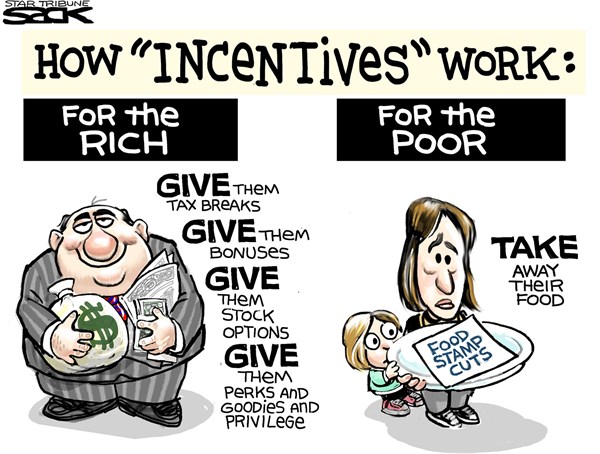
Saturday, September 21, 2013
GOP, take heed: the millennial generation is more “liberal”
..................................................................................................................................
Millenials: A generation politicians shouldn’t take for granted
By Kailani Koenig-Muenster, September 21, 2013
The millennial generation came of age in what progressives see as a recipe for instilling left-leaning opinions: Dire economic circumstances, low wages, disappearing benefits, and empowerment over racial, sexual, and gender equality.
Peter Beinart’s recent column in The Daily Beast, “The Rise of the New Left,” touches on an idea that Democrats may want to hear: That the millennial generation is embodying and embracing being “liberal” and electing candidates like Elizabeth Warren and Bill De Blasio, politicians who made unabashedly “liberal” policies like regulating Wall Street and taxing the wealthy their campaign cornerstones.
“This is a generation that’s very much deeply invested in the principles of America: Equal access, equality, no matter what your background, no matter what your sexuality,” said Lehigh University professor James Peterson. “There’s a test here.”
But is this significant for the millennial generation, or is it about life cycle? Melissa Harris-Perry’s Saturday panelists looked at whether this assertion is real, or if the younger progressive political generation will shift more conservative as they grow older.
“We have come of age in a time of political and economic instability, and Barack Obama embodied our diversity,” said Valarie Kaur, a senior fellow at Auburn Seminary. Yet she continued, “We’ve seen those numbers of engaged political millenials decline since 2008.”
In 2008, 41% of millenials identified themselves as Democrats, while 22% identified themselves as Republicans, according to the Pew Research Center. But that’s actually less than the Boomers in 1974 and the Silent Generation in 1956.

“This is the story, right? That when you’re young you’re liberal. As you age and you pay more taxes you become more conservative,” said host Melissa Harris-Perry.
This generation is expected to grow as an overall voting block over the coming years. In 2016 and 2020, the Center for American Progress, a liberal think tank, estimates that they will encompass a third or more of the entire electorate.

But the panelists argued that it actually takes specific individuals in a specific environment to spur millennials to become inspired and actively engaged in policy. They say the bigger concern right now on the left for maintaining this generation’s trend isn’t necessarily about them growing more conservative, but becoming discouraged by ongoing political gridlock and disengaged from policy matters overall. De Blasio, of course, won a Democratic primary in blue New York City and Warren won her seat in blue state Massachusetts during a major election year.
“If millenials threaten not to show up, and we see this in off-year elections, we’re going to see this down the road,” said former Virginia congressman Tom Perriello. “Those Democrats are not going to win those races.”
..................................................................................................................................
Millenials: A generation politicians shouldn’t take for granted
By Kailani Koenig-Muenster, September 21, 2013
The millennial generation came of age in what progressives see as a recipe for instilling left-leaning opinions: Dire economic circumstances, low wages, disappearing benefits, and empowerment over racial, sexual, and gender equality.
Peter Beinart’s recent column in The Daily Beast, “The Rise of the New Left,” touches on an idea that Democrats may want to hear: That the millennial generation is embodying and embracing being “liberal” and electing candidates like Elizabeth Warren and Bill De Blasio, politicians who made unabashedly “liberal” policies like regulating Wall Street and taxing the wealthy their campaign cornerstones.
“This is a generation that’s very much deeply invested in the principles of America: Equal access, equality, no matter what your background, no matter what your sexuality,” said Lehigh University professor James Peterson. “There’s a test here.”
But is this significant for the millennial generation, or is it about life cycle? Melissa Harris-Perry’s Saturday panelists looked at whether this assertion is real, or if the younger progressive political generation will shift more conservative as they grow older.
“We have come of age in a time of political and economic instability, and Barack Obama embodied our diversity,” said Valarie Kaur, a senior fellow at Auburn Seminary. Yet she continued, “We’ve seen those numbers of engaged political millenials decline since 2008.”
In 2008, 41% of millenials identified themselves as Democrats, while 22% identified themselves as Republicans, according to the Pew Research Center. But that’s actually less than the Boomers in 1974 and the Silent Generation in 1956.
“This is the story, right? That when you’re young you’re liberal. As you age and you pay more taxes you become more conservative,” said host Melissa Harris-Perry.
This generation is expected to grow as an overall voting block over the coming years. In 2016 and 2020, the Center for American Progress, a liberal think tank, estimates that they will encompass a third or more of the entire electorate.
But the panelists argued that it actually takes specific individuals in a specific environment to spur millennials to become inspired and actively engaged in policy. They say the bigger concern right now on the left for maintaining this generation’s trend isn’t necessarily about them growing more conservative, but becoming discouraged by ongoing political gridlock and disengaged from policy matters overall. De Blasio, of course, won a Democratic primary in blue New York City and Warren won her seat in blue state Massachusetts during a major election year.
“If millenials threaten not to show up, and we see this in off-year elections, we’re going to see this down the road,” said former Virginia congressman Tom Perriello. “Those Democrats are not going to win those races.”
..................................................................................................................................
No matter how you calculate it, I think it's safe to say that many of us here feel a whole lot poorer than we used to
New Way of Calculating Poverty Rate Faces Hurdles
By Carl Bialik, September 20, 2013
The official U.S. poverty measure, which turns 50 this year, isn't aging gracefully, economists say. But for reasons ranging from the practical to the political, it likely won't be changed or replaced soon.
The poverty line, devised by Social Security Administration economist Mollie Orshansky in 1963, was a sensible, essential piece of President Lyndon B. Johnson's war on poverty, economists say. Today, it falls short. It fails to account for noncash benefits such as food stamps; for changing expenditure patterns that have shifted the poor's burden from food to medical expenses and housing; and for regional variation that makes a dollar go further in the rural South than, say, in New York.

The poverty line's inadequacy is a rare point of agreement among economists in academia and at left- and right-leaning think tanks. "There is pretty much unanimous agreement across the ideological spectrum that the current measure of poverty is inadequate," said Michael D. Tanner, senior fellow at the libertarian Cato Institute. "Unfortunately there is far less agreement on how to do a better one."
Ms. Orshansky's poverty calculation involved two steps: calculating the cost of the cheapest sustainable diet; and multiplying that by a set number for each household type—three, for families of three or more—on the assumption that food made up a fixed share of all costs for basic survival for each type of household.
The measure has been updated each year for inflation using the consumer-price index. But that's about all that has changed—including in this week's release of 2012 figures showing the poverty line for a family of four was $23,492, and that 15% of Americans were impoverished, statistically unchanged from a year earlier.
In 1995, economists and sociologists convened by the National Academy of Sciences made recommendations to replace the official gauge. The Census Bureau, which now reports the poverty rate, in 2011 launched a new measure based largely on those recommendations. The Supplemental Poverty Measure sets the poverty line at the level of expenditures on essential items at the 33rd percentile, meaning two-thirds of households spend more on such items. The gauge includes medical spending, and is calculated by region. For 2011, the new measure showed a poverty rate of 16.1%.
Many economists applauded this step. But the supplemental measure remains supplemental, and experimental. It also has been overshadowed, since Census typically doesn't release these stats until at least 1.5 months after the official data.
Trudi Renwick, chief of poverty statistics at Census, said it was never meant to replace the official gauge, which has some advantages, such as simplicity and the continuity of data going back to 1959. The SPM can only be calculated back to 2009. Census surveys before then lacked some questions needed to calculate the SPM.
Some researchers have other objections to the SPM, such as how it accounts for medical expenses. But political obstacles may matter more. "There are more people who are poor under this measure" than by the official gauge, said David M. Betson, a University of Notre Dame economist. "Obviously that is a political problem."
Some local governments have taken the hit of a higher poverty number. In 2008, New York City released its own gauge, filling gaps in national data using local numbers and statistical models. This didn't paint a pretty picture of the city's economy, with 23% of residents poor in 2006 in initial estimates, against 18% by the official measure.
While the higher numbers initially may have reflected poorly on New York, the city's move has paid dividends. It has allowed the city to tout positive effects on poverty from programs it implemented after the new gauge was launched. Researchers have developed measures for other states, such as Wisconsin and California.
New York City and other high-cost areas could benefit from getting attention for their measures if it leads to change on a national level. A new poverty measure that reflects regional variation, used to determine eligibility for benefits, would mean a bigger share of dollars from federal programs.
Kristin Morse, executive director of New York's Center for Economic Opportunity, which produces the city's numbers, said that "just wasn't the motivation" behind the new gauge.
It isn't only certain regions, but also some segments of the population, that stand to gain or lose if the national measure is overhauled. Seniors, for example, would see higher poverty rates because the new gauge takes medical expenses into account. "There will be winners and losers and thus the politics of this are not inconsequential," said Hilary Hoynes, a University of California, Berkeley, economist.
..................................................................................................................................
The GOP had better believe that we see their disunity and know that they don't have any leverage
..................................................................................................................................
Sen. Paul says GOP 'probably can't defeat or get rid' of Obamacare
By Marisa Schultz and Nolan Finley, September 21, 2013
..................................................................................................................................
Sen. Paul says GOP 'probably can't defeat or get rid' of Obamacare
By Marisa Schultz and Nolan Finley, September 21, 2013
U.S. Sen. Rand Paul, a libertarian leader and potential presidential contender, said Saturday Republicans likely have lost the battle on repealing Obamacare and should focus on improving the president’s signature health care law.
Paul struck a tone of realism Saturday — a day after the U.S. House voted for the 42nd time to derail the Affordable Care Act. The latest effort was a condition of funding federal operations past Sept. 30 or risking a government shutdown.
“I’m acknowledging that we probably can’t defeat or get rid of Obamacare but by starting with our position of not funding it maybe we get to a position where we make it less bad,” Paul, R-Ky., told reporters at the Mackinac Republican Leadership Conference.
Later in the evening in a keynote address that capped off the GOP confab, Paul avoided much talk about Obamacare and outlined the principles of the liberty movement his father, Ron Paul, launched and the younger now is preaching around the country to attract new diverse faces to the GOP.
Paul, who famously staged a 13-hour filibuster on the Senate floor in protest of drone strikes, spoke out against indefinite detentions and mandatory minimum sentences for drug crimes. On spending, Paul said the $85 billion in automatic cutbacks that kicked in this year was the right fiscal move.
“We aren’t winning every legislative battle, but on the sequester we won one,” Paul said of the budget rollbacks Democrats and the president want to restore for its reductions to Head Start, unemployment aid and senior nutrition programs.
Paul, an ophthalmologist who won the U.S. Senate seat in 2010, rattled off a list of programs he deemed wasteful, including $8 million to Fargo, North Dakota for Homeland Security. “If the terrorists get to Fargo we might as well just surrender.”
Paul, son of former presidential candidate Ron Paul, came to the island to address about 1,500 Republicans here on appealing to a broader swath of America. Paul said the party gave up on African American voters 30 years ago and needs to show up at all venues and try harder.
Paul said justice, civil liberty and less aggressive foreign policy platforms can appeal to more voters.
“Liberty issues ... will bring more people to the party,” said Paul, who testified before the Senate this week on eliminating mandatory minimum prison sentences he says disproportionately affect African Americans.
As for Obamacare, Paul says the GOP are united about defunding it because their constituents are universally urging them to. But there needs to be agreement on strategy.
“Because Democrats perceive disunity, our leverage doesn't really work,” Paul said. “Leverage doesn't work unless people believe you'll actually do something. The fact that Democrats don't believe we'll do anything, in the end they'll get what they want and a bill will be cobbled together.”
The Democratic-led Senate will take up the defunding legislation next week. President Obama has threatened to veto the plan and the Senate is expected to strip out offending Obamacare provisions and send a clean version back the the U.S. House.
Had the U.S. House leadership pushed the strategy three months ago, perhaps the different House and Senate versions could be hashed out in a conference committee and result in compromise on improving Obamacare, Paul said. But with a week left before the government runs out of money, Paul says lawmakers shouldn’t shut down the government over this issue.
“In the end the sausage factory in Washington will make sausage,” Paul told The News. “Nothing good will happen though. They'll pass a continuing resolution. When they do that though, they're acknowledging that we're borrowing $30,000 a second and I think that's unconscionable.”
[snipped]
We've been telling you that it isn't a "great plan"!
..................................................................................................................................
Ted Cruz, Liberal Hero, May Have Just Bailed Washington Out Of The Shutdown Crisis
By Ryan Grim and Sabrina Siddiqui, September 20, 2013
In one moment, with one statement, Sen. Ted Cruz (R-Texas) managed Wednesday to accomplish what House GOP leaders, Republican senators and the Wall Street Journal editorial page had failed to do for months: Persuade rank-and-file House Republicans that shutting down the government in an attempt to defund Obamacare was simply impossible.
On Wednesday, after House leaders said they'd go forward with the defund strategy Cruz had been pitching with ads on Fox News, his response boiled down to 'Thanks, you're on your own.'
"Harry Reid will no doubt try to strip the defund language from the continuing resolution, and right now he likely has the votes to do so," Cruz said in a statement. "At that point, House Republicans must stand firm, hold their ground, and continue to listen to the American people."
On the surface, House Republicans were seething. Members openly accused Cruz and his allies, Sens. Mike Lee (R-Utah) and Marco Rubio (R-Fla.), of waving the white flag before the fight had even begun. One House GOP aide even called Cruz a "joke, plain and simple."
But by admitting that he had no ability in the Senate to back up the House effort to defund Obamacare, and saying so on the same day that House Republicans had announced they would support the Cruz-inspired strategy, Cruz has inadvertently done more than any other lawmaker to avert a government shutdown.
"Cruz officially jumped the shark this week," said one GOP operative allied with House leadership, who, like others, requested anonymity to speak critically about fellow Republicans. "He's doing for the House Leaders what they couldn't do for themselves. House rank-and-file members are uniting with Boehner, Cantor over Ted Cruz's idiotic position."
The retreat by Cruz has led to public questioning from House Republicans about his motives and political acumen, not to mention joking speculation that he may be part of a vast and devious liberal conspiracy to undermine conservatives.
"Cruz is the leader of a secret cabal of leftists that are seeking control of the conservative movement," quipped one senior House Republican leadership source. "Their aim is to force the party to take on suicidal missions to destroy the movement from within."
Another senior House GOP aide was grateful that Cruz had made plain what House leaders had been arguing for weeks -- that there was no viable strategy connected to a government shutdown that would defund Obamacare. "We can only defund Obamacare if it passes the Senate," the aide said. "If there is no plan to get the defunding provision passed in the Senate, or even a plan to fight to get it passed in the Senate, then what we’re talking about isn’t a plan to defund Obamacare -- it’s just a plan to shut down the government and hope for the best. That’s not a great plan."
That Cruz was left without any strategy at all, after demanding for months that Republicans follow his lead, feeds into the notion that the tea party is rooted more in political nihilism than any particular ethos, an argument Walter Sobchak would appreciate.

When asked by HuffPost Thursday to respond to his Republican critics in the House, Cruz said, "I salute the House Republicans for their fight on this." He added, "The House of Representatives, where Republicans have the majority -- the House has to drive this process."
He also thanked House leadership for their work on Wednesday, in an appearance on Fox News' "Hannity." With Lee by his side, Cruz pledged to continue the fight, likened himself to Winston Churchill, and noticeably put the onus to defund Obamacare on Senate Majority Leader Harry Reid (D-Nev.) -- all with a straight face.
"As Churchill said, we will fight on the beaches, we will fight on the streets, we will fight at every step to stop the biggest job killer in America," Cruz said, adding later that "Harry Reid needs to listen to the American people just like John Boehner did."
For liberals, Cruz and the tea party have been the gift that keeps on giving. In both 2011 and 2012, tea party opposition staved off a "grand bargain" between Boehner and Obama that would have brought draconian cuts to Medicare and Social Security. In 2010 and again in 2012, the tea party pushed extreme Republicans through Senate primaries, where they subsequently lost winnable races in Delaware, Nevada, Colorado, Indiana and Missouri.
And they also brought Cruz to the Senate.
..................................................................................................................................
Ted Cruz, Liberal Hero, May Have Just Bailed Washington Out Of The Shutdown Crisis
By Ryan Grim and Sabrina Siddiqui, September 20, 2013
In one moment, with one statement, Sen. Ted Cruz (R-Texas) managed Wednesday to accomplish what House GOP leaders, Republican senators and the Wall Street Journal editorial page had failed to do for months: Persuade rank-and-file House Republicans that shutting down the government in an attempt to defund Obamacare was simply impossible.
On Wednesday, after House leaders said they'd go forward with the defund strategy Cruz had been pitching with ads on Fox News, his response boiled down to 'Thanks, you're on your own.'
"Harry Reid will no doubt try to strip the defund language from the continuing resolution, and right now he likely has the votes to do so," Cruz said in a statement. "At that point, House Republicans must stand firm, hold their ground, and continue to listen to the American people."
On the surface, House Republicans were seething. Members openly accused Cruz and his allies, Sens. Mike Lee (R-Utah) and Marco Rubio (R-Fla.), of waving the white flag before the fight had even begun. One House GOP aide even called Cruz a "joke, plain and simple."
But by admitting that he had no ability in the Senate to back up the House effort to defund Obamacare, and saying so on the same day that House Republicans had announced they would support the Cruz-inspired strategy, Cruz has inadvertently done more than any other lawmaker to avert a government shutdown.
"Cruz officially jumped the shark this week," said one GOP operative allied with House leadership, who, like others, requested anonymity to speak critically about fellow Republicans. "He's doing for the House Leaders what they couldn't do for themselves. House rank-and-file members are uniting with Boehner, Cantor over Ted Cruz's idiotic position."
The retreat by Cruz has led to public questioning from House Republicans about his motives and political acumen, not to mention joking speculation that he may be part of a vast and devious liberal conspiracy to undermine conservatives.
"Cruz is the leader of a secret cabal of leftists that are seeking control of the conservative movement," quipped one senior House Republican leadership source. "Their aim is to force the party to take on suicidal missions to destroy the movement from within."
Another senior House GOP aide was grateful that Cruz had made plain what House leaders had been arguing for weeks -- that there was no viable strategy connected to a government shutdown that would defund Obamacare. "We can only defund Obamacare if it passes the Senate," the aide said. "If there is no plan to get the defunding provision passed in the Senate, or even a plan to fight to get it passed in the Senate, then what we’re talking about isn’t a plan to defund Obamacare -- it’s just a plan to shut down the government and hope for the best. That’s not a great plan."
That Cruz was left without any strategy at all, after demanding for months that Republicans follow his lead, feeds into the notion that the tea party is rooted more in political nihilism than any particular ethos, an argument Walter Sobchak would appreciate.
When asked by HuffPost Thursday to respond to his Republican critics in the House, Cruz said, "I salute the House Republicans for their fight on this." He added, "The House of Representatives, where Republicans have the majority -- the House has to drive this process."
He also thanked House leadership for their work on Wednesday, in an appearance on Fox News' "Hannity." With Lee by his side, Cruz pledged to continue the fight, likened himself to Winston Churchill, and noticeably put the onus to defund Obamacare on Senate Majority Leader Harry Reid (D-Nev.) -- all with a straight face.
"As Churchill said, we will fight on the beaches, we will fight on the streets, we will fight at every step to stop the biggest job killer in America," Cruz said, adding later that "Harry Reid needs to listen to the American people just like John Boehner did."
For liberals, Cruz and the tea party have been the gift that keeps on giving. In both 2011 and 2012, tea party opposition staved off a "grand bargain" between Boehner and Obama that would have brought draconian cuts to Medicare and Social Security. In 2010 and again in 2012, the tea party pushed extreme Republicans through Senate primaries, where they subsequently lost winnable races in Delaware, Nevada, Colorado, Indiana and Missouri.
And they also brought Cruz to the Senate.
..................................................................................................................................
Subscribe to:
Posts (Atom)