To Participate on Thurstonblog

email yyyyyyyyyy58@gmail.com, provide profile information and we'll email your electronic membership


Monday, November 21, 2016

Judge Primomo, your attitude is not acceptable!

...................................................................................................................................................................
‘Go to another country’ if you don’t like Trump, judge tells new U.S. citizens
By Cleve R. Wootson Jr., November 21, 2016


The photographs and hugs and congratulations from family members would have to wait.

First, several dozen of the nation’s newest citizens who gathered at the Institute of Texan Cultures in San Antonio would have to endure some harsh words about the state of the country they had just become a part of. The topic: President-elect Donald Trump.

Federal Magistrate Judge John Primomo presided over the induction ceremony on Friday. In his speech to the émigrés, he touched on the protests that have cropped up across the nation since Trump’s election.

And he told those gathered what they could do if they didn’t like the person who won on Nov. 8.

“I can assure you that whether you voted for [Trump] or you did not vote for him, if you are a citizen of the United States, he is your president and he will be your president,” the judge said, according to CBS affiliate KHOU. “And if you do not like that, you need to go to another country.”

Primomo, who did not return messages from The Washington Post on Sunday, also criticized American protesters who carried signs saying, ‘He’s not my president,’ including some in San Antonio, according to the news station.

Primomo lashed out against NFL players such as Colin Kaepernick who choose to take a knee instead of standing during the national anthem.

“I detest that, because you can protest things that happen in this country; you have every right to,” Primomo said. “You don’t do that by offending national symbols like the national anthem and the flag of the United States.”

Primomo told San Antonio CBS affiliate KENS that he wanted his words to be unifying and respectful of the office of the president, not political or divisive. He said he didn’t vote for Trump.

Still, his words set off a controversy, with people calling for him to be removed from office. Critics started a petition on MoveOn.org to censure the judge, who was appointed in 1988.
19 Nov
 The Hill ✔ @thehill
Federal judge at citizenship ceremony: If you don't like Trump, then leave http://hill.cm/lAqVweW  pic.twitter.com/6dTxty9g3z
 BrighterDays @StevenBogarat
@thehill Primomo needs to be muzzled/pulled off the bench/stripped of his law license/big mouth judges=STFU
8:08 AM - 20 Nov 2016
 Eric Bost @EricOnTheTrail
#Primomo is incompetent and should be impeached. #notapatriot.http://www.huffingtonpost.com/entry/donald-trump-immigration_us_5830bac4e4b099512f833cf8?ncid=engmodushpmg00000004 …
8:16 AM - 20 Nov 2016
Judge Tells New Citizens They Can Leave The U.S. If They Don't Like Trump
“He will be your president and if you do not like that, you need to go to another country.”
huffingtonpost.com
Since Trump won, thousands of people have protested in dozens of American cities.

Among them were eight people who were arrested Saturday near Austin as White Lives Matter protesters clashed with counter-protesters, according to the Associated Press. The conflict happened after Texas Gov. Greg Abbott (R) dedicated a monument honoring African Americans’ contributions to the state.

Protesters interviewed by The Post have cited myriad reasons for taking to the streets — fears about climate change, even concerns about the electoral system and capitalism itself.

But mostly, they don’t like Trump.

The protesters have faced their own criticism from people who said they should be working to unite the country, not divide it.

According to The Post’s Abigail Hauslohner and Mark Berman, “Trump and his surrogates have insulted the protesters on television and social media, calling them paid professionals ‘incited by the media,’ jobless ‘crybabies,’ people with mental disorders and ‘goons.’ ”
...................................................................................................................................................................


"And since Trump isn’t actually relinquishing control of his businesses, all of this means that rather than sacrifice, Trump is poised to use the presidency for his personal profit. ... The only solution? Actual divestment from his business ..."

...................................................................................................................................................................
Trump spokeswoman says Americans should ignore conflicts-of-interest, focus on Trump’s ‘sacrifice’
In his first week as president-elect, Trump used his new position to bolster his business interests
By Laurel Raymond, November 21, 2016

Kellyanne Conway, a Senior Advisor to President-elect Trump, said people should focus less on Trump’s conflict-of-interest and more on the “sacrifice” he’s making to his business career by becoming president.

Trump, however, doesn’t seem to be ready to sacrifice anything.

At the tail-end of her interview on Fox & Friends Monday morning, host Brian Kilmeade asked Conway whether she agreed that the Trumps “have to work out where the business starts and the presidency starts.” Trump’s web of business investments, hotel properties and dealings with foreign investors “will create conflicts of interest of unprecedented magnitude,” according to an open letter from a group of open-government watchdogs.

Conway waived off the concerns on Monday.

“Oh well sure. But they are doing that…they have experts behind the scenes doing that, the adult children who already help him run that business and who obviously will be the stewards in their father’s absence are on top of that” Conway said.

“It’s a unique situation to have such a successful a businessman that has so many holdings ascend to the oval office. But I also want people to see what a sacrifice it is. He has invested tens of millions of dollars and other deals have had to wait, because he’s doing this. But his adult children are right there, they’re already his colleagues, he’s already been their mentor and they’re already chief executives there.”

Unlike previous presidents, who have placed their assets in index funds or a blind trust, Trump has done nothing to separate himself from his business interests as he assumes control of the government. He’s previously said he would turn his businesses over to his children.

Trump has referred to this arrangement as a “blind trust” but it’s actually the opposite. In a real blind trust, in a neutral party takes control of marketable assets. Because the administrator can trade these assets away at anytime, the contents of the trust are soon unknown.

Trump, however, knows what his assets are, and says he’s giving them to his children — hardly a neutral party. As Conway say, he has been their mentor — and not only are they his business colleagues, he’s made them part of his transition as well.

Trump gave his children — supposedly the new stewards of his personal empire — high-profile positions on his transition team. The same people shaping his administration are also the ones leading his business empire. And he’s not hiding this web of conflicts — instead the Trump team is flaunting it.

On November 17th, the Trump team handed out a photograph of Ivanka Trump, likely the new CEO of the Trump empire, sitting in on a diplomatic meeting with the Prime Minister of Japan. The photograph sends a message to Trump’s business cohort: Dealing with Ivanka is dealing with someone who has the power of the American presidency behind her.

And foreign diplomats — and the Trump businesses — have taken note. On Friday, The Washington Post reported that over 100 foreign diplomats gathered at Trump’s new downtown DC hotel to listen to sales pitches and admire the new accommodations. Some of them told the Post that it was an explicit attempt to curry favor with the President-Elect.

Nor has Trump himself stopped his business dealings. Last week, Trump met with three Indian businessmen who are building a Trump-branded luxury apartment complex. The men told Indian media that they discussed expanding their partnership with the Trump organization now that Trump will be the next American president.

Like many of Trump’s business ventures, his involvement in the deal in India is one of branding: For a fee, he lets other developers use his name. Now that he’s President, that name is likely even more valuable.

And since Trump isn’t actually relinquishing control of his businesses, all of this means that rather than sacrifice, Trump is poised to use the presidency for his personal profit.

That’s a huge problem — both for free Democracy, and for the constitution. According to an exclusive ThinkProgress interview with Richard Painter, George W. Bush’s ethics lawyer, Trump is headed for a major violation of the constitution on his first day in office.

The only solution? Actual divestment from his business, said Painter.
...................................................................................................................................................................

Sunday, November 20, 2016

Bad bird!

................................................................................................................................
cf6_kkk-bold-eagle_01_web

"'When he's opposed to our values, we're going to go after him tooth and nail,' Schumer said." We need to back Schumer!

...................................................................................................................................................................
Chuck Schumer Says Donald Trump's Victory Is 'Not a Mandate'
By Ryan Struyk, November 20, 2016

Incoming Sen. Minority Leader Chuck Schumer says that President-elect Donald Trump's victory is "not a mandate," vowing to oppose the policy agenda of the Republican-controlled White House and Congress where he and his fellow Democrats disagree.

"What Trump talked about was against the establishment of both parties," the New York Democrat told "This Week" co-anchor Martha Raddatz. "As you know, Democrats got a majority of the popular vote, Hillary [Clinton] did."

Although Trump won the election by clinching more than 270 Electoral College votes, the most recent tallies show Hillary Clinton garnered more than 1.5 million votes than Trump in the nationwide popular vote.

"When he's opposed to our values, we're going to go after him tooth and nail," Schumer said. "For instance, we're not going to let him repeal Dodd-Frank or the rules we’ve put in place to limit Wall Street," he said, referring to the 2010 law passed in the wake of the financial crisis that enacted sweeping changes to the regulation of the financial industry.

"They’re going to regret the day they try to repeal the [Affordable Care Act]," Schumer added. "So when we oppose Trump on values or this presidency takes a dark divisive turn, we're going to do it tooth and nail."

For the first time in a decade, Republicans control the White House and hold a majority in both chambers of Congress, handing them broad power to enact their agenda as long as their party's members stick together.

"Once you lose an election like that, you look it straight in the eye. You don't flinch. You don't blink and you try to examine what you did wrong," he said. "We did not have a strong, bold economic message. We sort of nibbled around the edges -- and not just a message but a platform."

Schumer also pledged to block Trump's pick for the Supreme Court if the pick is too far out of the mainstream. Under current Senate rules, a Supreme Court nominee needs 60 of the 100 votes in order to clear the necessary hurdles for nomination -- meaning Republicans will need at least some Democratic support.

"For the Supreme Court, you need a mainstream nominee," he said. "I hope that President Trump, when he becomes president, will nominate someone who might garner bipartisan support, who might be in that mainstream. If the opponent is way out of the mainstream, I think we’ll oppose that person tooth and nail."
...................................................................................................................................................................

"... abolishing the Electoral College would be high on the Republicans list had they lost in a similar fashion."

...................................................................................................................................................................
Blaming The Electoral College Oversimplifies The Problem
By Byron Williams, November 20, 2016

Can you name the only two presidents who have won the popular vote in three consecutive elections?

The first and most obvious would be Franklin Roosevelt, who won four consecutive elections between 1932-1944. The other would be Grover Cleveland, who accomplished this feat between 1884-1892.

The glaring difference between the two: Cleveland lost his 1988 reelection bid to Benjamin Harrison, but won the popular vote. Therefore, Cleveland has the historical distinction of being the 22nd and 24th president, and was also the last person to win the popular vote but lose an election for 112 years.

Winning the presidential election without winning the popular vote has only occurred five times in the nation’s history. It did not happen at all in the 20th century, but we’ve witnessed this phenomenon twice in the 21st century.

Democrats have won the popular vote four out of five times this century, but have lost three of the five elections.

It does appear that Hillary Clinton’s margin over Donald Trump may be the largest over any candidate who failed to win. But that’s good for trivia questions and moral victories.

Here are Clinton’s thoughts on the Electoral College after she was elected to the Senate in 2000: “We are a very different country than we were 200 years ago. I believe strongly that in a democracy, we should respect the will of the people and to me, that means it’s time to do away with the Electoral College and move to the popular election of our president.”

There’s no doubt the current system is flawed. As Robert Speel, associate professor at Penn State University, recently pointed out in a Time Magazine article, Trump’s margin of victory in Pennsylvania and Florida was roughly a combined 200,000 votes, which garnered 49 electoral votes in the current winner-take-all system. Conversely, Clinton won Massachusetts by nearly one million votes, and won 11 electoral votes.

Sen. Barbara Boxer (D-Calif.) introduced legislation last week to get rid of the Electoral College, after Clinton’s loss despite leading in the popular vote. This is a ceremonial exercise that will obviously go nowhere. I’m certain that abolishing the Electoral College would be high on the Republicans list had they lost in a similar fashion.

The problem I have with recent calls to abolish the Electoral College is that they come on the heels of defeat, making such appeals reactionary. I am usually suspect of reactionary proposals because they tend to possess an overreliance on a preferred outcome (In reaction to X, I am proposing Y so that Z will occur).

Did the problems that exist today with the Electoral College, exist in 2008? What about 2012?

Under the nom de plume, “Publius,” James Madison wrote in Federalist no. 10 that delegates distrusted the passions of the people. Madison and others questioned the ability of average voters to make a reasoned decision in electing a president. Are Madison’s contentions in 1787 applicable today?

The Electoral College in its present form is problematic, but to offer it as the reason Clinton lost is reactionary and shortsighted.

Clinton lost, in part, to the power of the Apathetic Party flexing its nihilistic muscles. At the time of this writing, according to CNN, 26.3 percent of eligible voters supported Trump, while 26.5 voted for Clinton. It marked the lowest voter turnout in 20 years.

American democracy cannot survive if it continues on this declining path of sub-60 percent voter turnout. And quite frankly, that is unacceptable. Both Clinton and Trump received fewer votes than Mitt Romney, who lost to President Obama in 2012. Even Obama’s historic election in 2008 garnered only 33 percent of the voting populace.

How does America address the growing decline in voter participation? Or is it a problem that warrants consideration?

Paul Weyrich, co-founder of the Heritage Foundation, stated in 1980: “I don’t want everybody to vote. Elections are not won by a majority of people, they never have been from the beginning of our country and they are not now. As a matter of fact, our leverage in the elections quite candidly goes up as the voting populace goes down.”

When Weyrich says “our leverage,” he was speaking specifically about the ability of conservatives to win elections. But he’s absolutely right in that American elections “are not won by a majority of people, they never have been from the beginning of our country.”

Though right about the past, are his sentiments in the best interest for a nation going forward still, at least on paper, in pursuit of that more perfect union?

Time will tell.
...................................................................................................................................................................

"The Trump brand stands to benefit mightily from his lofty new position." Yes, a "lofty new position" that is ill-gotten!

...................................................................................................................................................................
Trump’s not-so-blind trust fails ethical standards
Boston Globe Editorials, November 18, 2016

As a Presidential candidate, Donald Trump vilified the Clinton Foundation as a dark criminal enterprise. No quid pro quo between any donation to the foundation and any official action taken by Hillary Clinton while she was secretary of state was ever established. But Trump told voters the Clinton Foundation’s acceptance of money from foreign leaders while Clinton served as America’s top diplomat represented pay-to-play corruption.

If that’s Trump’s definition of a corrupt enterprise, he seems about to create his own version. The president-elect has already named his children — Donald Jr., Eric, and Ivanka — to his transition team, and said he intends to rely upon them as advisors once he takes office. At the same time, he is putting his children in charge of the family’s vast business empire.

Want to get in good with the new president? Invest in Trump property or lend money to a Trump venture. The Trump brand stands to benefit mightily from his lofty new position. How many more suites will be booked at a Trump hotel or rounds played at a Trump golf course? How many more Trump shirts or ties — or Ivanka Trump bracelets — will be sold?

Indeed, one day after Trump’s daughter participated in a “60 Minutes” interview about her father’s election, The Washington Post reported that her jewelry line had started marketing the 18-karat diamond bangle she had been wearing during the show. A spokesperson for the Ivanka Trump brand told the Post the “style alert” notification about the bracelet “was sent by a well-intentioned marketing employee . . . who, like many of us, is still making adjustments post-election. We are proactively discussing new policies and procedures with all of our partners going forward.”

That should have been discussed long ago. During a presidential primary debate last January, Fox Business Network anchor Maria Bartiromo asked Trump how he planned to disentangle himself from his business interests, should he be elected president. “If I became president, I couldn’t care less about my company. It’s peanuts,” said Trump.

Pressed for details, he said, “I would put it in a blind trust — well, I don’t know if it’s a blind trust if Ivanka, Donald, and Eric run it.” Most modern presidents do put their business interests into a blind trust, to be administered by an independent manager.

What Trump plans to do isn’t blind. It isn’t even near-sighted. And he should not get away with it. It could end up looking a lot like the pay-to-play corruption he connected to the Clinton Foundation. On steroids.

Under current law, federal office holders are prohibited from engaging in government business where they could stand to profit. But the president and vice president are exempt. A bill filed by Massachusetts congresswoman Katherine Clark on Thursday would remove that exemption. As The New York Times and other publications have suggested, Trump should sell his holdings and put the proceeds into a truly blind trust, to be managed by an independent trustee. He should — finally — produce his tax returns and disclose all his business partners and ties to foreign governments. So far, there’s no indication he will do any of that. He’s exempting himself from the corruption standard he applied so relentlessly to Clinton.
...................................................................................................................................................................

Saturday, November 19, 2016

Stands to reason....

...................................................................................................................................


"One of the most confounding American qualities is our capacity to lie to ourselves about where things come from, or why that might matter today."

...................................................................................................................................................................
The electoral college and its racist roots
By Stephen Henderson, November 19, 2016

There’s a book on my shelf called “Negro President,” by historian Garry Wills.

It’s about Thomas Jefferson. That’s what some of Jefferson's critics called him after his election in 1800.

Why?

Because his ascent to the presidency was powered, as one Boston newspaper put it, by a half-million slaves who had no more say in the election of 1800 than “New England horses, cows and oxen.”

The slaves counted for electoral purposes — each was good for 3/5 of a person in determining how many representatives each state had in Congress, and thus what power that state wielded in the electoral college.

But of course, slaves had no rights, and couldn’t vote. Their “will” was expressed by their owners.

Jefferson got 14 Electoral College votes that were apportioned to Southern states based on their slave populations. That margin put Jefferson over the top, and led to him, a slaveholder, being ridiculed as a “black” president.

Slavery, at that moment, defined the balance of power in the Electoral College and in the nation. It would do so for James Madison’s election, for James Monroe's, and for those of several other presidents before 1860.

The origins of inequality

One of the most confounding American qualities is our capacity to lie to ourselves about where things come from, or why that might matter today.

We’re really comfortable pretending that this nation’s most admirable ideals — especially the democracy that undergirds our system of government — is about freedom and liberty, and nothing else.

But of course, history intrudes, like a pest tapping you repeatedly on the shoulder, sometimes kicking you in the backside. And uncomfortable truths insist on rearing their heads, especially when it comes to the history of our democratic institutions.

The Electoral College is one of those institutions.

Its roots — and its profound influence on America's earliest presidential elections — sprouted from the South's determination to preserve its political power and the institution of slavery.

Southern states, outnumbered about 60-40 in population at the time of the Constitutional Convention, were panicked at the notion of a popularly elected president. They joined forces with other interests — those who wanted balance between large and small states, elites who feared popular ignorance, those who worried about urban domination of rural places — to design the Electoral College.

Slavery wasn’t the only impetus to dislodge popular democracy. But it was an important factor whose influence played out in dramatic ways in early America.

That history matters today, because it places the Electoral College pretty firmly along the spectrum of America’s struggle with inequality.

This is an institution that was born, in part, of a desire to preserve black oppression. (It also finds some roots in the elitism that looked down on less-educated popular voters.)

And so when we think about it, and especially if we think about changing it, we ought to have that inequality front of mind.

Balancing past and present

Politically, I respect some of the other, less racially freighted arguments for preserving the Electoral College, or some other mechanism to leaven the majority's unrestrained will.

We ought to worry about large, urban states marginalizing small rural ones. One of the most powerful ideas behind a constitutional republic is the check on naked majoritarian will, especially where it might smother the interests or rights of significant minority populations.

But we also ought to recognize how the very bigotry and extreme partisanship that gave rise to the Electoral College plays out today, in anti-majoritarian ways.

For a century after the end of the Civil War, for instance, Southern states enacted laws that prohibited or illegally discouraged black voting, reserving the South's electoral power for the purposes of white voters.

Now that black voting is finally expanding in the South, we see express efforts to suppress it. North Carolina legislators were smacked down by the federal judiciary this year for adopting voting restrictions that were expressly designed to disadvantage black voters.

Or think of the partisan gerrymandering that takes place in states like Michigan, which is designed, in part, to blunt the electoral power of minority voters (who tend to be Democrats) in places like Detroit.

In last week’s congressional elections, for instance, Democratic votes outnumbered Republican ones by a narrow margin. But because Republicans drew the congressional map, they were still able to maintain a 9-5 advantage.

If we’re going to talk about Electoral College reform, it can’t take place outside the context of the other anti-democratic dynamics that play out in electoral politics. Is there a balance that can be struck that makes things fairer?

Maybe.

We ought to be willing to indulge the conversation. We ought to be open to thinking through alternatives to the Electoral College.

But the path to a just result leads through our past — and an honest reckoning of how it matters today. Our penchant for deflection, for fantasies that feel good but crumble under the irrefutable weight of historical fact, is what stands in our way.
...................................................................................................................................................................

"... the President-elect's grasp of such matters was, as the debates had made plain, modest at best." Well, damn, are we surprised about that?

...................................................................................................................................................................
Trump was 'awed' when Obama told him what he would have to handle as president
By Mark Abadi, November 17, 2016

A new profile on President Barack Obama gives more detail on Donald Trump's apparent lack of familiarity with the scope of the presidency.

The Wall Street Journal previously cited sources saying that during Trump's private meeting with Obama last week, the president-elect was surprised by the wide range of the president's job.

New Yorker editor David Remnick described some of the topics the two covered, as explained to him by some of Obama's staff members:

"Obama told staff members that he had talked Trump through the rudiments of forming a cabinet and policies, including the Iran nuclear deal, counter-terrorism policy, health care — and that the President-elect's grasp of such matters was, as the debates had made plain, modest at best. Trump, despite his habitual bluster, seemed awed by what he was being told and about to encounter."

Despite Trump's apparent "loose grasp of policy," Remnick wrote, Obama and his team made sure to respect the traditional etiquette displayed during a presidential transition — in part to preserve a shot at influencing Trump in the future, Remnick said.

Denis McDonough, the White House chief of staff, also painted a less-than-rosy picture of the Trump transition effort. On the day after Election Day, he reportedly chatted with the person Trump sent to learn how to staff and run the White House — Trump's son-in-law, Jared Kushner.

"Everything's great!" McDonough told The New Yorker, evidently with a struggle:
"He clenched his teeth and grinned harder in self-mockery. McDonough is the picture of rectitude: the ramrod posture, the trimmed white hair, the ashen mien of a bishop who has missed two meals in a row. "I guess if you keep repeating it, it's like a mantra, and it will be O.K. 'Everything will be O.K., everything will be O.K.'"
Read the full New Yorker profile here.
...................................................................................................................................................................
"So, yes, having Trump's children so close to his presidency is already ethically and legally questionable." However, does #TruthlessTrump have any ethics?

...................................................................................................................................................................
Why Donald Trump’s family being in the White House is problematic, explained
By Aaron Blake, November 18, 2016

In case there was any doubt, the last 24 hours have sealed it: Donald Trump's family will play a big role in his presidency, if they have anything to say about it.

That's problematic for a host of reasons. But the Trumps appear primed to press the envelope of what's legal and ethical in the new administration.

Trump's daughter Ivanka and her husband, Jared Kushner, appeared in photos of the president-elect's meeting with Japanese Prime Minister Shinzo Abe on Thursday. And the New York Times is reporting that Kushner may test the legal bounds of what he's allowed and attempt to join the Trump administration.

The revelations follow a series of controversies involving Trump's family over the past week. First, Trump's lawyer said that the president-elect's fortune would be put in the hands of his three oldest children -- Donald Jr., Ivanka and Eric Trump. The following day, all three were named to Trump's transition team, helping him pick who will run his administration. Then it was reported that the high-level security clearances were being sought for those three children and Trump's son-in-law -- something the Trump campaign eventually denied.

The first move was already questionable, since it's customary for wealthy politicians like Trump to set up true blind trusts in which they have no real control over their fortunes and don't know how the decisions they make might enrich themselves. And just about everything since then suggests there will be no real firewall between Trump's presidency and his kids; if anything, they might be more involved than we previously thought and certainly more involved than just about any previous presidential children.

Even if Kushner is the only one to technically join the administration -- and it remains an open question of whether he can -- the presence of Trump's children on his transition team and at a high-profile meeting with top world leaders shows just how Trump plans to involve his family in his presidency.

But why is all of this a big deal in the first place? Why wouldn't family members of politicians be allowed to serve in their administrations or take meetings with world leaders?

It traces back to the Kennedys. After President John F. Kennedy appointed his 35-year-old brother, Robert, as attorney general -- a basically unprecedented move at the time, involving an office for which few thought the younger Kennedy was qualified -- Congress in 1967 passed an anti-nepotism law. It reads:
A public official may not appoint, employ, promote, advance, or advocate for appointment, employment, promotion, or advancement, in or to a civilian position in the agency in which he is serving or over which he exercises jurisdiction or control any individual who is a relative of the public official.
But it's not completely clear whether this law applies specifically to White House staff. In other words, Kushner certainly couldn't be a Cabinet secretary, but the Trump team seems to think he could be an adviser. And the possible precedent for that traces back to another famous political family: the Clintons.

When President Bill Clinton appointed his wife, Hillary, to head up his health-care efforts, the couple was sued. It wasn't that the filers wanted to nail the Clintons for nepotism, but given that she could not be an official government employee under the law, they argued that the meeting of her health-care task force should be open to the public.

The appeals court decision that resulted might have given Kushner and Trump hope to get around the law in 2016, though some experts are dubious. Here's the passage from D.C. Circuit Court Judge Laurence Silberman, which was joined in by Judge Stephen Williams:
...We doubt that Congress intended to include the White House or the Executive Office of the President. ... So, for example, a President would be barred from appointing his brother as Attorney General, but perhaps not as a White House special assistant. ... The anti-nepotism statute, moreover, may well bar appointment only to paid positions in government. ... Thus, even if it would prevent the President from putting his spouse on the federal payroll, it does not preclude his spouse from aiding the President in the performance of his duties.
In keeping with this ruling, the New York Times reports that a lawyer whom Kushner has consulted with suggested he forgo a paycheck and put his own holdings into a blind trust.

Granting for the moment that Trump can shoehorn his son-in-law into the White House, though, there remains the question of his proximity to Trump's finances. Trump is already taking heat for not using a true blind trust; the Wall Street Journal editorial board said Friday that he should liquidate his assets and put the cash proceeds in a true blind trust, if only in the name of putting the controversy to rest. As a White House staffer, Kushner would be deeply involved in the decisions that would affect the finances of the Trump Organization that his wife is running.

One could argue that the Trump kids serving on the transition team doesn't give them direct control over the levers of government that could affect their fortune. But Kushner would have access to those levers and have potential knowledge of Trump's fortune that Trump himself is not supposed to have. And Ivanka Trump sitting in on meetings with high-profile world leaders only compounds the possible conflicts of interest.

So, yes, having Trump's children so close to his presidency is already ethically and legally questionable. And tasking them with controlling his fortune while he's in office and potentially giving one of their spouses an official role in his presidency makes all of this very dicey.

But Trump seems to be ignoring the doubters and pressing forward. We'll see how far he can take it.
...................................................................................................................................................................

Friday, November 18, 2016

That was a poor promise.

.......................................................................................................................................


" In other words, this bill is a solution to a non-existent and undocumented problem." That's pretty common in GOP administrations.

...................................................................................................................................................................
The So-Called ‘Midnight Rules Relief Act’ Is A Sweeping GOP Bill That Addresses A Non-Existent Problem
By Rep. Hank Johnson, November 18, 2016

This week, the House GOP passed H.R. 5982, the so-called “Midnight Rules Relief Act.” In short, this is a sweeping measure that dramatically expands the ability of Congress to summarily disapprove rules submitted to it under the Congressional Review Act (CRA) during the last six months of an outgoing presidential administration.

It represents yet another unfounded and reckless attempt to prevent the implementation of critical laws by federal agencies.

H.R. 5982 would amend the Congressional Review Act to enable Congress to bundle numerous rules finalized during the final year of a president’s term into a single vote on a joint resolution of disapproval.

Alarmingly, once these rules have been invalidated through this process, the agency may not adopt a subsequent similar rule absent express authorization by Congress.

Notwithstanding the bill’s colorful title, the bill does not simply apply to rules submitted during the lame-duck period following an election.

To set the record straight, this bill applies to every rule submitted to Congress within the final 60 legislative days of a session.

As the non-partisan Congressional Research Service (CRS) has clarified, this would include rules submitted as early as May 2016.

Eight months should be adequate time for Congress to consider the merits of economically significant rules, which often take years to finalize.

Indeed, according to the nonpartisan Administrative Conference of the United States (ACUS), many of these rules adopted between an election and the inauguration of a new president involve “relatively routine matters not implicating new policy initiatives by incumbent administrations.”

Public Citizen similarly found in a report issued earlier this year that rules adopted during the final months of an administration take 3.6 years on average to finalize.

In other words, this bill is a solution to a non-existent and undocumented problem.

But according to my Republican colleagues, this legislation is necessary to combat politically-driven midnight rules in the final days of an administration. They also say that the Obama administration’s regulatory agenda has eroded job growth and economic prosperity.

Far from it, under President Obama’s leadership, we have seen the longest consecutive streak of private job creation, the fastest-growing middle class income ever, and more high-quality and affordable healthcare for working Americans.

Recently, the Census Bureau released new data indicating that in 2015, the median household income grew at the fastest rate on record, while the poverty rate fell at a faster rate than at any point since 1968.

New data from the American Community Survey likewise indicates that the number of uninsured Americans is declining in nearly every state.

These metrics reflect a strong record of progress as Federal agencies implement laws like the Dodd-Frank Act and Affordable Care Act.

If anything, we need new laws to ensure corporate accountability and stronger enforcement of the laws already on the books.
...................................................................................................................................................................

"Asked whether he sees any hypocrisy in Trump supporters gloating over Unionwear’s bankruptcy, Cahn paused and said 'No.'" Well, we think so!

...................................................................................................................................................................
Trump Supporters Are Celebrating An American Manufacturer Going Bankrupt
By Alexander C. Kaufman, November 18, 2016

A U.S.-based mom-and-pop manufacturer known for paying its workers well has declared bankruptcy.

Oddly, some fans of President-elect Donald Trump ― whose professed economic populism and repeated pledges to revitalize U.S. manufacturing helped him score a surprise election victory ― seem delighted.

Twitter users, some bearing frog emojis that allude to a cartoon that came to symbolize white nationalism, began tweeting a link to a Wall Street Journal story about the bankruptcy Friday.

That’s because Unionwear, which is based in Newark, New Jersey, made the red “Make Donald Drumpf Again” hats ― a parody inspired by a segment from comedian John Oliver’s HBO show “Last Week Tonight.”
 James Steed @James_May_Not
Gooooood morning, Twitteratti. Coffee tastes amazing this morning for some reason. http://blogs.wsj.com/washwire/2016/11/18/manufacturer-of-make-donald-drumpf-again-parody-hats-files-for-bankruptcy/ …
12:20 PM - 18 Nov 2016
Photo published for Manufacturer of ‘Make Donald Drumpf Again’ Parody Hats Files for Bankruptcy
Manufacturer of ‘Make Donald Drumpf Again’ Parody Hats Files for Bankruptcy.  blogs.wsj.com
 Başkan @OttomanZealot
There are consequences if you try to stump the Trump. This guy learned the hard way http://blogs.wsj.com/washwire/2016/11/18/manufacturer-of-make-donald-drumpf-again-parody-hats-files-for-bankruptcy/ …
11:42 AM - 18 Nov 2016
Photo published for Manufacturer of ‘Make Donald Drumpf Again’ Parody Hats Files for Bankruptcy
Manufacturer of ‘Make Donald Drumpf Again’ Parody Hats Files for Bankruptcy.  blogs.wsj.com
 gab: @Borzoi @BorzoiKosh
Apparently you can't turn much of a profit on smug, self-satisfied snarky liberalism http://blogs.wsj.com/washwire/2016/11/18/manufacturer-of-make-donald-drumpf-again-parody-hats-files-for-bankruptcy/ …
12:13 PM - 18 Nov 2016
Photo published for Manufacturer of ‘Make Donald Drumpf Again’ Parody Hats Files for Bankruptcy
Manufacturer of ‘Make Donald Drumpf Again’ Parody Hats Files for Bankruptcy.  blogs.wsj.com
 The Right Remarks @TheRightRemarks
Starting to get tired of winning so much... NOT! hehe http://blogs.wsj.com/washwire/2016/11/18/manufacturer-of-make-donald-drumpf-again-parody-hats-files-for-bankruptcy/ …
12:15 PM - 18 Nov 2016
Photo published for Manufacturer of ‘Make Donald Drumpf Again’ Parody Hats Files for Bankruptcy
Manufacturer of ‘Make Donald Drumpf Again’ Parody Hats Files for Bankruptcy.  blogs.wsj.com
 Deplorable Nikolai   @Nikolai03
Please Donald, no more winning, Im so sick of it. We can't handle this much winning. http://blogs.wsj.com/washwire/2016/11/18/manufacturer-of-make-donald-drumpf-again-parody-hats-files-for-bankruptcy/ …
12:12 PM - 18 Nov 2016
Photo published for Manufacturer of ‘Make Donald Drumpf Again’ Parody Hats Files for Bankruptcy
Manufacturer of ‘Make Donald Drumpf Again’ Parody Hats Files for Bankruptcy.  blogs.wsj.com

“That was a very small part of our business,” Mitch Cahn, the company’s president and founder, told The Huffington Post on Friday. “We had a great year in political merchandise, but it didn’t make a big dent in our sales number.”

Unionwear employs 151 workers, who are represented by Workers United, Local 155 ― a point of pride for the company, which touts the union on its website. Cahn said the company was forced to file for bankruptcy protection because the pension fund had reached “critical status,” meaning it lacks enough assets to meet at least 65 percent of future obligations.

“Our union pension fund really has nothing to do with our business,” he said, “but we were affected by it.”

The company plans to reorganize and sell itself sometime in the next 60 days. Cahn said he has a buyer lined up who plans to honor the union but negotiate a new contract.

Unionwear has been in the political hat-making business since 2000. The company made every hat for the campaigns of President Barack Obama and Sen. John McCain. During this election cycle, Hillary Clinton, Bernie Sanders and Jeb Bush contracted Unionwear to make their campaign caps, too.

Trump’s popular “Make America Great Again” baseball caps are stitched in at a factory in Los Angeles, but an investigation by The Associated Press found that the hats did not contain a fabric the manufacturer insisted was used to make them. Two employees told the AP that the hats’ fabric, bills and stiffeners were imported.

Asked whether he sees any hypocrisy in Trump supporters gloating over Unionwear’s bankruptcy, Cahn paused and said “No.”

“I’m surprised anyone really cares,” he said. “We’re a small business in a very small, easy reorganization.”
...................................................................................................................................................................

"Evangelical Christians who justified their decision to back Trump based on Supreme Court picks, will be humiliated if Trump trades a conservative judge for something else he wants — a distinct possibility for a man who shows no convictions beyond self-promotion."

...................................................................................................................................................................
Evangelical Christians owe their fellow Americans something better
By Jennifer Rubin, November 16, 2016

According to exit polling, about 80 percent of evangelical Christians voted for President-elect Donald Trump, a man who personifies none of the values evangelical Christian leaders say they embrace. 

That 80 percent figure can be misleading, however. “To clarify, 80% of white people who voted and call themselves ‘evangelical’ or ‘born again’ voted for Trump,” explains evangelical activist Eric Teetsel, who has been an outspoken critic of Trump. “This is a sociological category more than a theological one. Consider that just 56% of voters who said they attend religious services ‘weekly or more’ voted for Trump.'” Nevertheless, in an email Teetsel observes that a lot of sincere Christians backed Trump. “Now that the election is over, all Christians must remember that we are not to be known by our voting patterns,” he cautions. “Rather, our reputation is to be one of selfless love for others. This means standing with Jesus on the side of the poor, sick, and marginalized and for public policies that recognize the dignity of every human being.”

Conservative scholar and former adviser to President George W. Bush Peter Wehner argues that evangelical Christian voters now have a special burden. “Trump voters — the fully committed and the partially committed — made his presidency possible, so they have part ownership in it. We’ll see the level of competence and honor and toxicity that will characterize the next four years.” He adds, “Appointing Steve Bannon to be chief strategist and senior counselor in the Trump White House is quite a worrisome development. Bannon, after all, has described himself as a ‘Leninist’ who wants to ‘bring everything crashing down’ and gave a platform to the malicious ‘alt-right’ movement while he was executive chairman of Breitbart News.”

For evangelicals, in particular, Wehner urges that “those who supported Trump will have the integrity, if and when it is necessary, to speak out against him, just as those of us who vehemently opposed Trump need to be willing to praise him if he does things that warrant it.” In an email, he emphasizes, “The point here is that our allegiances have to be to things beyond party and tribe and ideology; there needs to be an allegiance to truth, as best as we mere mortals can discern it – and in the case of Evangelical Christians, an allegiance to a Lord who asks of us to act justly and to love mercy. He adds, “One of the things that really concerns me as a Christian is how in the political arena our faith has become weaponized, how our political loyalties disfigure our faith commitments rather than our faith commitments shaping our politics. I’m as susceptible to that as anyone else; it’s a temptation we all must all strive to resist.”

Going forward, evangelical Christians will find a changed landscape, one in which their influence may be vastly reduced. “The idea that Trump’s most vocal supporters will in the future weigh in on the importance of character in public leaders is risible,” Wehner says. “That argument is now gone, at least for a time. Many Evangelical Christians marched under the banner — some even helped raise the banner — for a man whose personality is characterized by vindictiveness, cruelty and coarseness.” He explains, “They rallied behind a man who in my estimation embodies a Nietzschean ethic rather than a Christian one, and there’s a price that will be paid for that. Trump supporters would say it was worth it in order to prevent a Clinton presidency.”

Where that leaves evangelical Christians, both Trump supporters and opponents, is uncertain. Teetsel says withdrawal from public life is not an option. “The responsibility to love our neighbor and seek the welfare of our communities remains, no matter who is president.” That said, how they engage may change. They would be wise to start out by reflecting on their non-Christian and nonwhite brothers and sisters. Wehner says, “Trump supporters need to think about how they would view things if they were Muslim or Mexican and felt unfairly targeted — or an African American, knowing that the thing that really catapulted Trump into politics was peddling a racist conspiracy about Barack Obama not being born in America.” He muses, “In many ways empathy and sympathy – what Adam Smith in The Theory of Moral Sentiments referred to as ‘fellow feeling’ — are lost, or at least de-valued, virtues.” Ultimately, however, Wehner, like Teetsel, comes down on the side of engagement, explaining that “politics, for all its mundane aspects and downsides, is still a means through which we pursue justice, protect human dignity and advance human flourishing, and those things are never unimportant.”

Evangelical Christians who justified their decision to back Trump based on Supreme Court picks, will be humiliated if Trump trades a conservative judge for something else he wants — a distinct possibility for a man who shows no convictions beyond self-promotion. Perhaps evangelical conservatives need to not only reflect on their faith but on their political acumen as well. “In the last few decades – and especially in the last year — Christians have often done politics poorly,” Wehner observes. “So do most other groups in democracy. The answer is to do politics better. I think we can, and I hope we do. Because this nation is in a difficult place just now, in need of healing and reform and restoration.” People of different faiths or of no faith at all certainly can agree with that.
...................................................................................................................................................................

Thursday, November 17, 2016

Good choice, #Lyin'Donald.

....................................................................................................................................


"... Trump's history of playing 'fast and loose with the law,' his unpredictability as well as lack of public service experience could lead to an impeachment."

...................................................................................................................................................................
Professor who correctly forecast Trump victory predicts possible impeachment for the president-elect
By CNBC.com staff, November 16, 2016

Donald Trump caught the world by surprise when he emerged victorious at the U.S. elections, but his stay at the White House could be short-lived, according to a professor who has correctly predicted presidential poll outcomes for the last 30 years.

Allan Lichtman, a political historian at the American University, told CNBC's "Squawk Box" on Thursday that Trump's history of playing "fast and loose with the law," his unpredictability as well as lack of public service experience could lead to an impeachment.

He added the prognostication was based on a 'gut feeling' rather than the scientific methods he employed in predicting Trump's election victory.

Since winning the election last week, Trump, along with his Vice President-elect Mike Pence , has been trying to fill out key posts in his Cabinet. Reports, however, hinted at the strain his transition team was under in setting up a new administration.

Trump also faced backlash when he appointed Steve Bannon, the former president of Breitbart News, as his chief strategist and senior counselor.

"Trump is a wild card," Lichtman said, adding Bannon's appointment would be a litmus test for the President-elect to either jettison him or stick with him no matter how controversial he became.

Though Republicans have won the majority in Congress, Lichtman pointed out they did not have a "filibuster-proof majority" in the Senate. Trump's appointment of controversial figures like Bannon and his unpredictability could make it more difficult for the Republicans to work with Democrats and other members of the Congress, he said.

"Republicans love control and they would love to see Mike Pence as president because he is predictable and controllable - a down-the-pipe standard conservative Republican."

Lichtman's predictions on presidential election outcomes were based on history. Appearing on CNBC in October, Lichtman explained he looked at 13 "keys" he developed by studying every election from 1860 to 1980 and then applied it to the next eight elections.

The way his method worked was if six or more "keys" went against the incumbent party at the White House, its candidate would likely lose the election. In the October interview, Lichtman said there were six "keys" that were against the Democratic party.

To-date, only two presidents have been involved in formal impeachment trials by the Senate - Andrew Johnson in 1868 and Bill Clinton in 1999. 
...................................................................................................................................................................

Do you see any "diversity" in this picture?

...................................................................................................................................................................
This photo the House Republicans tweeted out is making some waves
By Brenna Williams, November 17, 2016


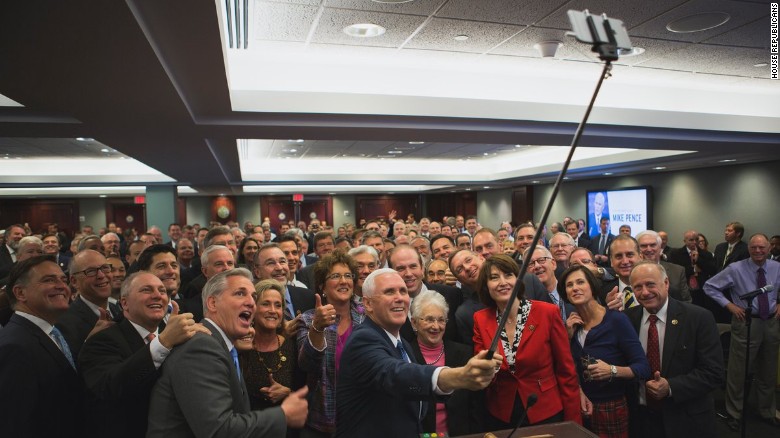
This is the photo the House Republicans Twitter account tweeted out today. And it's making some waves.

No, it's not the fact that certified grown adult Vice President-elect Mike Pence is using a selfie stick.
Look closer. Do you see it?

Trick question. It's actually what's missing that's making news: diversity.


The tweet accompanying the photo reads "UNIFIED." The photo, however, shows mostly white men.

 House Republicans ✔ @HouseGOP
UNIFIED.
7:57 AM - 17 Nov 2016

House Republicans, according to data released by the Senate, are currently able to claim two African-Americans, nine Latinos and 23 women in their ranks. While it's easy to spot some of the women front and center, some Twitter users were still not jazzed.

 Sahil Lavingia ✔ @shl
@housegop against non-white people?
9:22 AM - 17 Nov 2016

 Euna Park ✔ @eunapark
@HouseGOP What is diversity? Who are millennials?
8:54 AM - 17 Nov 2016

 joanne @rippleintime17
@HouseGOP so diverse! There’s more than one woman and omg, do I see a guy under 50 in there?!
8:12 AM - 17 Nov 2016


 Chaco @Chaco_Chicken
@HouseGOP @mike_pence @SpeakerRyan @GOPLeader with price included.
8:07 AM - 17 Nov 2016

15h
 sean. @SeanMcElwee
you'd think by now republicans would have learned their lesson on the all-white selfies pic.twitter.com/pQRA7g98pp

 darth™ @darth
hey is that paul ryan@SeanMcElwee pic.twitter.com/wYCPJRql3s
8:28 AM - 17 Nov 2016
View image on Twitter

On Election Day this year, only about 8% of African-American voters and 29% of Latino voters supported Donald Trump. However, Trump was able to clinch the nomination with 58% of the white vote.

The photo is also very reminiscent of a photo Paul Ryan Instagrammed over the summer.  I think this sets a record for the most number of #CapitolHill interns in a single selfie. #SpeakerSelfie.
...................................................................................................................................................................

"... the term white nationalism means white domination. It isn't necessarily an endorsement of a 100% pure white society, a goal now regarded by the far right as unrealistic ..."

...................................................................................................................................................................
White nationalism, a term once on the fringes, now front and center
By Joe Sterling, November 17, 2016


President-elect Donald Trump's selection of Stephen Bannon as his chief strategist and senior counselor swept a new term out of the fringes and into the mainstream: white nationalism.

Bannon, the Trump campaign CEO and executive chairman of Breitbart News, has called his site "the platform for the alt-right," a far-right movement that has been linked to white nationalism, racism, misogyny and anti-Semitism.

So, what exactly is "white nationalism"? Activists on the front lines of fighting racism say it denotes white domination and superiority.

Promoting the interest of whites

Oren Segal, director of the Anti-Defamation League Center on Extremism, said white nationalism is a term for a form of white supremacy or separatism.

Its supporters defend "country by white racial identity." They promote the interests of whites exclusively and denigrate all others.

"Bannon established himself as the chief curator of news for the alt-right," he said. "And when you descrbe Breibart as a platform for the alt-right that's not insignificant."

"Under his stewardship, Breitbart emerged as a leading source for the extreme views of a vocal minority who peddle bigotry and hate."

White domination

Mark Potok, senior fellow at the Southern Poverty Law Center, said the term white nationalism means white domination. It isn't necessarily an endorsement of a 100% pure white society, a goal now regarded by the far right as unrealistic, he said.

"White nationalism is more the idea that whites should dominate," he said, that the culture should dominate and policies that jibe with the idea should be supported, such as opposing nonwhite immigration.

White nationalists believe the country "should be built by and for white people." They "tend to be less about ethnic slurs, less about Nazi slurs, tend to speak more academic language."

Some people who embrace the white nationalist identity refer to themselves as "race realists" -- generally speaking, that means people who believe the races can't live together. They may also call themselves "Identitarians," a movement that emerged last decade on the French far right. The movement is linked to the opposition to multiculturalism and anti-Islam attitudes.

'The people I'm describing don't live in Washington'

Paul Gottfried is the former Horace Raffensperger professor of humanities at Elizabethtown College in Pennsylvania. He is also the president of the H.L. Mencken Club, which calls itself a "society for the independent right."

He said "white nationalism is more often used by the left than on the alternative right" and that "white Identitarian" and "race realist" are the terms more common on the alt-right

Gottfried rejected the view that Bannon is a racist, an anti-Semite, a white Identitarian or race realist. Instead, Gottfried said, Bannon comes from the world of Washington politics and journalism.

"The people I'm describing don't live in Washington," he said, when making reference to race realists and Identitarians. "I don't think he knows any of those people."

'I like the term alt-right'

A major voice of the alt-right is Richard Spencer, president of the National Policy Institute and the editor of Radix Journal. He defines "white nationalism" as a U.S.-focused movement concerning white racial consciousness and identity.

"I don't use the term white nationalist to describe myself," he said. "I understand it's a fairly fair term. Obviously white refers to race, of European descent."

To the extent that nationalism means caring for one's family, that is a good thing, he said.

But the word "nationalism" reflects deep-seated historical grudges, "ethno-nationalism," in which Europeans warred with one another.

"We want to get beyond these things," Spencer said. "I like the term alt-right. It has an openness to it. And immediately understandable. We're coming from a new perspective."

He prefers the terms Identitarian and alt-right.

Alt-right, he said, "has a new starting point from conventional conservative. That was the origin of it."

"It's been filled out and come into its own. It's an Identitarian movement. Race realism is a component of it. It's an understanding of European identity."

Distancing themselves from white supremacy

Daryl Johnson is the owner of DT Analytics, with DT standing for domestic terrorism. He is a security consultant and a former counterterrorism expert at the Department of Homeland Security.

Johnson was the primary author of a 2009 report about right-wing extremism that drew fierce outrage on the right.

White nationalism is a "new buzzword," Johnson said, but the first time he saw the term was in "white supremacy literature."

The far rightists used "white nationalism" to appear more credible and patriotic, Johnson said, and the term detracts from the stereotypes conjured by white supremacy.

But make no mistake, he argued, white nationalism is a euphemism. "They want to distance themselves from white supremacy," he said.
...................................................................................................................................................................

Wednesday, November 16, 2016

Not damned likely.

........................................................................................................................................


"If Trump supporters truly end their usage of all products that have opposed Trump, they’ll be left with the companies WhiteChristianMan suggests they support, such as Yuengling beer, Hydrox Cookies, NASCAR, the WWE, Carl’s Jr./Hardee’s, Dominos Pizza, Chick-fil-A, and Home Depot."

...................................................................................................................................................................
Trump supporters launch boycotts of Pepsi, Oreos, and Netflix
Because if you don’t like Trump, they want you to fail.
By Zack Ford, November 15, 2016

While many in the country are protesting and condemning Donald Trump’s election as president, his supporters (including both the alt-right and other traditional conservatives) are trying to counter with their own demonstrations. At the top of their list of targets is PepsiCo, but it’s one of only many companies some are planning to boycott for criticizing Trump or otherwise working against what they believe to be his goals.

PepsiCo garnered their wrath last week when CEO Indra Nooyi talked about the election in an interview with the New York Times’ Andrew Ross Sorkin at a conference on Thursday. “They are all in mourning,” she said of her daughters and employees. “Our employees are all crying.

 And the question that they’re asking, especially those who are not white: ‘Are we safe?’ Women are asking: ‘Are we safe?’ LGBT people are asking: ‘Are we safe?’ I never thought I’d have had to answer those questions.”

Nooyi went on to condemn the way Trump has spoken about women in a conversation that also addressed domestic violence issues in the NFL. There is no place for such language, she said, “not in locker rooms, not in football players’ homes, not in any place.”

These comments moved PepsiCo to the top of the boycott list, ousting GrubHub from that position. The food delivery service earned its boycott when CEO Matt Maloney sent a company-wide email the day after the election explaining to his employees that demeaning minorities, immigrants, and people with disabilities is behavior that has “no place at Grubhub,” regardless of whether it “worked for Mr. Trump.” Anybody who didn’t agree that the company should be an inclusive place was invited to submit their resignation. Maloney later clarified he wasn’t asking people to resign if they voted for Trump, only if they support “discriminatory activity or hateful commentary.”

There is an “official” list of the many companies for Trump supporters to boycott, maintained by Reddit user “WhiteChristianMan” in a channel called r/The_Donald, “the unofficial Donald Trump 2016 subreddit.” In addition to PepsiCo and GrubHub — WhiteChristianMan calls Maloney a “total cuck” — the list also includes:


Though the Reddit list bears many trappings of the alt-right, it’s not only the alt-right embracing these boycotts. For example, the Family Research Council, a conservative evangelical anti-LGBT hate group, applauded the boycotts of PepsiCo and GrubHub, mocking the way their stocks dipped because of their CEOs’ comments about Trump’s divisive rhetoric. Tony Perkins, the group’s head, compared these boycotts to other social conservative boycotts FRC has participated in, such as of Target, Lands’ End, J.C. Penney, and Angie’s List — all of which were targeted for taking pro-LGBT or pro-choice positions.

Gizmodo points out that WhiteChristianMan’s list is incomplete. Back in July, a group of tech luminaries signed an open letter opposing Trump’s candidacy. That included Alexis Ohanian, co-founder of Reddit — where his list ironically lives — as well as execs from several other tech companies, including Facebook, Tumblr, Apple, Yelp, Twitter, YouTube, Tinder, Google, Wikipedia, and Instagram.

If Trump supporters truly end their usage of all products that have opposed Trump, they’ll be left with the companies WhiteChristianMan suggests they support, such as Yuengling beer, Hydrox Cookies, NASCAR, the WWE, Carl’s Jr./Hardee’s, Dominos Pizza, Chick-fil-A, and Home Depot.

They can also wear New Balance sneakers, but that might soon change. The company’s vice president of public affairs said that Trump’s victory was good for the country, but then Neo-Nazis declared New Balance the “official shoes of white people.” The company has since responded with comments about how it “does not tolerate bigotry or hate in any form” — basically the same sentiment that prompted boycotts of PepsiCo and Grubhub.


There have also been boycotts against Trump. Activist Shannon Coulter started the #GrabYourWallet boycott after the release of a 2005 recording of Trump talking about grabbing women “by the pussy.” Her list focuses on stores that do business with the Trump family or sell its products, and incidentally includes some of the same targets as WhiteChristianMan’s, including Amazon and Macy’s.
...................................................................................................................................................................